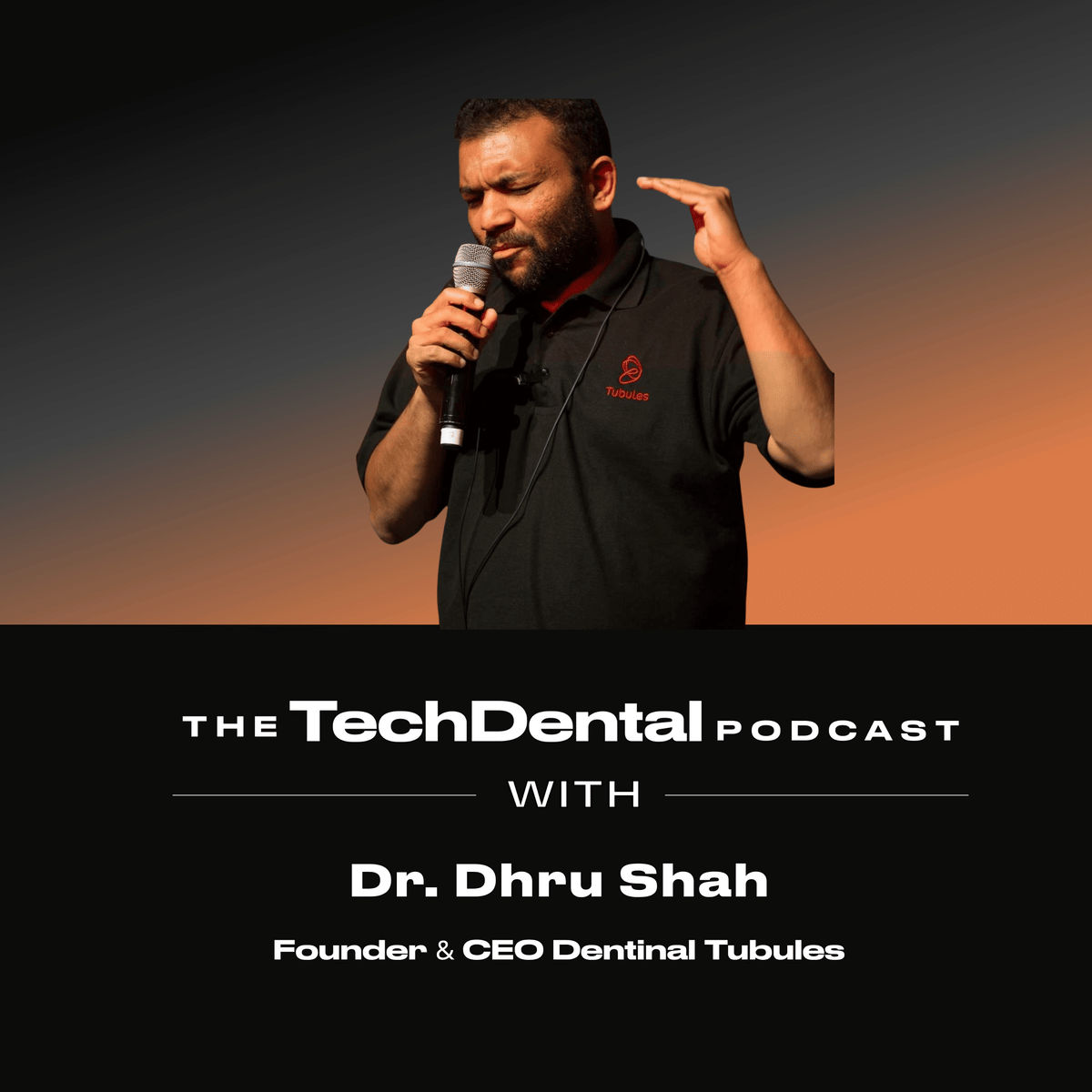
Direct answer: Dr. Dhru Shah, founder and CEO of Dentinal Tubules, argues that the UK's most prominent dental professional development community is not a CPD compliance platform. It is professional infrastructure, the place where clinical identity is formed, learning culture is built, and the relationship between a practitioner and their own development is either transformed or abandoned. With 60,000 users, 17 years of data about how dental professionals actually learn, and an active transition from content provision to AI-enabled curation, Dentinal Tubules is in the early stages of becoming what Dhru calls a professional growth passport: the documented evidence of a practitioner's development trajectory, insight, and translated capability in a profession that is becoming harder to standardise, harder to lead, and harder to develop cohesively at scale.
Listen to the full episode: 🎧 Spotify 🎧 Apple Podcasts ▶️ YouTube
What Is Dentinal Tubules Actually Building?
There are 125,736 dental professionals registered with the GDC. Every single one of them has a mandatory CPD obligation. Every single one needs a personal development plan. And for the majority of that workforce, the annual experience of continuing professional development is something to be endured. A box ticked. An hour logged. A certificate filed.
Dr. Dhru Shah has spent 17 years trying to change that. In this episode of TechDental, the conversation moves quickly past the origin story to the structural question underneath it: what Dentinal Tubules is becoming, and what that means for practice owners, DSO operators, and the profession at large.
The founding story is not a passion project narrative, even if it is often told that way. Shah arrived at dental school paying international fees, had his family's finances wiped out in his third year, worked shoe shops and burger bars at night to stay enrolled, and spent periods where a four-pack of Maryland cookies was the week's food budget. The conviction that came out of that was not passion for CPD. It was something sharper.
"Nobody should ever go through what I did. Education is a right, not a privilege. Now that's the passion that started the Tubules project."
That origin matters because it explains why Tubules was built community-first rather than content-first. The platform did not begin as a video library. It began from the belief that connection precedes learning, and that genuine professional growth is social before it is transactional.
Is This a Compliance Product or a Growth Engine?
I put the uncomfortable version of this question directly to Dhru: is Dentinal Tubules' success substantially a regulatory compliance product wearing the language of passion and growth? And does the distinction matter?
His answer was direct.
"It does matter. The previous success has been a combination of both. There is no doubt about that. But what we have to recognise is that while the GDC as a regulatory requirement does need this and therefore there is a commercial factor in that, that's a dying factor."
The platforms competing for the compliance market are in a race to the bottom. Cheap CPD. Free CPD. AI-generated content that meets the letter of the regulatory requirement while producing nothing durable. That market will be commoditised quickly, and the value of being a compliance destination will continue to erode.
"As these platforms offer them free, the value goes down. It also means that the people who come in don't value good education. They just want a tick box. And commercially, in the long term, that's just a race to the bottom and we know what happens to the race to the bottom."
The platforms that survive are the ones built on something the compliance requirement cannot replicate: genuine community identity, trusted curation, and a development infrastructure practitioners choose rather than tolerate. Tubules built community first, content second, commercial model third. That sequencing is structurally different from every platform that built a video library and bolted on community as an afterthought.
What Is the Strategic Transition Underway?
Dentinal Tubules is in a deliberate strategic transition from providing education to curating it. Those are different propositions with very different commercial consequences.
A provider controls content. A curator controls the standard.
After COVID, something broke in the information economy of dental education. Access to information, which had been Tubules' structural advantage for its first decade, became table stakes. As Dhru describes it, there are now more courses than dentists.
"Young practitioners say there are more courses than dentists out there and they don't know how to choose which course to go on. They don't know how to select which content to engage with. What they then end up doing mistakenly is following the people who are the loudest. They spend thousands of pounds on courses and then go, that was hyped up, I've wasted money."
The response is curation, and curation is where AI arrives usefully. Tubules is building AI-enabled PDP tools that surface gaps practitioners would not identify themselves, match content to individual learning trajectories, and challenge assumptions rather than simply confirming stated preferences.
The distinction Dhru draws is precise: AI-enabled, not AI-driven. The framework is human. The structure of reflective practice is human. AI operates one layer below, enabling the process rather than replacing it.
"AI is like your sat nav. It shows you the route. Driving there is your job."
Is AI Making the Development Plan More Meaningful or Just Faster?
This is the most philosophically important question in dental education technology right now. The GDC's enhanced CPD requirements were built on a specific belief: that practitioners should genuinely reflect on their learning needs, honestly identify their gaps, and document not just what they did but why they chose it and what they got from it.
The risk of AI arriving inside that process is obvious. If the system designed to produce genuine self-reflection can be completed faster, cheaper, and with less effort, does the learning happen at all?
Dhru's answer is the most precise I have heard in any conversation about AI in professional development.
"If you are not somebody who thinks reflectively and analytically, AI is not going to do anything different for you. It's just going to throw more at you. AI makes processes more meaningful if you have the drive and the purpose to make them meaningful."
The active effort question is where the line exists. AI can guide a practitioner to relevant content. It can surface blind spots. It can suggest directions they had not considered. What it cannot do is replace the cognitive load of genuine learning.
"People are doing mistakenly with AI is they are summarising the content. They are saying, how can I summarise this so I can quickly take in the information very quickly? That isn't learning. Learning is an active process. AI cannot replace that. And if you think AI is going to replace that with shortcuts and summaries, then you're really headed for a very difficult place."
The implication for every practice owner, group operator, and HR director evaluating professional development platforms is significant. A platform that uses AI to reduce the effort required is not a learning platform. It is an administration platform. The two are not equivalent, and the commercial consequence of confusing them compounds over time.
We examined how AI adoption in dental organisations becomes a governance and culture problem, not just a technology decision, in The Intelligence Layer: What a DPO Inside a Growing UK Dental Group Knows About AI That Most Leaders Don't.
Does the Profession Have a Responsibility to Educate About AI, Not Just Use It?
I asked Dhru directly: does the most prominent dental education platform in the UK have a responsibility to educate the profession about AI, not just use AI to educate the profession?
His answer was unambiguous.
"Yes, it does have a responsibility to educate about AI, not just AI. What people need to recognise is where AI comes from and that's a much deeper conversation where you've got to understand basic principles."
There is a bandwagon, he argued, and it is a serious one.
"Currently there's a bandwagon, a serious bandwagon going on where everyone wants to lecture about AI in dentistry without recognising actually what is AI. Some people are calling digitisation AI and it's not really that way. You've got to recognise how AI has its own biases because AI is built from data and you know the principle of shit in, shit out still operates."
The clinical analogy he draws is precise: you teach the biological and material principles before you introduce the materials and the biology of their application. The profession has put the cart before the horse. Surface-level AI content, the kind that explains which tools exist without explaining how they work, produces practitioners who are informationally current but fundamentally unable to evaluate, safely deploy, or critically interrogate what they are using.
The platform that owns the foundational conversation, that builds AI literacy as a clinical competency before it builds an AI content catalogue, will be in a structurally different strategic position in five years than every platform that joined the bandwagon.
This connects directly to the governance argument explored in The North Star Partnership: How MyDentist and Overjet Are Building the Operating Infrastructure for AI-Era UK Dentistry.
What Are DSO Operators Getting Wrong About Professional Development?
Most group operators think about professional development as a practitioner benefit. A perk. Something to mention in a job advert. Dhru's challenge to DSO leadership is direct.
"They shouldn't even be talking about compliance as CPD. Complete Puppet Directive number one. If they're talking about CPD, they need to be talking about how the team develops together."
The underlying argument is about root causes versus symptoms. Practices come to education platforms with a problem, receive a targeted solution, return a year later with the same problem or an adjacent one, and never address the root cause. The symptom recurs because the diagnostic infrastructure to surface the actual problem was never built.
"The DSOs need to really rethink. What they're doing when they come to education is actually creating much more reflective, insightful teams that start from a position of understanding the deeper problem. That's a diagnosis. If you understand your gap, you then can direct to the right learning, which then creates the right culture within your practice."
The Gallup figure he cites is worth pausing on: approximately 80% of the global workforce is disengaged. Dentistry is not unique. But a disengaged clinical workforce does not just underperform commercially. It fragments, disputes, and leaves. The groups treating this as an HR problem are treating a symptom.
"If you just want your bottom line to grow, the first thing you will cut is the learning budget for your team. And I've always believed in difficult times or growth times, any business should invest in two things very powerfully. One we all know, marketing. But the second one I always talk about is team growth. Because if you can spend more time on team growth, then you will grow."
For a detailed model of how community infrastructure compounds as a competitive advantage that cannot be replicated quickly, see What The Magic Dentist Teaches the Dental Industry About the Only Growth Strategy That Cannot Be Copied.
Does the Community Model Reach the Practitioners Who Need It Most?
I pushed on a ceiling that exists inside every community-led professional development model. The practitioners most engaged with platforms like Tubules are the most growth-oriented, most motivated members of the profession. They were already investing in their development before the platform arrived.
The practitioners with the most significant development gaps, the ones whose capability shortfall is most commercially damaging to the groups and practices employing them, are the ones least likely to seek out a community platform proactively. Does the model actually reach that population?
"The community model engages the people who are already there, which is why we're evolving to the problem-based model as well. Because when you can help someone discover their problem, it suddenly becomes autonomous. It becomes meaningful. It becomes engaging."
This is where the diagnostic tooling becomes the commercial and mission-critical lever. Not bringing disengaged practitioners into a community first. Helping them identify their own problem first. Lighting the spark before expecting it to burn.
"Content is king. Community is the castle in which it lives. But we have to recognise that when people who are not engaged want to come in, we help them identify the problem. We identify a meaning to it. They then need a community that will help them drive that meaning forward."
What Is the Passport, and Why Does It Matter?
The concept Dhru closes the conversation with is the one the industry has not properly processed yet.
In a profession where standards are increasingly non-standardised, where the workforce is diversifying across overseas qualifications, group employment models, and expanding clinical scope, what will matter is not the hours logged. It will be the growth journey documented.
"When you have non-standardisation, when you have multiple models, when you have chaos happening around you, how do you identify who's the person who is fit for that chaos? Your growth journey, your data, everything should be recorded into something very useful. And that's called a passport."
The framing is specific. A practitioner's growth passport documents not just what CPD they completed, but what gaps they identified, what insight they developed, how they applied it, and what positions and capabilities they built as a result. In a profession where the GDC register has grown to 125,736 and is becoming harder to standardise, harder to develop cohesively, and harder to lead at scale, that documented trajectory is a meaningful signal.
"If in 10 years you can say, here's my growth passport. They look at you and say, this person has shown insight into this. They have shown this growth and learning. They have therefore translated it to real life positions and mechanisms. This is the person who has insight in these areas. That's the person most suited for the next part of our organisation's journey."
It is a meaningfully different commercial proposition from every platform currently competing on price and content volume. The platform that becomes the place where that passport is built is not a CPD platform. It is professional infrastructure. It is the LinkedIn of clinical growth, except with actual evidence behind it.
What Would Dhru Build if He Started Today?
In the lightning round, I asked if Dhru could rebuild Dentinal Tubules from scratch in 2026 with full access to modern AI and everything he now knows about how dental professionals actually learn, what they avoid, and where they grow, what would it look like?
"It would look like where we are going. It's almost starting from scratch. All the stuff we've talked about in this discussion is probably what I would use to build it."
That answer, and the specificity of what the platform is now becoming, is the most commercially significant signal in this conversation.
Key Takeaways
Dentinal Tubules is not a CPD platform. It is professional development infrastructure, and the distinction has significant consequences for how it should be evaluated by practice owners, group operators, and investors in dental workforce capability.
The compliance market is being commoditised. The platforms competing on price and content volume are in a race to the bottom. The platforms competing on curation, community identity, and diagnostic depth will occupy a structurally different position as that commoditisation completes.
AI is a curation and gap-identification tool, not a learning replacement. The platforms using AI to reduce the effort of professional development are building administration systems, not development infrastructure. The cognitive load of genuine learning cannot be automated away without eliminating the outcome it was supposed to produce.
The profession has a foundational AI literacy deficit. The platform that addresses that deficit, building AI literacy as a clinical competency before building an AI content catalogue, will have earned a trust that the bandwagon cannot manufacture.
DSO operators are thinking about professional development at the wrong level. The commercial argument is not the compliance benefit. It is the cultural standardisation and team capability architecture that determines whether a multi-site group operates coherently or fragments.
The professional growth passport is the most strategically significant concept in dental education right now. The platform that builds it, that becomes the documented record of a practitioner's development trajectory and translated capability, is not competing with other CPD platforms. It is building something that has no direct competitor in the UK market.
About TechDental
TechDental is a strategic intelligence platform for founders, executives, operators and investors shaping the future of dentistry. Through high-level analysis and systems-focused conversations, we explore how AI, governance frameworks and operating model design influence performance, scalability and enterprise value in dental organisations.
The future belongs to those who deploy technology with discipline.
© 2026 RIG Enterprises Limited. All Rights Reserved. This article was authored by Dr. Randeep Singh Gill and is published under the TechDental brand, a trading name of RIG Enterprises Limited (Company No. 11223423), incorporated in England and Wales on 23 February 2018, registered at 1a City Gate, 185 Dyke Road, Hove, England, BN3 1TL. All editorial content, analysis, synthesis and intellectual property contained within this article are the original work of the author and remain the exclusive property of RIG Enterprises Limited. Opinions and statements attributed to named guests reflect the views of those individuals as expressed during recorded interviews and are reproduced here for editorial and informational purposes. No part of this article may be reproduced, distributed, transmitted, republished, or otherwise exploited in any form or by any means, whether electronic, mechanical, or otherwise, without the prior written consent of RIG Enterprises Limited. Unauthorised reproduction or use of this content may constitute an infringement of copyright under the Copyright, Designs and Patents Act 1988.