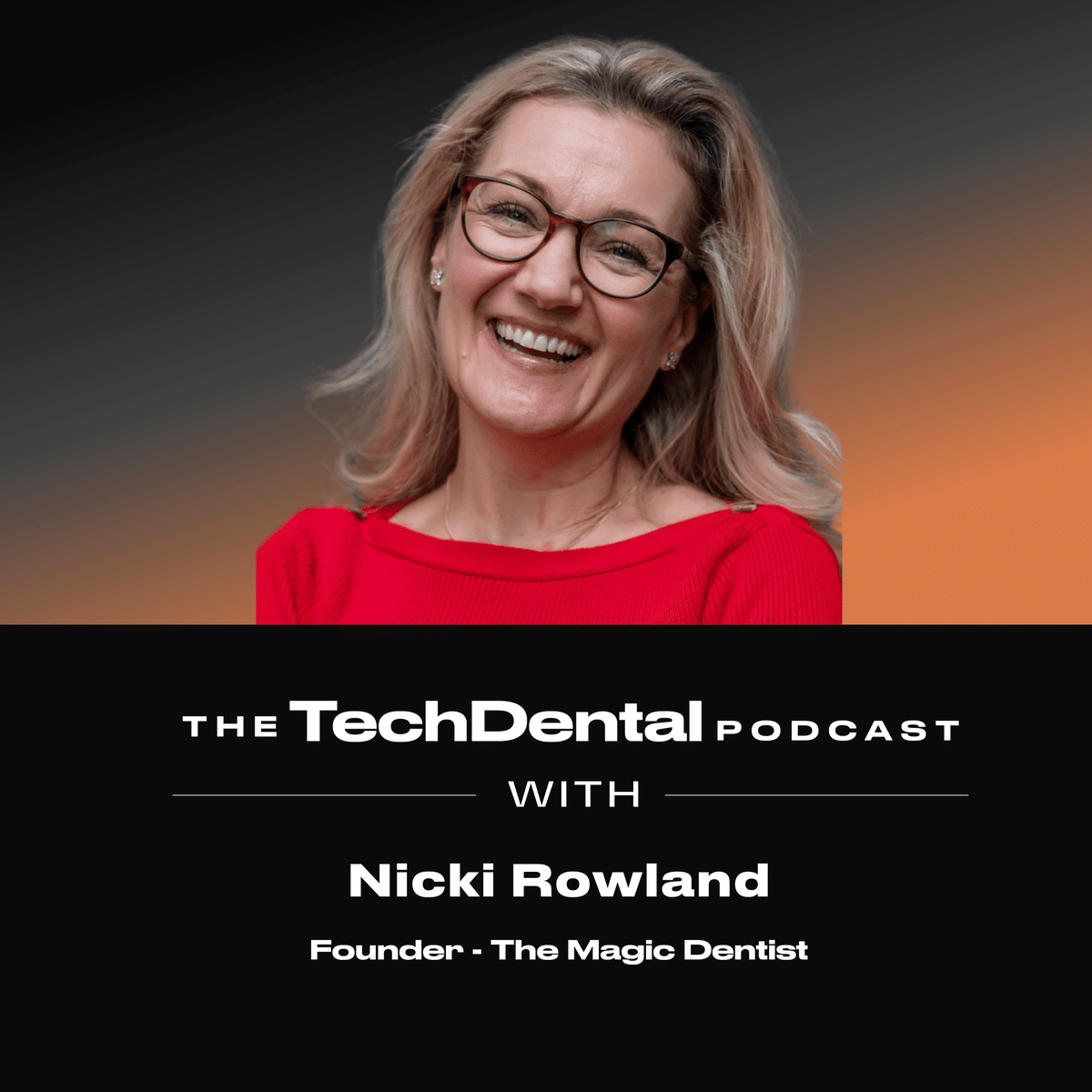
Direct answer: Nicki Rowland, founder of Practices Made Perfect and The Magic Dentist charity, argues that the most durable growth strategy available to a dental practice is not technology, marketing, or treatment mix optimisation. It is genuine community presence, built through structured, consistent engagement with the schools, families, and local institutions that sit within the practice's postcode. Drawing on 30 years of NHS and private dental experience and the results she saw in her own practice, Nicki demonstrates that community engagement converts into patient acquisition, retention, and CQC differentiation in ways that no commercial platform can replicate. The primary action for UK dental operators: build the community infrastructure before the commercial need for it becomes urgent, because it compounds, and it cannot be purchased quickly.
The Number Underneath This Conversation
There is a number that sits underneath this conversation that is worth naming at the outset.
In the financial year ending 2025, more than 56,000 children and young people aged zero to 19 underwent tooth extractions in NHS hospitals in England. Nearly 34,000 of those were due to tooth decay, an 11% increase on the previous year, at a total NHS cost of £87.7 million. The decay-related extraction rate in the most deprived communities was nearly 3.5 times that of the most affluent.
Tooth decay is the leading cause of hospital admissions in children aged five to nine. It is wholly preventable. And it is getting worse.
The Magic Dentist: How a Children's Book Became a Parliamentary Charity
Nicki Rowland started with a book she wrote with her daughter. What followed was a nationally recognised charity with parliamentary backing, two appearances in the House of Commons in the past month, BBC coverage, and an Adopt-a-School programme pairing dental practices with schools in the communities where children are most at risk.
The mechanism is straightforward. A dental practice partners with a school, typically in a lower socioeconomic area where children are three times more likely to have poor oral health. A team member, who does not need to be GDC-registered, completes a train-the-trainer programme and delivers oral health education through a structured toolkit of magic tricks, each carrying a key public health message: brush twice a day, use fluoride toothpaste, two minutes each time, spit do not rinse.
The insight at the heart of the model is pedagogical. When a child learns a magic trick with an oral health message embedded in it, they do not just learn the message. They go home and perform the trick. They teach it to their parents.
"What we are doing is turning the educational piece on its head by empowering children through the magic. It is their homework when they learn those magic tricks at school to go home and perform them to adults, family, friends, because often a child is not educated because the parents are not in the first instance."
The Community Model as a Commercial Strategy
The commercial logic of Nicki's argument is grounded in what she observed in her own practice.
"Our practice did very well because we had a very strong CSR model. It helps conversion. Patients want to go and see practices that really care. You are demonstrating that you are genuine. And at the bottom line, they really care. It is actions, not just words that matter."
This is not a charitable argument dressed up in commercial language. It is a specific and verifiable commercial claim. The practices known in their communities for doing something real attract families who have chosen them rather than been found by them through an ad. That patient loyalty reduces churn, increases referral volume, and generates the kind of organic growth that paid acquisition cannot replicate at the same margin.
CQC's Well-Led framework adds a regulatory dimension. The framework explicitly asks whether a practice understands and responds to the needs of its local population. The practices building structured community programmes are scoring differentiation in assessments that their competitors without those programmes are not. In a consolidating market where CQC grading increasingly features in acquisition due diligence, that differentiation has a financial value.
The Scalability Question
One of the most important observations Nicki makes in this conversation concerns the moment at which bootstrapping a model like this becomes the constraint rather than the proof of concept.
"It is about financial fuel. Now we have the model, we have the systems, we have the resources, we have the team. But any mission needs financial fuel in the tank. Once we have got some, we can scale, we can go to the next constituency. It is a scalable model because it is a system."
The Adopt-a-School programme costs £1,000 per school adoption. The resources are digital and hosted on the charity's website. The training and content delivery tools can be used without Nicki being present. A dental practice partnering with a school in its catchment area is not signing up for an ongoing operational burden. It is buying into a system.
For dental groups scaling across multiple sites, the model offers something genuinely rare: a community engagement framework that is replicable, documented, and does not depend on the clinical principal to deliver.
The Systemic Question
The final argument Nicki makes is the most structurally important.
"Every dental practice in the UK has a waiting room full of children who have never really been told why their teeth matter, and a team that has never really been told why they matter either," I put to her. "Are they actually the same problem?"
Her answer was direct:
"I think they are very much interlinked. It comes back to the why. If children do not know why they need to brush their teeth, they are not going to do it. And from a CQC point of view, front of house team members are often left outside the learning. Then they do not engage, they are not committed, they are not accountable in the way they should be. It is all about communication. Drive systems, drive a really powerful culture in your business, inside and out."
The connection is not coincidental. The practices that invest in telling their staff why they matter and telling their communities why their teeth matter are building the same thing: a culture in which people understand the purpose behind the work. That culture is the asset that compounds over decades and cannot be acquired through a capital transaction.
What Operators Should Do
The bifurcation in the UK dental market over the next five years will not be between the practices with the best AI and the ones without it. It will be between the practices that have built genuine community presence and the ones that have not.
Community presence cannot be purchased on a short timeline. The trust that converts into patient loyalty, referral volume, and CQC differentiation is built over years of consistent action. The practices starting now will have a compounding advantage that the practices waiting for a contractual incentive will not be able to close quickly.
One thousand pounds adopts a school. The resources are digital. The system is documented. The referral route to the practice is built into the model. For the practices that still think community work is charitable rather than commercial, this conversation is worth listening to in full.
About TechDental
TechDental is a strategic intelligence platform for founders, executives, operators and investors shaping the future of dentistry.
Through high-level analysis and systems-focused conversations, we explore how AI, governance frameworks and operating model design influence performance, scalability and enterprise value in dental organisations.
If you are building, scaling or investing in dentistry and want independent, systems-level insight into AI, governance and capital readiness:
LinkedIn: https://www.linkedin.com/in/dr-randeep-singh-gill-576580357/
For strategic advisory, board briefings or keynote speaking enquiries: www.techdental.com/advisory
The future belongs to those who deploy technology with discipline.
© 2026 RIG Enterprises Limited. All Rights Reserved. This article was authored by Dr. Randeep Singh Gill and is published under the TechDental brand, a trading name of RIG Enterprises Limited (Company No. 11223423), incorporated in England and Wales on 23 February 2018, registered at 1a City Gate, 185 Dyke Road, Hove, England, BN3 1TL. All editorial content, analysis, synthesis and intellectual property contained within this article are the original work of the author and remain the exclusive property of RIG Enterprises Limited. Opinions and statements attributed to named guests reflect the views of those individuals as expressed during recorded interviews and are reproduced here for editorial and informational purposes. No part of this article may be reproduced, distributed, transmitted, republished, or otherwise exploited in any form or by any means, whether electronic, mechanical, or otherwise, without the prior written consent of RIG Enterprises Limited. Unauthorised reproduction or use of this content may constitute an infringement of copyright under the Copyright, Designs and Patents Act 1988.