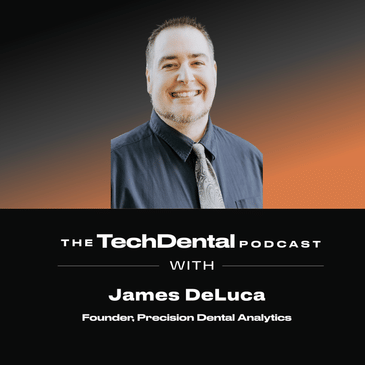
Episode Title: The Man Who Built the Playbook PE Uses to Buy Dental Groups. Now He's on Your Side.
Direct Answer: James DeLuca, Founder of Precision Dental Analytics and author of Phantom EBITDA, explains why the EBITDA on a dental practice P&L almost never survives private equity scrutiny, what PE buyers are actually doing with clinical data that most founders have never seen, and why the only window to protect a dental group valuation is the pre-LOI forensic audit window. This episode of The TechDental Podcast with Dr. Randeep Singh Gill is essential listening for any UK dental founder, DSO operator, or investor navigating a dental acquisition or preparing for one.
What is this episode about?
Private equity is not smarter than the dental founder. They just know how to read a P&L in a way the founder has never been taught. James DeLuca spent years inside the biggest DSOs in America, building the exact playbook PE-backed buyers use to acquire, price, and extract value from dental groups. He scaled NADG from 80 to 200 locations, ran a region to 31% EBITDA, and sat in the war rooms where acquisition decisions were made. Then he switched sides.
In this episode of TechDental, Dr. Randeep Singh Gill sits down with James DeLuca, Founder of Precision Dental Analytics, to explore the data asymmetry gap that costs dental founders millions at the transaction table, why the EBITDA on a clean P&L disappears under institutional scrutiny, and what the pre-LOI window actually looks like for a founder who wants to defend their valuation.
This is not a surface-level conversation. It is a conversation about the structural argument underneath, what the data says, and what every dental founder building a group asset needs to understand before the moment of transaction arrives.
What you will learn from this episode:
- Why PE buyers look at five years of your clinical data while most founders prepare three, and what the two-year gap reveals about how your practice really operates
- What a Quality of Earnings audit actually does to your EBITDA and which findings most founders never see coming
- How the 2024 Cotiviti study on D2950 billing compliance exposes core buildup patterns that look clinically reasonable but fail institutional scrutiny, with direct consequences for deal value
- Why your practice management system is an evidence locker that your buyer can read far more accurately than you can, and what defensible EBITDA looks like versus hollow growth
- What Phantom EBITDA is, where it appears on a clean P&L, and how it becomes the mechanism through which escrow holdbacks and retrades are executed
- Why pre-LOI forensic defence is not only for practices with problems, and how the lens of growth differs fundamentally from the lens of risk that a buyer applies to the same data
Key quotes from this episode:
"Phantom EBITDA is the money that is yours that you are going to give away at the transaction table." — James DeLuca
"They're measuring the exhaust. The buyer is looking at the engine. They're pulling your whole database and looking at what each provider does, what the practice looked like before you started preparing for the sale, and whether this is sustainable income once the practice changes hands." — James DeLuca
"That was $800,000 of bottom line revenue. You take that to market and multiply it by ten because you're in the institutional market. You're talking about an $8 million error that was happening in your practice. And it was just a misunderstanding." — James DeLuca
Free resource for TechDental listeners:
James DeLuca has made his full book, Phantom EBITDA, available free to TechDental listeners.
Download here: precisiondentalanalytics.com/books/phantom-ebitda Use code TECHDENTAL at checkout for your free copy.
About James DeLuca:
James DeLuca is the Founder of Precision Dental Analytics and author of Phantom EBITDA. He scaled NADG from 80 to 200 locations as Regional Director, achieving 31% EBITDA. He built the operational and financial analysis playbook that PE-backed acquirers use to evaluate dental groups, then transitioned to advising sellers, helping dental founders identify and remediate the data asymmetry gaps that determine whether a valuation survives institutional due diligence.
LinkedIn: https://www.linkedin.com/in/james-deluca1/ Precision Dental Analytics on LinkedIn: https://www.linkedin.com/company/precisiondentalanalytics Website: precisiondentalanalytics.com
About TechDental:
TechDental is a strategic intelligence platform for founders, executives, operators and investors shaping the future of dentistry. Independent analysis on AI, operating models and capital strategy in UK dentistry.
Website: www.techdental.com Email: info@techdental.com
Host: Dr. Randeep Singh Gill LinkedIn: https://www.linkedin.com/in/drrandeep/
Newsletter: Subscribe on LinkedIn — TechDental Analysis
Subscribe and follow:
Apple Podcasts: https://bit.ly/41pKL9b
Spotify: https://bit.ly/41UsqRO
YouTube: https://bit.ly/3JSfl5c
TechDental publishes independent analysis on AI, operating models and capital strategy in dentistry. For leaders navigating scale or structural change: www.techdental.com. Copyright Dr. Randeep Singh Gill and RIG Enterprises Limited (Company No. 11223423) 2026.
[00:00:00] If a founder has built a genuinely profitable, well-run group, the data will speak for itself, right? Honestly, the biggest thing that I saw was data asymmetry. DSOs have a singular playbook that they're going off of. When PE enters a dental acquisition, what are they actually doing with the clinical data that most founders have no idea is happening? Phantom EBITDA is the gap between the money that you think that you're going to get and the money that you're actually going to get.
[00:00:32] This is the Tech Dental Podcast, the strategic intelligence hub for leaders shaping the dental industry. We break down how AI, data, and operating discipline drive performance and scale. I'm Dr. Randeep. Let's dive in. Private equity is not smarter than the dental founder. They just know how to read a P&L in a way the founder has never been taught before.
[00:01:01] My guest today spent years inside the biggest DSOs in America, building the exact playbook buyers used to acquire and price dental groups. James DeLuca, welcome to Tech Dental. Thank you, Randeep. Happy to be here. You scaled NADG from 80 to 200 locations and hit 31% EBITDA. You were inside the wallroom where acquisition decisions were made. Then you switched sides. What did you see that made you do that?
[00:01:31] Actually, the biggest thing that I saw was data asymmetry. I saw that DSOs have a singular playbook that they're going off of. They're looking for all the missed opportunities that most practice owners make and are common there. But then on the more nefarious side, all the things that aren't institutionally correct about that, that don't survive the roll-up when you're under more scrutiny. And at that point, they're already so far into a deal that it's hard to get out for that practice owner.
[00:01:58] And when PE enters a dental acquisition, what are they actually doing with the clinical data that most founders have no idea is happening? So most clinical founders, when they're looking at your information, it's not really all the information, right? It's aggregate data that your practice management software is putting together. Now, if you have a dashboard that you think is giving you all of your data and cleaning it up for you, most of those dashboards are using between 10 and 20% of your actual information. What they're measuring is the exhaust.
[00:02:28] They're measuring the output of everything. Those institutional buyers, they're looking at all the inputs. They're actually looking at the engine. They're pulling your whole database. And they're really looking at a more granular level, what each provider does, what, and this is another one, is most people will prepare three years of data. They're looking at five. They want to know before you started to prepare for this transition, what the practice or the group operate like.
[00:02:56] And then after, when you're in that three-year window, when you see all these massive changes happen, those are things that get flagged in the QOE report. This is not how you've always done business. So the PMS is not just a scheduling system. You call it the evidence locker. The operator cannot read their own evidence the way a buyer will. Give me a specific example of what that looks like.
[00:03:20] If you're looking at ledger data, for instance, ledger data is hundreds of lines, even the most simplest thing, right? Just the date of when something happened. At the very most granular level, there's a second column. There's a minute column. There's an hour column. There's a day of the week. There's a month, date, year. There is all these different columns. That gets baked into one or two of the ones that make a user-friendly report, right?
[00:03:50] So all of those missing elements that get cut out, you never see, right? They never exist in your world. Once you pull a database and you look at that level, now instead of seeing just that specific date, you have timeline, but then you have that lined up to who did that procedure, when that money was paid, who the referral source were for those new patients, all of the information that a buyer is really looking at to say, is this sustainable income that's going to happen once the practice changes hands
[00:04:20] versus something that's just an easy-to-consume report? And talk us through what a quality of earnings audit is, because most Tental founders have never been through one. What does it actually reveal? Your CPA will put together a validation of your income, and then your broker is going to build a narrative from those aggregate reports we talked to, but the quality of earnings is going to validate all of the inputs.
[00:04:47] It's going to make sure that there wasn't aggressive billing practices happening. It's going to... And with aggressive billing practices, so there's something called a Cotaviti benchmark. And this was a very large study that was done, and basically it is a way that you can look at a procedure code and know just the relationship that procedure code has to another procedure code, if it's being done aggressively or not. A really good example of that is a core buildup versus a crown.
[00:05:16] So insurance standard says that for you to do a crown and then add a core buildup to there, 50% of the tooth structure has to be missing, right? If you are looking at a clinical standard, can I keep my license? That 50% is not a factor in it at all. But Cotaviti says that when they did this study, roughly 40% of the crowns that are done should have a buildup to them.
[00:05:44] So if you're billing 70, 80% of your crowns with a buildup, there's that gap that immediately just jumps off the paper to that buyer and says, we have aggressive billing here. Once we roll this practice up, or we have a much larger target on our back, it's not going to withstand the institutional scrutiny that we're having. And James, most brokers and dental accountants would say they prepare their sellers adequately.
[00:06:11] You're arguing the clinical data conversation is the one that determines whether the EBITDA survives. If the gap is as large as you say, why are so few people doing what you do? It comes down to capability. And we talk about that database. So for instance, if I were to start building a dashboard that uses 100% of the database information, one, it's still not going to account for the variability that you're going to have in different operations.
[00:06:39] The second half of it is just the raw amount of data you're talking about. Instead of $500 a month, you'd be paying $3,000 a month for that same software just so they could house and manipulate the data in a way to make it consumable for you. So a lot of it comes down to that. Now, the other half of it is they're just not looking far enough ahead. A lot of dentists wait till they're emotionally ready to sell and not when they should be preparing for that sale. My recommendation is if you are intentionally building an asset to sell it,
[00:07:09] that you should be going through this process when you still have the runway to make changes. Most people that we work with, they're at least five years out from that sale. So you have a couple years of runway where you can not only remediate all the issues that a buyer's side QOE would find, but then also, so then the upside that happens comes on your side where you have leverage to bring it to the transaction table. We had one practice we looked at and we looked at their insurance claims. For instance,
[00:07:38] we found an anomaly with one specific insurance payer where they were collecting about 51% of the expected collections on claims. And when we brought this up to the owner, he said, oh yeah, we get killed on the adjustment that happens. They said, no, this isn't the adjustment. This is the net production to collection dollars. This is without the adjustment there. These are claims that aren't being paid. The upside, that was $1.1 million in claims for that payer that were paid out
[00:08:07] where it should have been $1.9 million. That's $800,000 of bottom line revenue. Now you take that to the market and you multiply it by 10 because you're in that institutional market. You're talking about an $8 million error that was happening in your practice. And it was just a misunderstanding of what our adjustment is versus what the actual net to collection dollars is. Phantom EBITDA is the title of your new book. Define it precisely.
[00:08:37] What is it? Where does it come from and why does it appear on a P&L that looks completely accurate to the owner? So Phantom EBITDA is the gap, the easiest way that I'll say, it's the gap between the money that you think that you're going to get and the money that you're actually going to get at the table. And it doesn't always happen on a retrade, which is a potential deal killer. Often it happens when there's an escrow account that opens up after the fact.
[00:09:04] And as the buyer is making claims against that account, these are on remediating issues that they already knew were going to happen, right? So what they're doing basically is they're resolving the Phantom EBITDA. They're resolving that income that's been earned while you accumulate what I call governance debt. It's basically just not having right clinical standards in play. A really good example is when I was with 1P backed DSO.
[00:09:32] So at this point they had 80 practices, right? And we operated on tribal knowledge. We grew by acquisition. And I saw the kind of pain points that happens when you acquire. Now they go in for a funding round and they're starting to go into institutional sale at 200 practices. Everything about that company changed from the inside. All the tribal knowledge gets codified in the SOPs. Those SOPs all have KPIs that are attached to them.
[00:10:01] So I can tell just by looking at a report if compliance is happening at the practice level, those reports are then broken down per team member, per clinician. There's complete transparency in everything there. Compliance departments, they start to come to life. You have credentialing happening with every insurer in every state. You have all the licensure that you need to show a completely scalable product to show that you have sustainable revenue
[00:10:29] and also make sure that it's going to go past the highest levels of scrutiny. It's a very different game. You can tell the speed goes from like driving in a residential area to now you're on the freeway and there's no safety lanes. There's aggressive traffic everywhere. And one of the mechanisms is provider coding drift. Walk me through what that actually looks like inside a clinical data set. How does a bias analyst spot it?
[00:10:58] And so often what you're going to find is a historical jump or historical retraction one way or the other. So a really good example is you might see something like perio treatment. You're going to have roughly 30% of your patients who go through, probably 30% of your patients who go through your recall system are going to land in perio instead of healthy mouth. So as you see over say five years, you're going to have,
[00:11:26] this company's always ran really aggressive, say 50% or say the opposite, 10%, right? Then all of a sudden now they're operating at baseline for these three years. What they've done is essentially start to engineer the outcome that they're looking for. So when a QOE team looks at it, it's going to jump off the page. But again, they're looking at five years of data. So now they see this state A versus state B, and they understand very quickly that something happened.
[00:11:55] Now we talk about SOP and documentation. If you go to an institutional buyer and all those things are in place and you can prove that was part of a remediation process, it's not going to be drift, right? Now it is going to be drift if all of a sudden these things started to happen. And the only real event is that all of a sudden you're getting ready to sell your asset. And you also describe hollow growth anomalies. What distinguishes genuine revenue growth from hollow growth?
[00:12:24] And how does a QOE analyst tell the difference? So you're going to see hollow growth, a really good example. That's the core buildup that I used earlier. True growth would be growth that is going to pass institutional scrutiny. So core buildups aligned with that 40% code of ED standard. Great. You're in the clear. This is not hollow growth. Now, when you do get to that 70, 80% benchmark,
[00:12:52] 40% of those core buildup revenue, that's hollow growth. Because when you go to the table, even though you did it, even though you spent the material cost on it, even though you spent the labor cost, the chair time, even though all of those things are right, if the clinical notes don't back up that 50% or more of that two structure was lost, and that's what they can even go into the chart audit level, at that point, it's indefensible income. It is actual growth that was hollow. It doesn't stand up.
[00:13:21] So the retrade happens after the LOI is signed. And at that point, the seller is in exclusivity and cannot negotiate with anyone else. What is the actual leverage position of the seller when a buyer proposes a price reduction based on a QOE finding? The biggest leverage point is to walk away. That's really it. And that's where a much more nefarious thing happens, which is when there's not a retrade.
[00:13:49] Instead, it's the escrow. But there's a holdback, right? So here's a number of compounding issues. And there's a 20% or 30% holdback that will be paid out after 36 months. Now, that holdback, that's going to be the mechanism where you could take all these things that they identify to be remediated. The deal's already done, right? It's too late to go back. The seller no longer has the leverage. And when they have to remediate those issues,
[00:14:18] it's actually being subsidized by the seller who's paying for all the new structure and paying for all the people that are being hired and all that remediation process because it's coming out of that escrow account. I have had even lawyers who've approached me and said, I have a client who's really upset. This is all after the fact and he wants to fight it. The problem is the reporting supports what they're doing. It's all in, it's all, everything's already in writing.
[00:14:47] It's in black and white. These issues are clear. It's not that they're fixing issues that don't exist. It's just that you are completely unaware of them going into the sale. It's, you know, in the U.S. very common, you just have a security deposit. And most people expect when I leave my rental agreement, I'm going to get that money back, but not if you don't clean the house before you give the keys back. And that's essentially what's happening is everyone understands that there's a mess still in there
[00:15:15] and they're just charging to essentially clean it up after the fact, but with your money, not with theirs. And some buyers will retrade, not because the QOE revealed a genuine problem, but because they can. Is there a version of what you were describing that is simply just opportunistic? And if so, does pre-LOI data preparation actually protect a founder from the opportunistic buyer? There are situations where it's opportunistic.
[00:15:43] Most people would never admit it's such, but typically it's going to come later in that situation. When you think about that process, right? You're very isolated once you've signed that LOI. You only have a few people that you can even talk to about the deal. You're under an NDA when there's things happening, you have no one to really turn to. And they rely on that kind of isolation to just close the deal. Plus you're looking at an exit, right? You've been thinking about your next stage of your career,
[00:16:12] your next stage of your life. Maybe it's getting out of dentistry. Maybe it's your next big thing in dentistry. Whatever those next steps are, those are already firmly implanted in your head. Do you want to walk out, start this whole timeline back over, go through another QOE process, hope that those people don't find these same things? Because again, they're not issues that don't exist. They're not fabricating data, right? It's just under data asymmetry, your side is looking at two reports and I'm looking at one and they are not the same.
[00:16:42] They just know how to read a P&L in a way the founder has never been taught before. Is that a fair summary? And if it is, why has nobody fixed that knowledge gap before now? It really goes beyond the profit and loss. Your CPA, most of them are incredibly competent at their job, right? It's not an ever an issue of just looking at that. Now they're going to see relationships between items that says
[00:17:10] there could be an issue here or there, especially if you're using like accrual-based accounting where you're logging production, it actually masks a collections issue, right? So there's the profit and loss tells half the story. It's only corroborated with the other piece of information that no one's really looking at. And again, it really just comes to technical ability to do. That's the biggest difference out there. Walk me through the pre-LOI defense architecture.
[00:17:39] What are the components and what order do they go in? So what you're essentially building is a complete chain of evidence for every dollar of revenue. When you talk about patient interest, right? You're having your new patients. So are those new patients, do they have a referral source? Is it, do you have a lot of new patients because of the charisma of the practice owner or because you have a system backed that is bringing in the amount of new patients that you need? Now those new patients,
[00:18:08] there are points that they drop in between their first appointment and when they've just said yes to scheduling an appointment. Are those layers all optimized? So now they're looking at upside. If you're losing 40% of your new patients and the gap between when they schedule their appointment and when they come into the practice, you probably don't have digital new patient paperwork. Your confirmation system is probably blown up, right? There's symptoms that will pop up because of that.
[00:18:38] So the next step would be you look at broken appointments, right? Are people showing up for appointments? It's the efficiency of the practice. You're just going through the flow of the entire, what we'll call the kind of patient journey. And can you look at every dollar that is earned at every point and say that it was, one, it came from a completely organic source. That organic source then presented a condition that's compliant with insurance standards.
[00:19:06] That condition was then treatment plan. That patient said yes, signed yes. They have a financial agreement that explains the terms and that they fulfilled those terms. And then on the back end, did they get scheduled for their next visit? What's your retention rate? And then was the money collected that the patient said they would when there was an insurance claim? Was that? So they followed the complete chain of custody.
[00:19:33] And now when you talk about, you get to that very bottom end, there's even overdue credits, right? So really it's a complete data chain from patient interest all the way through a closed account and their next appointment. And James, most groups approaching a transaction have a broker and a dental accountant. Why is that not enough? And what is the specific gap there?
[00:19:59] So you think about the structure that I was in, for instance, in DSOs, right? I not only had my office managers, and always tell me that, there was a regional manager, there's directors, there's analysts, there's their own internal CFOs. These are all people that they set up a reporting structure and they have the amount of support that a single dentist, you don't have a data analyst living in a practice, right? When you have a DSO structure,
[00:20:29] you can support roles like that because of your size. And that's essentially where you get the difference between the two is, it just comes down to, I have an internal person that does this and you don't. For a UK dental founder with five to 10 sites, two to three years away from a transaction, what should they be building right now before they have spoken to a single buyer? A complete, complete data chain, that exact same way.
[00:20:58] And then an understanding of the standards that governs each of those. Like when you talk about insurance standards, for instance, does this mean I can keep my license or does this mean that an institution can buy this and it's still revenue that they can predict regardless of what dentist is there, right? They're looking at benchmarks and averages. So it's very different. Essentially starting first that chain of custody and then scrutinizing each and every point,
[00:21:27] just starting with the front of the funnel and going all the way through the end, unless you have a very big conversion problem, case acceptance, if you're presenting a lot of treatments, not getting accepted, completed, I always start there first. So that way you stop any leaks you have. And then when inevitable growth happens on the front end, when you optimize those processes, then you have a better conversion system that all those leads go into. If a founder has built a genuinely profitable, well-run group,
[00:21:57] the data will speak for itself, right? And the QOE will confirm the valuation. So is pre-LOI forensic defense only necessary for groups with problems or is it necessary regardless of the quality of the underlying business? It's definitely regardless. The reason is it's the environment that data goes into, right? One, you're likely looking at aggregate reports when you're putting your stuff together. So it's not even possible to surface all the issues you have.
[00:22:26] You don't know what you don't know in that position. Now, say that you have a really sophisticated seller and they do. They figure it out. They have their own internal system and they have it. They're looking at that through the lens of growth normally where the person purchasing is looking at the lens of risk, right? They want to de-risk the asset. Now, if you think about it in that same environment, the lens that you're going to attack it is, where am I losing money? They're going to say the money
[00:22:56] that you've already made, I'm going to scrutinize it again at the highest level. Where's the documentation for this? There's no patient signatures here. Is this really sustainable? Do I just have a charismatic doctor? All of those things are getting baked up into this kind of doubt of the asset versus the other side. It's I can rely on what I'm already seeing and here's how we can get more, do more, make more and go out line. The targets are very different.
[00:23:24] James, when the history of this period in dental M&A is written, what will they say about the founders who went to market without understanding what was inside their own data? And is there a version of this story where the information asymmetry gets closed or does the buyer always have the structural advantage? There's definitely a way that the seller can get ahead of this. And it's by having that same buyer's level QOE report done ahead of time.
[00:23:54] And it needs to be done by a third party. Again, it has to be scrutinized. It has to be scrutinized against every standard that someone else could possibly pull against. And the thing that is probably the worst is really PE buyers often will be villainized in these situations. And they're not, again, they're not doing anything that's illegal. They're not doing anything that's wrong. However, but because they have that, you have a lot of people that they have a bad taste
[00:24:23] in their mouth at the end of the deal. And that's unfortunate because they essentially got bad advice. Or again, they waited too long until they were emotionally ready. It's something that I think is going to change. I'm hoping that Precision Dental Analytics leads that charge. And I always say is the book that was released, Phantom Ebeda, I hope this is the most expensive book to the buyer side that ever existed, which is because I want complete transparency for both sides. I no longer want data asymmetry to exist
[00:24:52] and willing to help every practitioner out there to make sure that's the case. James, we're coming to the end of the podcast and towards the end, I like to do a lightning round. So quick, short, sharp answers. What's the single most common finding in a pre-LOI forensic audit that founders are genuinely shocked to discover about their own practice? It's definitely those Codaviti benchmarks. When you approach your craft every day with your licensure
[00:25:21] and your kind of clinical morale being your number one guiding principle, as you should, as I had 100% support, it's definitely much different when you measure that against what the insurance companies say is the right thing to do in those situations. And unfortunately, that's where a lot of those checks come from. So that's the playbook that everyone's playing by. One question every dental founder should ask their PMS vendor before they engage a broker
[00:25:51] is I need to see the reporting and literally is to follow that chain through. Close your eyes and imagine you are a patient walking through that practice from the very first time that you call. Is there a spot for me to mark referral sources that's convenient and easy for my team to do? If I have a large team. So definitely, I want to see the reporting. That's the short of it. Where does dental M&A sit in 2028
[00:26:20] and who has been retraded out of the market by then? Honestly, I see it slowing down in some areas as your sellers become more sophisticated because the amount of risk essentially on their end becomes much greater, right? When you no longer have, you think about just as we were talking about the escrow issue. If I know reliably that I can get a 20% hold back and I can reliably pull 90% of that out
[00:26:49] into remediation, why would I go to a system where I am now fully funding any changes that I want to make, stuff like that? Now, that asset's always worth a premium if it is there, but they rely on it because they know that almost every dentist that goes to market when they hit that point, they have not ran a QOE and they have not ran it five years in advance in order to remediate all their issues. They're going to reliably be able to have the seller subsidize those.
[00:27:21] Phantom EBITDA in one sentence for someone who has never read the book. It is the money that is yours that you are going to give away at the transaction table. James, this has been a fascinating conversation. Where do people find you, read the book, and get in touch? You can find us at precisiondentalanalytics.com. You can also find me on LinkedIn as well as books on Amazon.
[00:27:50] To our listeners, if this episode sharpened how you think, share it with one person in your network who needs to hear it today. Subscribe on Apple Podcasts, Spotify, or YouTube. All links are in the show notes. The Tech Dental newsletter drops every Monday on LinkedIn. I'm Dr. Randeep. This is Tech Dental. See you in the next one. You've been listening to the Tech Dental Podcast, strategic intelligence for dental leaders navigating structural change. If you're responsible
[00:28:19] for growth, performance, or long-term value in this industry, make sure you're subscribed. I'm your host, Dr. Randeep. We'll see you next week.