
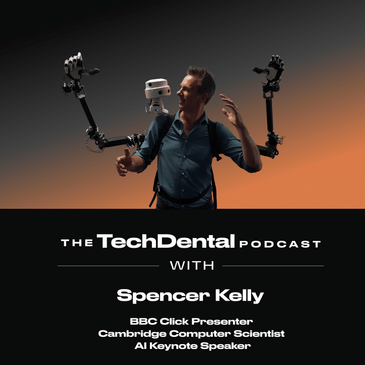
Episode Title: "The Lights Are Off." A Cambridge AI Scientist on What We Are Actually Building.
Direct Answer: Spencer Kelly, Cambridge computer scientist, BBC Click presenter for 20 years, and AI keynote speaker, argues that the most dangerous assumption in AI is that there is something behind the words it generates. In this episode of The TechDental Podcast, Spencer draws a precise and unsettling distinction between intelligence and consciousness, explains why AI should have been called Applied Statistics, reflects on the Spotify prediction he got spectacularly wrong, and asks whether this technology wave is genuinely different from every one that came before it. Essential listening for anyone building, deploying, or investing in AI in healthcare right now.
What is this episode about?
Spencer Kelly studied artificial intelligence at Cambridge University in the 1990s, before it entered mainstream academic or public discourse. For two decades he presented BBC Click, the corporation's flagship technology programme, reporting from NASA, the Large Hadron Collider, and communities across Kenya, Korea, and India. He left the BBC in March 2025 when Click ended and now delivers keynotes on AI, works as a media coach, and makes music using AI tools.
His central argument is deceptively simple and commercially important. Intelligence and consciousness are not the same thing. AI has extraordinary intelligence by any useful definition of the term. It operates in novel situations, synthesises patterns across vast datasets, and produces outputs that outperform human experts across a growing range of tasks. But there is no awareness behind any of it. No judgement. No experience. Just extraordinarily sophisticated mathematics running in complete darkness.
That distinction, between what AI can do and what it understands about what it is doing, is the most commercially important question anyone deploying AI in a healthcare environment can ask right now. And it is the question most AI conversations avoid entirely.
What you will learn from this episode:
- Why AI should have been called Applied Statistics and what that framing changes about every decision you are about to hand to it
- The distinction between intelligence and consciousness that most people building AI products have never properly examined
- What Spencer got spectacularly wrong about Spotify and what the logic of VC-funded disruption actually teaches you about how technology transforms industries
- Whether this wave of AI is genuinely different from every previous automation cycle and why Spencer holds that question with genuine uncertainty rather than confident prediction
- What 20 years of watching every technology cycle teaches you when the biggest one of all finally arrives
- Why the country with the healthiest relationship with AI right now is Australia
- What AI in general, not just generative AI, will do to healthcare, disease detection, and the patterns no human researcher could ever find alone
Key quotes from this episode:
"There is nothing behind those words. The lights are off. There is no experience. There is no judgement. There is no critical thinking. There is just nothing." — Spencer Kelly
"Half of me thinks surely this is going to be the same. But then the other half thinks, this time it does feel different. Because we have always said the machines can do the dangerous, physical, heavy lifting. But we will still be making the decisions. And AI is creeping into that now." — Spencer Kelly
"He looked at me like I was an idiot. Which I clearly was. I hadn't understood the power of disruption. As long as you have enough money to disrupt and end the previous model, you can do what you want." — Spencer Kelly on Daniel Ek and Spotify
"AI in general is going to improve our lives, but it needs to be used by the right people for the right reasons and not just for profit." — Spencer Kelly
About Spencer Kelly:
Spencer Kelly is a Cambridge computer scientist, technology broadcaster, and AI keynote speaker. He presented BBC Click for 20 years, making him one of the most trusted technology communicators in the UK. He holds a degree in computer science from Cambridge University where his final year dissertation used AI genetic algorithms to optimise the London Underground route. He now delivers keynotes on AI for business audiences globally and works as a media and presentation coach.
Website: https://www.spencerkelly.com LinkedIn: https://www.linkedin.com/in/spencer-kelly-400a512/ Instagram: @spenleykelly Twitter: @spenley YouTube: @spencer0kelly
Outro music:
The outro music for this episode is by CLAWS, a band featuring Spencer Kelly's daughter. Used with permission. This is a real-world example of human-AI co-creation: a father and daughter making music together, augmented by AI tools. Spencer discusses this in the episode.
Listen to CLAWS on Spotify: https://open.spotify.com/track/1BoKFIPMePNHMtvY4CKihF Watch on YouTube: https://youtu.be/7iOo3bWWnQA
About TechDental:
TechDental is a strategic intelligence platform for founders, executives, operators and investors shaping the future of dentistry. Independent analysis on AI, operating models and capital strategy in UK dentistry.
Website: www.techdental.com Email: info@techdental.com Host: Dr. Randeep Singh Gill LinkedIn: https://www.linkedin.com/in/drrandeep/ Newsletter: Subscribe on LinkedIn, TechDental Analysis
Subscribe and follow:
Apple Podcasts: https://bit.ly/41pKL9b
Spotify: https://bit.ly/41UsqRO
YouTube: https://bit.ly/3JSfl5c
TechDental publishes independent analysis on AI, operating models and capital strategy in dentistry. For leaders navigating scale or structural change: www.techdental.com. Copyright Dr. Randeep Singh Gill and RIG Enterprises Limited (Company No. 11223423) 2026.
[00:00:00] We talk about AI like it understands us, like it thinks. Intelligence is not consciousness. Intelligence is something else. Just a very sophisticated pattern match. The AI companies at the moment are allowing this conversation to happen because it's boosting their investment. I have to ask about the predictions. Why is it conscious? Why is it having an experience? Will AI replace the dentist? The workforce is shrinking, so they need something to fill the gap.
[00:00:27] The BBC period is over. Are there things you can say about AI that you kept to yourself? I don't know whether I'll be able to do this. This is the TechDental Podcast, the strategic intelligence hub for leaders shaping the dental industry. We break down how AI, data and operating discipline drive performance and scale. I'm Dr. Randeep. Let's dive in.
[00:00:57] We talk about AI like it understands us, like it thinks, like there's something behind the words it generates. But what if the lights are genuinely off? What if it's extraordinarily capable and completely empty at the same time? And what does that mean for every decision we're about to hand to it? My guest today has spent 20 years as one of the most trusted technology communicators on the planet.
[00:01:25] He studied AI at Cambridge before most people knew the word. He presented BBC Click for two decades. He's reported from NASA, from the Large Hadron Collider, from villages in Kenya, Korea and India, asking the same question every time. What does technology actually do to people? And then recently, he made a rock song about cats with his daughter using AI in about 20 seconds and sat there afterwards a little speechless.
[00:01:54] We talk about consciousness, about what AI is and is not, about the predictions he got spectacularly wrong, and about what 20 years of watching every technology cycle teaches you when the biggest one of all finally arrives. This is one of the conversations I've been most looking forward to. Spencer Kelly, let's go. Thank you for having me on. Spencer, before we get into the big questions,
[00:02:24] I want to understand the shape of your career, because I think it matters for everything that follows. 20 years at the BBC covering technology, you were watching AI before it was called AI in any meaningful public sense. What did that arc feel like from the inside? Not the highlights, but the shape of it all. Well, just to say for a start, artificial intelligence, the term is about 70 years old, I think now. Okay, so the concept was invented a long, long time ago.
[00:02:53] And actually, I think I've heard it said that it was given the wrong name. It should have been called applied statistics, because it would give people a more realistic understanding of how it actually works, what it can and what it can't do. I'm sure we'll talk about that in more detail in a bit, but basically it's just maths behind the scenes. And I first came across it. I mean, I watch a lot of sci-fi and always have done. So there was always the promise of what artificial intelligence could do
[00:03:22] on sci-fi movies and in books and stuff like that. But I went to university and artificial intelligence was still, even then it was however old, 40 years old, the concept. But it was still very, very basic. And we just didn't have the technology to make the ideas work. Things didn't run fast enough. But my first real encounter with it was my final year dissertation at Cambridge,
[00:03:50] where my project for that year was to use AI to break the world record of going around the London Underground in the fastest possible time. And so that's using a technique called genetic algorithms, which is a type of AI where you breed different solutions together. If you, in the genetic way, it's survival of the fittest. So if one thing is good at what part of the solution and another thing is good at a different part of the solution, you breed those together in theory, you get an offspring, which is good at both.
[00:04:19] Or you get weird mutants and then you have to shoot them before they take over the lab. But that was my first encounter. And then it kind of all went away for a while. We didn't hear anything of it for quite a while. And again, that's just because the methods that they'd come up with, which might work, needed computers that were way beyond what we had at the time.
[00:04:43] And it was only, I would say, in the early 2000s, when even the late 2000s, when I started to see AI arriving in a kind of real sense. But even then, most people wouldn't have recognized it. It would be the way that a phone camera could autofocus on a face, which sounds really random. But I'm a computer programmer, right?
[00:05:12] If you give me a problem and I can write it out step by step, the solution, then that is called a computer program. You know, decide this or that, do this so many times. There's no way that you can write a computer program to identify a human face. The world is infinitely varied and messy. And there's no way you can tell a computer specifically what is a human face. All it sees is pixels and every face is different. And so they've used artificial intelligence and machine learning
[00:05:40] to get the computers to, and I'll use the word understand here with air quotes because it's not really understanding anything, but the computer will understand what a human face looks like and then it'll be able to find it in an image and focus on it. The internet was invented for cats and porn. I'm not quite sure which order, but the internet's full of cats. And so computers were starting to recognize what a cat was because it had access to millions and millions of images of cats.
[00:06:09] And so that's when AI started to sort of make itself known, although a lot of people wouldn't have understood that they were looking at AI then. And I think most people started paying attention to AI with the arrival of ChatGPT, obviously, because it was finally doing what we have been promised in the sci-fi movies. It was behaving like a human. It was talking like a human.
[00:06:38] And I think that's why, you know, just only in the last few years people have started saying, oh, we've got AI now. And the geeks like us say, well, excuse me, we've had AI for 70 years, everything I've just said, basically. But under the bonnet, I'm passionate. When I talk to companies and I do lots of keynotes and events for companies, I'm passionate to make the point that under the bonnet, it's still just maths. It happens to, you know, it just so happens now
[00:07:06] that maths can write really good human sounding sentences, but it's just maths. That's where my passion lies at the moment, is almost cutting through the hype of this. You left the BBC in March 2025 when Click ended. You described it as having had the time of your life. Now you're doing keynotes, podcasts, building music with AI. Does it feel like freedom or something else?
[00:07:34] I think I'm going to need a few more years therapy before I can talk freely and openly about it. I mean, the Click existed in this little bubble within the BBC. So we were protected from the sort of workings of the BBC on about two levels, I think. And we were kind of left to do what we thought was for the best. And we were a bunch of geeks and we loved what we did. And we used technology to make the programme as well as talk about it in the programme.
[00:08:01] For example, you know, we had a lot of world first. Our boss, and this is the importance of having a great manager who's really into this stuff and wants to take risks and stuff as well. So our boss would say in 2012, let's try and make a programme just using mobile devices. So we film it on a phone, we edit it on a tablet, everything is just on phones. And back in 2012, that was a massive ask. It was a complete nightmare. We nearly killed each other, but we did it.
[00:08:31] And then we made the world's first full show in 360 a few years later. So we 3D printed our own casing for six GoPro cameras that pointed in different directions. And then we stitched the footage together afterwards. And we went to the Alps because you have to go to spectacular locations when you're filming in 360, when the audience can choose where they're looking in their goggles. They don't have to look at me. Boy, did they choose not to look at me. But you have to give them fantastic surroundings. So we went to the Alps, we went to the Large Hadron Collider, we went to all these spectacular places.
[00:09:01] And we kind of made it up again as we were going, because these days it's a lot more common to do that kind of thing. And things are kind of made easier by the technology companies, but at the time it wasn't. And then for our 1,000th show, we made the world's first factual kind of choose your own adventure programme. So it's non-linear. So you don't just watch a 25 minute programme every couple of minutes. You're asked to make a decision about, do you go this way? Do you go that way? Do you want to find out more about this?
[00:09:30] Do you want to skip this? Do you want to go deeper into this? Do you want to hear that? And again, never been done before in factual TV. We had a phenomenal time. There are certain things that you can't do when you're at the BBC, especially these days, you know, the BBC is a lot more locked down. Everyone's attacking it. And so understandably, it doesn't want to take any chances. And so there's stuff that I can do now. I don't think I would have been able to release a music album
[00:10:00] under the regime at the BBC. At the moment, they would have got upset for some reason. I'm not quite sure what. And obviously I can work with a lot more companies. You know, I do training and stuff these days, so I can actually help execs on their stagecraft, for example. You know, I've been doing keynotes for more than half my life, I think. And so the stuff that I've learned on stage, I can now help coach them or interview techniques, that kind of thing. So yes, there's freedom. There's also moderate terror,
[00:10:27] because for the first time in my life, I don't have a regular job. And you never quite know when the next job's coming. And you never know what it is. But I've been warned that that goes away after about three years. So come back to me in a couple of years, and I'll let you know. Now that the BBC period is over, are there things you can say about AI that you kept to yourself? Things you actually think that the institutional constraints stopped you from saying out loud? I think...
[00:10:58] So at the BBC, you leave your opinions at the door. And that means, because we're all human, and the BBC's full of humans, and yeah, sometimes they make mistakes, but a lot of the time there's a lot of good people trying to do good stuff. And that's something that I still try and do now. You know, I'm still a journalist, so I'm still trying to understand a subject and then present the best, most accessible account of that. There was this misunderstanding that balanced journalism, if you like, or impartial journalism,
[00:11:27] involves just asking two opposite opinions and airing them both. It was in my time at the BBC that we finally got the memo from management saying we no longer have to present climate change as a balanced argument. So it's as recent as when I was at the BBC, when you didn't have to give equal airtime to someone saying, no, climate change isn't real.
[00:11:54] So it takes a long time for the organisation to move on those sorts of things. But that's not what impartial journalism is. There's a book called Flat Earth News, written by a brilliant investigative journalist called Nick Davies, who used to work for The Guardian. And I think he was the one that broke the phone hacking scandal back in the day. And he makes a great point in that book, which is, as journalists,
[00:12:21] it's not our job just to present both sides of the story and say, well, now you make up your mind. It's our job to understand a story or a subject and then give our best account, our best honest, educated accounts to people. So that's, yeah, that's just in my blood, really. That's the sort of stuff I can do. I mean, I can absolutely rave about certain things that I like now. And the problem is stuff's moved on as well
[00:12:49] in that everything is full of opinion now. I mean, we're on a podcast now where I can give you my opinion and I don't have to give a balanced account of my own opinion or something nonsense like that. And I choose, I mean, the news is just, so much of it is depressing. I choose not to listen to it for my mental health. But what I will listen to are podcasts where people that I not necessarily agree with,
[00:13:17] but who are my kind of people will debate or explain a subject. So I have put myself in my own echo chamber, if you like. Not necessarily, I just want to hear about these views, you know, and I don't want to know about the counter arguments, but more, I want to hear reasonable, balanced people discuss and argue about this. I can make up my mind from that. I can't make up my mind from a two-minute factual news story
[00:13:44] with no insight or opinion. And I have to ask about the predictions because I think they are more interesting than the ones you got right. You told Spotify's founder it would never work. And 12 hours before Apple launched the iPad, you said they would never make a tablet. Walk me through one of those moments. What were you actually thinking? I'm going to walk you through both, if you don't mind, because I'm very proud of them,
[00:14:13] because I think I still think I was right. I come from a commercial music radio background. Okay. Before I was at BBC, I did a breakfast radio program down here where I live on the South Coast. And so I had a feeling I knew how expensive it was to provide a music service. So this guy called Daniel Eck turned up and we interviewed him and he was launching this service called Spotify. And it was mainly a free service.
[00:14:42] So you could listen to whatever music you wanted within reason and there would be adverts placed in there. And then there would be a premium tier as well. But first of all, I didn't understand why anyone would pay for listening to music. So I didn't understand that. And I told him that in my experience, you needed nine minutes of adverts every hour to pay for all the licensing that's involved in providing a music service. And no one's going to listen to nine minutes of adverts every hour.
[00:15:12] And he looked at me like I was an idiot, which I clearly was, because I didn't understand the power of venture capital funding that can last potentially for 20 years before you actually do make a profit. And that's pretty much the story of Spotify, maybe 15 years, but Spotify made a loss for hundreds of millions of dollars for years and years and years. Again, what I hadn't understood was the power of disruption.
[00:15:41] So as long as you have enough money to disrupt and end the previous model, then you can do what you want. And eventually Spotify and other music streaming services have completely changed the way we consume music. So I don't think hardly anyone buys music anymore and certainly doesn't buy it from a CD on a CD. I don't know how many people pay for downloads, but most of us are streaming our music. So they've completely disrupted the way we consume music.
[00:16:10] Once we're reliant on it, once our libraries are on, say, Spotify, and once we understand how brilliantly useful it is, and it is, then they can start turning the prices. And I pay for a Spotify premium service, but I'm still getting adverts in the middle of my podcasts. Right? So they're still making money from the adverts, even though I've paid in theory not to have the adverts.
[00:16:38] With Amazon Prime, which I pay for, which is the equivalent video streaming service, I'm getting adverts in the middle of my films, even though I'm paying for it. Oh, and by the way, the price is going up. So this is how disruption works, and that's what I didn't understand at the time. And by the way, if you think that we're going to continue getting large language models like ChatGPT for nothing, forever, when we know they're so expensive to run, I think the similar thing is going to happen.
[00:17:08] I think they're going to start, once we become reliant on them, once we can't do without them, once we're writing all our LinkedIn posts using AI, once they're acting like secretaries that we could never afford in real life, summarizing our emails, once they are vital in our lives, they'll either start turning up the price, or they'll start putting adverts in, or probably both. That was the long description of my Spotify mistake. iPads, you say?
[00:17:37] Let's do iPads as well. Yes. Yeah. I went on Radio 5 Live, and I said that the rumours that Apple are about to launch a tablet are completely untrue. It must be untrue, because it's a rubbish form factor. You would have to hold up a screen rather than a laptop where you'd rest it on a desk and it would have a hinge. You'd have to hold it up, so your arms would get tired after a while. Typing on it is a nightmare because you don't have a real keyboard.
[00:18:05] And it turns out Steve Jobs wasn't listening to 5 Live that afternoon because he went ahead and launched the iPad that evening anyway. But in that launch, I believe, or soon afterwards, they also quietly launched a stand for the iPad and a separate keyboard for the iPad. So first of all, he had paid attention, and secondly, it looked like he was selling you a laptop in installments. So that's your arrogant man saying,
[00:18:35] no, no, I was right, even though clearly I was wrong. On all these things, I was still right. I have the moral high ground. Is there something you're currently predicting confidently that you suspect you might be wrong about? Well, I mean, I suspect I might be wrong about most things just because history has shown that way. I do think, as I say, that large language models, there's a lot of research out there saying that large language models are kind of reaching
[00:19:03] a top end of their abilities. And this is all to do with the complex maths that goes on behind to get them to do these fantastic things. I think there's quite a lot of research now saying if they double the amount of training data that they throw into these things, you don't get double the performance increase. And so I think something's going to hit a limit there. That's my prediction. But in the same way that we're still making computers go faster,
[00:19:32] even though we can't shrink the chips much more, they've found ways around that where the reason that computers used to speed up, it's called Moore's Law. It was an observation that computer power would double every 18 months or so. And the reason they could do that is because they could make the chips smaller so everything was closer together so the signals didn't have to go so far. We reached the physical limit of that a little while ago where you just can't shrink stuff anymore. But they've managed to find other ways
[00:20:02] to kind of fulfil that promise. So there may be a way where large language models continue to get more powerful. The chain of thought and reasoning models that they've introduced are a really clever way. It's not just predictive text anymore, which I assume a lot of people know now. They're just predictive text. They're not thinking. There's no understanding there. They're just predicting the most likely next word based on everything that's come before, but on a scale that's unimaginable. And that's the amazing thing. And that was reaching a limit
[00:20:30] and they were talking nonsense. You know, the word people use is hallucinating, but I think that gives them too much. That's anthropomorphizing them too much. They were making stuff up. The chain of thought and reasoning models that they have now, before they give you the answer to your question, they have a little internal monologue where they break down what they have to do in complex tasks and then they execute those in natural language. That's achieved a lot.
[00:20:58] And so, yeah, my slightly muddled prediction is we are going to reach a limit on large language models and they're also not going to replace a lot of the jobs that people are worried about at the moment. And anyone who is using them for that at the moment may have some issues in the next couple of years. Search is something that particularly annoys me because if you're just doing a very simple old style search,
[00:21:27] it's way more energy efficient to do a normal search than to get an AI to start thinking about this. Their knowledge cutoff is not, I think it's January 2025 for a lot of these. Certainly Gemini says its knowledge cutoff is 2025. So it doesn't instinctively know stuff after that. It can still go away and look. But I am guilty of doing the same thing when it's a more complicated thing than just what is this or what is that. When I want to, I don't quite know how to phrase
[00:21:57] a search term. I do use it. So, yeah. But then I asked it, I think I asked Gemini a few months ago, which is larger, Pluto or the moon? And I think it gave the size, I can't remember which one is larger now, but it gave the relative sizes of each and then it said the other one was bigger. So it clearly said in a sentence, this is 6,000
[00:22:26] and this is 5,000. So therefore, and then the 5,000 one is bigger. It doesn't understand what it's saying. So if you are searching with a large language model, oh my God, check the answers. What's your honest answer to whether AI understands anything or is it always at some level just a very sophisticated pattern match? Is there something behind the words? All of the AI companies at the moment are allowing this conversation to happen because it's boosting their investment.
[00:22:56] Just want to say that first. Whether the company is saying we'll have it in five years time or two years time or whether we're saying we think there's a 10% chance that our AI could end civilization or yes, we are really worried about our own invention and we want this regulated. all of that is basically saying the same thing. We are on course for artificial general intelligence and they're either being positive or negative about it but they're basically saying
[00:23:26] we're nearly there so keep giving us the money. I think that's, like I say, these things are are just maths at the moment and it is amazing what's, how human they can sound when you, when they put together sentences and arguments, entire arguments that look correct or answer quantum physics exam questions really well but they are mimicking and that's all they are doing
[00:23:55] and you can look as well if you don't want to look at the text or if you can't spot the errors in the text you can look at AI generated images. Some of the stuff, the examples I use in my keynotes are I got it to draw a rabbit jumping out of a plane wearing a parachute, okay? So something that's clearly never been done before. It got most of it right but there's an extra pair of ears on the back of the rabbit and it's in the same way that predictive text is just looking at the next thing that it can write. The predict, the diffusion models, the predictive image models are saying, well there's a furry bit there
[00:24:24] so oh ears come off of that not understanding that there's only one pair of ears on a rabbit so they don't understand anything. They really do not understand anything about what they're doing. They don't understand concepts at all. The lights are off. There's no experience. That's a genuinely unsettling framing. I find this really fascinating. This is my passion actually. All I need is a few million pounds and I will make a TV series about consciousness
[00:24:53] because it's the biggest mystery I think that we've got. Why is this bag of atoms here talking to you? Why is it conscious? Why is it having an experience? Because it's been shown that a human body or it's been suggested that a human body can operate without any consciousness. Everything that I'm doing at the moment is run on, we'll call it instincts but it's hormones and it's signals and the brain obviously
[00:25:22] is hugely important in that. But I could be a flesh zombie. I could be a robot if you like, a flesh robot and I would still be doing the same thing. But behind all that there is a, the only one I can come up with is a soul. something that is looking out and experiencing it. And really, I've no idea whether you are conscious or whether you are just, everyone is here just for my entertainment. It makes more sense
[00:25:51] that there's only one conscious entity in the universe than there are about 7 billion of us plus cats and dogs but not flies or worms. The argument I make is how far down do you go before things are just simply not, you know, amoebas don't feel like they're conscious. They don't feel like they have an inner experience. And so somewhere between maybe an amoeba and a fly there's something that explains why some things are conscious
[00:26:21] and some things are not. But we don't know what that is. Is it a brain? Do you need a brain? Is a tree conscious? Is a tree experiencing things? I think most people would say probably not. So maybe you need a brain. So in that case, at the moment, the artificial intelligences that we have invented are not as complex as brains. But at some point, we will make an AI which is at least as complex
[00:26:50] as the number of neurons that we've got here. It will happen at some point in the future. Does that mean that because it's so complex, it is conscious and we've created a new soul that needs rights because it will experience pain and it's actually a thing and an entity that's experiencing the universe. We don't know what makes things conscious. Oh, by the way, I'm not talking about intelligence. That's a different thing. Intelligence,
[00:27:19] I define as well, the best definition of intelligence that I've ever heard is intelligence is what you use when you don't know what to do. Basically, what that means is a computer program can follow rules that are set out but as soon as it experiences something that's not in its list of instructions, what does it do? And so we use intelligence to work new things out for ourselves and I would say
[00:27:49] that the large language models and all the artificial intelligence software that's out there is intelligent. It can work out what to do even if it doesn't have specific rules. That's how we teach these computers to do things. So intelligence is not consciousness. Intelligence is something else. Intelligence is about increasing your own or something's own source of list of instructions self-teaching if you like. So that's not consciousness. Consciousness is something else.
[00:28:18] You can be really dumb and still be aware naming no names, thinking of no public figures at all right now. You reported from India, Kenya, Korea, China, Japan, amongst others. What did you see in one of those places that you could not have understood from a UK desk? Unsurprisingly, I'm not going to give you just one. So feel free to fast forward. Just because we've talked about what we've just talked about,
[00:28:48] there's something about Eastern cultures and I'm talking about Japan and Korea. Mainly, let's start with very fearful of technology here. We think it's going to rise up and kill us, especially if you listen to me. But in places like Japan, they're really accepting of technology. And part of that is because say robots are ingrained in their culture. I think there was a cartoon, I think it was called Astro Man or Astro Boy from the 1950s.
[00:29:17] So Japan has grown up not thinking about killer robots like the Terminator, but thinking of robots as something that are helpful. Interestingly, one of the religions, Shintoism, in that part of the world imbues everything with a soul anyway. Going back to what we just talked about. So a stone has a soul, a tree has a soul, and so why not a robot? When I was over there, one of the first times I was there, I was asking someone from Japan,
[00:29:48] what are you hopeful about robots in the future? And their answer really surprised me. They said, well, I hope it can be my friend. And so there are parts of the world that just think about technology in a different way. We're very cynical. We're on our guard and we've been brought up with these sci-fi movies that tell us that AI is going to go bad. I'm not saying it's not. But there are many different parts of the world where people are
[00:30:18] much more accepting. And in Japan and Korea especially, they need robots because their population demographic is all wrong. That sounds a bit judgmental, but what I mean is there are many more people retiring in Japan every year than they're entering the workforce. I think the workforce is shrinking, last time I checked, by 700,000 people every year. Okay? So they need something to fill the gap. robots make a lot of sense. So it's
[00:30:47] useful that they are very accepting of that because they also need it. Then you go to countries like India where, you know, I'm sure we can imagine it, but can we really imagine it? What it's like to live in a rural village four hours drive outside of Delhi where, you know, when I first went there, there were no mobile phones or anything and people were really isolated disconnected and disconnected. And that's how they'd always been. So it's not necessarily they've lost something, they just
[00:31:17] haven't, they haven't had the things that we would be used to. And there's a Hindi word called jugad, which basically means something like you find a solution however you can. And so they would hack together old bits of technology to do a job. They wouldn't wait for the latest app to come down to the latest iPhone, which they won't have anyway. They would just hack things together to form
[00:31:46] solutions. And the slightest bit of connectivity in some of the places that I've been have changed everything. In Kenya, pregnant women would often go through the entire pregnancy and the childbirth without seeing a midwife or a nurse because they're so far away from a clinic. And quite a few years ago, we covered a story where they would use a phone to
[00:32:16] just talk through their experiences, either with a live midwife or they would press buttons to answer predetermined questions about whether they're having this experience or that experience. And it meant that if their pregnancy needed assistance, they could be found. just the slightest bit of connectivity changes everything. Is there a country that has got the human relationship with technology most right?
[00:32:45] Yeah, I don't know. I mentioned Japan as being very accepting of it. But, you know, Japan's by no means a perfect country. It's until recently it was quite isolationist and insular. I think it's changing. My experience of it is it's changed over the last couple of decades. Korea put all its basically bet big on IT in the 90s and put all its money
[00:33:15] into developing itself as a technology nation. It was incredibly poor before that and that was very successful. But that's led to very, very crowded cities and a very hyper culture and very, everyone works really, really hard over there. So I don't think I would survive in that environment. America's like, it's like, that's what happens if you just let
[00:33:44] capitalism run riots and everything's covered in sugar. China, of course, I haven't mentioned China. I mean, China, my goodness, people have strong views on that both ways. When I first went to China in 2005, my very first click program that I was presenting, oh, by the way, I missed my flight, so I had to turn up a day later. But everything that I thought and everything I was expecting about China was wrong. So when I got there, I was
[00:34:14] expecting in 2005 the very paranoid culture where everyone was looking over their shoulders and it was a police state. That's what I had been brought up to think that China was like. It was nothing like that. Everyone there walked with a swagger. I think everyone kind of seemed to know the rules and how to circumvent them. And there was, increasingly there's a confidence in that country because, you know, rightly or wrongly, and I'm not
[00:34:44] making a judgment here, the government is just pushing things through and it's an incredibly advancing nation. It's ahead in a lot of different areas. But then, of course, you know, China's doing terrible things as well. And then you have Australia which has just brought in a social media ban for under-16s, which seems to make a lot of sense to me. We've seen what social media has done and I
[00:35:13] don't think it's been a very good thing. And then I think Europe is, I mean, it's very slow, isn't it, because it has to get all this agreement from all the different countries. But Europe seems to be the more balanced same part of the world at the moment. Everyone else is sort of like ruled by these shouting bullies. And Europe seems to be trying to be much more reasonable and measured
[00:35:43] about this. Spencer, you use AI constantly. Music, code, films, improv comedy. You're a practitioner, not just a commentator. What can AI do right now that still genuinely surprises you? And what can it not do that people confidently assume it can? It's interesting. Yeah. I mean, most, if we're talking about the AI that people are used to nowadays, so the large language models, the image recognition and the image generators,
[00:36:13] they I mean, basically all AI needs an enormous amount of training data to work. You know, we can pick up concepts as humans quite quickly. AI needs millions of examples and counterexamples of something before it learns how to do something. I like to say that AI is a very slow learner, but it just does it very quickly. And that's the thing, you know, it can race through billions of training examples faster than we can imagine. But it's really stupid.
[00:36:43] but it still learns faster than we can. And so the AIs that we're talking about, the large language models have had to hoover up everything that they can find on the internet, on the web. And, you know, that's biased towards, you know, I would say Western or middle class and upwards culture. It can tell the difference between white men a lot more than it can anyone of any other colour
[00:37:12] or gender. And so that's, the bias is never deliberate. The bias is just, it's been overwhelmed with a certain flavour of training data. And then it seems the only way to fight against that bias is to fine-tune it with the known problems. You know, famously, even the Google image recognition a few years ago, you know, made some awful mistakes
[00:37:41] when trying to identify people of colour. And they would have to fine-tune that out. They would have to say, don't say that, you know, if your data suggests this, don't say it, just don't say it, go and do something else. But the problem is the web just doesn't have enough training data about, say, minority, people from minorities. There aren't enough photos of, I don't know, black people compared to
[00:38:11] white people. And so what I think I've heard that they're doing is they're using AI to generate new training data of, let's say, black women. Make that up. I hope that's roughly right. But they're using AI to synthesize training data that they then feed back into AI to train it. That doesn't feel right either, because maybe that synthetic data has its own bias. And AI is now eating
[00:38:40] itself. And I've seen what happens when you train AI on AI-generated faces, and then you get that to generate new faces, which you then train AI on. And after about five generations, you start to get these mutated faces coming out, because it's proper inbreeding. But that's what bias is. That's mainly what it is, is just the training data is massively skewed one way or the other. The thing that AI cannot do is reason
[00:39:11] or critical thinking or make judgments. But boy, can it pretend that it can. It just can't. It's just a front end. It's the most confident BS merchant that you've ever come across. The other thing that AI can't do at the moment, and this will come as a relief to anyone who's worried that Terminator is going to knock at the door anytime soon, AI has a real problem with the physical world, as in navigating it.
[00:39:41] So we're not going to have super intelligent robots anytime soon, because the way that AI needs to learn is to absorb billions and billions of bits of training data really, really quickly. If you think about it, the equivalent to that with training a robot, how to navigate a room, is to put billions and billions of actual real robots in billions of homes and somehow expect
[00:40:11] them to also run through scenarios really, really quickly. But they can't because they're trying to learn real physics and gravity only works at a particular rate. You can't speed that up. And so I don't think it will be possible, physically possible, to train robots, to just cope with the amazing things that we can do with our human bodies. That being said, companies like DeepMind are coming up with 3D simulations, physics simulations. So something that approaches
[00:40:41] the real world physics, but inside a computer. And in theory there, you could train robot brains on that, but you have to make sure your world model is really accurate. robots. And what I've heard is if we're worried about AI replacing jobs, the safest job in the world to be at the moment is a plumber. Can you imagine a robot having to come in through a front door, step over the kids' toys, find the
[00:41:10] pipes, work out, have you seen my plumbing? It's all over the place. And you can take that any way you want. You've got pipes all over the place. You've got manipulation of things. You've got many different ways that you might need to go about fixing whatever the problem is. So plumbing, I would imagine your profession as well is fairly safe because close human contact is not something that I think we're going to trust a robot to do. Feline Fury,
[00:41:40] tell me about the album, not as a technology story, as a human one. The thing that's blown me away is AI music. I mean, you mentioned it earlier. I've released a music album with my 10-year-old daughter and that's one of the first songs that we made. It's about cats. So basically a couple of years ago, I always have music on here in the
[00:42:10] house and my daughter heard a song roll around onto the speakers and she said, daddy, what's that? I said, why do you like it? And she said, yeah. And I said, well, that's meatloaf, which made her laugh. I said, no, no, no, he's not dinner. He's a very hairy and sweaty man who used to scare me when I was a kid. But his songs are very beautiful and she seemed to like it. So I made her a rock music playlist. And a few days later, because she loves drawing as well, she showed me a picture of a five piece
[00:42:39] female rock band that she'd drawn called Claws. Importantly, they're part human, very important. And she's thought about this. Claws is not just the name of the band. C-L-A-W and S are the initials of the singers or the band members. There's Celine, Lydia, Angel, Wester and Sertona. Not even boring names, right? She's really imaginative. And I think, brilliant, I'm having a chance to shape my daughter's music taste. I'm not going to pass that up.
[00:43:09] What I didn't realise was she was about to shape my music tastes too. Because in 2024, which is when this happened, AI music was still good, but not that good. But I thought, I'll have a go at creating a song by this band Claws. And so I came up with a couple of songs and they were acceptable. They were passable. And so just to surprise her, well, we made some more songs together. Some were ballads and some were rock. And then just to surprise her for Christmas, I put them on a CD
[00:43:39] for her, printed the CD booklet and everything like that. And then 2025 rolls around and I find myself thinking, I know the AI models have improved. I wonder how good they are. My God, they are faultless these and so we together have created a second album. It's called Rich in Red. She came up with the name and the concept and everything again. Three of the songs she actually wrote herself, it wasn't AI generated and the rest
[00:44:09] of them we riffed. We said, we want a ballad about this or we want a dance song about this. They're bangers. And so I thought I'll pop it on Spotify and Amazon Music and YouTube Music. We're never going to, no one's ever going to listen to it because you have to pay money to promote these things. But I actually think they're bangers. I mean, I'm slightly biased and I have shallow music tastes. But also a third of all music being uploaded to the streaming site Deezer is
[00:44:39] AI generated these days. 50,000 songs every day are AI generated. It's incredible. And this is what a lot of people call AI slop. It's AI generated. It's not that good. It's mediocre. But maybe it'll work as background music. I think Claws is a cut above the rest, but I am slightly biased. I'm kind of trying to work out how to spread the word about it just to see if we can give the algorithm a tickle. Because no one's listening to it at the moment because they haven't found it. But I wonder whether if we can get enough people to
[00:45:08] listen to it, the algorithm might cotton on and go I'll start recommending this to other people. But for me that has brought me incredible joy because I've got something I share with my daughter and we love it. And it's incredibly divisive AI music. I absolutely understand that. It's had to listen to all the rest of music throughout history in order to learn how to do this. Again, massive training set. That's what an AI needs. But what it's coming up with is so
[00:45:38] incredible. But yes, I obviously understand music artists saying it's stolen my work without my permission. And my answer to that is that might be the legal argument that works. But what you really want to say is this is not fair. It's able to do stuff that would take me ages and it's taken me years to learn and it can now knock it out. And that's automation. A lot of automation has happened that way. And firstly, I think, and I asked Will.i.am about
[00:46:07] this, just drop that name in. We kind of vaguely know each other. And I said, what do you think about AI music? Is it good? Is it bad? And he's a big fan. And he says the people that are worried about AI music are people who are insecure about their own abilities, which actually is harsher than what I would say. I would go with if you've been knocking out middling music tracks, if you wanted to be a billionaire music star and you think you're all that, actually, I've got news for you. The middle tier has been automated, so you
[00:46:37] do have to be exceptional to be an incredibly successful music star. But I think that sounds right, doesn't it? And then I would add to that, if it brings you joy, if creating this stuff brings you joy, that's my definition of art. It's not about will the public like it, will it sell lots of copies, will it make me rich? It's about if it brings you joy, then keep doing it, whether it's painting or writing or whatever. That's my definition of art.
[00:47:07] The question I get most in dentistry is, will AI replace the dentist? You've been asked the equivalent question about every profession for the last 20 years. What do you actually say? The actual physical side of it, like I say, I don't see that being replaced anytime soon. We are not about to be operated on by robots. You hear about surgical operations being carried out by surgeons using robots, but that is a surgeon remote controlling a robot. And I've seen that. I've been in
[00:47:36] surgery where I've seen colon cancer being removed. The surgeons on one side of the operating theatre and the robot's actually doing the work, but the surgeon's fully controlling it and the robot removes any kind of tremor from the hand, for example. It allows you to, I suppose, dial up the resolution of your movements. I'm kind of making this up a bit now, but where moving your hand three millimeters to the right might be tricky. If you dial up the resolution, say by moving your hand three centimeters to the right, the
[00:48:06] robot only moves three millimeters to the right, so it's a scaling thing. That's the sort of thing that these things can do. That still needs the same number of human operators as before, so I don't think that's going anywhere. I assume in the same way that I've seen with, say, breast x-rays looking for breast cancer, I assume there's not enough eyes to actually look at all the dental x-rays as quickly as you'd like. With radiologists,
[00:48:36] there just aren't enough on the NHS, and so if you have a mammogram, you could be waiting a number of weeks before you get the results, the yes-no about whether you are clear or not, which is obviously very anxiety-inducing. So the way they're using AI there, and it's very good, is as a second pair of eyes or a third pair of eyes, and these days it is kind of picking up tumors that humans might miss as well. But for the moment, that's not being automated, but it's filling a gap.
[00:49:07] And AI agents, systems that do not just respond, but act autonomously across tools, where is that actually going? Yeah, there are. So my opinion on AI agents is changing actually, because large language models are unpredictable and will make stuff up. Who the hell would want to give them the controls as well? Who would want an AI agent to actually be making decisions and executing them without your permission in the background if it's making stuff up?
[00:49:36] So that was my opinion. So again, moving away from dentistry just for a second, I have a friend who works in software development for a large bank, and part of his job is now looking at how you can have lots of AI agents do different bits of coding and programming. You have one agent that instructs and runs that. Maybe you describe to that agent the thing you want to achieve and then it spins off lots of different agents to do
[00:50:06] different parts of the task. You have another agent that then tries to test the result of that and break it. And so you have these teams of agents and then maybe you just have one overarching agent that you interact with and that describes the task to one agent and the testing required to another. So it seems to be advancing. That's much more complicated than I would imagine a dentist needs. But what you probably could do with is more of the
[00:50:36] administrative stuff. So whether it's managing appointments or even feeding back to patients, that kind of thing, that seems to be able to happen. And there are some tools out there. There's one called Zapier which allows you to manage, for example, your inbox. We've had versions of this kind of idea for a few years but not using AI where if it's
[00:51:05] this kind of inquiry then you do this and respond in this way. If it's that kind of inquiry then you do a different thing. If it's a cancellation then you maybe suggest a new free date. So fairly, I'd say, simple roles that a human obviously is well-versed to do. The difference with these agentic models, as they're called, is that you don't need to know any technical language to
[00:51:35] get these things to do this stuff. You describe it in natural language. So you have a chat with it and you say, if I get an email which is from an existing patient and seems uncomfortable about what's going to happen or is making inquiry, then use this information here, which I'll give you to inform them. If they're asking to change a date, then suggest this, but just chat to
[00:52:04] them about when's the most convenient and answer any questions they've got about how long the procedure might take. So the deal is that Zapier and other services like it allow you to have no programming knowledge and to create this. The mistake that most companies make when they're employing AI, and there's a lot of pushback at the moment where they're saying we're not getting our return on investment on what we're doing here, is because they've tried to just chuck it in somewhere. It's like, do this with AI, and it turns out that you need lots
[00:52:34] of fixes and humans just to watch it. If you can find a very small task that you think could be automated, give that to AI, to something that's an AI agent or something and see whether it works. Just notice whether it makes you more efficient. I think you've got to do it at that level. If you throw AI into everything, there will be plenty of companies that are suggesting their products as a catch-all,
[00:53:04] solve-all, cure-all. I would make sure that in the contracts there's something that's, I don't know how these contracts work, but make sure there's something in the contract that says if it all goes wrong, I want all my money back. But it's all experimental. There's this kind of explosion at the moment where these large language models have happened and there's now a million different companies that are trying to build services on top of that and provide them to you, for example. So we are sort of in the Wild West
[00:53:34] at the moment. One thing that AI is really good at is actually taking unstructured data. In the case of something like the NHS or possibly dentistry, it's written notes, this patient had this and you're not filling in specific forms or tick boxes. So it's not formatted in a way that a computer program could normally understand. AI is really good at taking in unstructured data and understanding what's in there.
[00:54:04] And so one of the things, if structured data is what you need, one great use of AI might be, and this is something that you could do at home, and I've actually done something similar with my music collection. You can vibe code something, so this is where you describe to a computer, I want this computer program to do this. You could take in unstructured data and put it into a more structured format if that is what you need. And that's
[00:54:34] something that I think you never ever get round to if you have to close your practice for a year to go through all that. And so that is a use. And the other thing I would say about data is I'm going to guess, certainly I know the NHS and things like breast tumors, they have an enormous amount of training data, and that's what you need for AI. You need enormous amounts of well-documented training data. I'm going to guess that dentistry is the same, where you must have decades worth
[00:55:03] of dental x-rays and annotations. You just need a hell of a lot of training data. You've watched more technology arrive, be celebrated, be misunderstood, and then either change everything or quietly disappear. Is AI different this time? It's such a good question. I'm so torn on this, because there's a lot of worry that
[00:55:32] AI is going to take everyone's jobs. history shows that every time AI is automation, basically. It's automation of a certain thing. In this case, it's more of a human type of skill. But every time automation has come along, people have been really worried, the printing press or the fridge. Before that, people used to deliver ice to your door on a horse and cart, and then the fridge came along. Car-building robots. There's a lot of worry that there's going to be mass unemployment when this automation happens. And history has shown that there hasn't been. We've created
[00:56:02] new jobs that we build on what we can now automate to do other things. So half of me thinks, surely this is going to be the same. But then the other half of me thinks, but this time it does feel different. Because we've always up until now said, yeah, the machines can do all the dangerous physical heavy lifting and stuff, but we'll still be making the decisions and having human contacts and using our intelligence.
[00:56:30] And AI is creeping into that now. And so just don't know. There are big societal problems if it goes one way. If we're going to replace all the junior roles somewhere, we're going to replace all the junior computer programmers, where are the senior programmers going to come from that have got the years of experience? But it is also a massive enabler. I've experienced the enabling side of it. I'm sure many people have. I don't use AI to write anything that
[00:57:00] I publish because, you know, that's what I do. But I can imagine that, you know, everything on LinkedIn must be AI generated these days, isn't it? Do people have to write like that? If people automate too much and everything gets homogenized, surely then the people who are, going back to musicians, the people who are unique or different will stand out from the crowd. crowd. But, you know, I am using AI to riff with. You know, if
[00:57:30] I need a word suggestion, I'll use it. Obviously, I'm doing it with my music. It's enabled me and my daughter to be creative in a way that we couldn't use previously because we didn't have the skills. So I don't know if it's different. I'm not convinced it's definitely heading towards a good place because you look at the people in charge and you think, none of those are working for
[00:58:00] the good of humanity. Are they? They're working for their own bank accounts and their own shareholders. That's not great. AI is much bigger than large language models. Okay? Generative AI and the large language models are a tiny part of a much bigger concept called artificial intelligence and machine learning. That is going to improve our lives massively. Never mind the fact that you can write a haiku about dentistry
[00:58:29] or draw a picture of a rainbow colored cat or even make a music album. AI in general is going to be able to spot patterns that we as humans would never be able as long as we give it enough data we would never be able to spot patterns in enormous data sets and it could very well lead to us being able to cure diseases because it notices that there's a certain type of person born in a certain part of the world or
[00:58:58] with a certain kind of diet that is resistant to a certain kind of disease and you think about how you would ever come across that as human researchers you just wouldn't and so I think AI in general is going to improve our lives but it needs to be used by the right people for the right reasons and not just for profit so we can all make videos of ourselves taking a selfie with a young Arnold Schwarzenegger ready for
[00:59:28] the lightning round is this the one that reveals my true personality I don't know whether I'll be able to do this right go on all right go on hit me the technology you were most wrong about Spotify the country with the healthiest relationship with AI right now Australia the AI prediction everyone is making confidently today that you think is wrong that it has anything going on behind the eyes that it's that it can make judgments that we should trust it what do
[00:59:58] you still not understand about AI after all of it it's limits Spencer where can people find you um now I don't have a weekly technology program as a shop window yes I have to I have to do all this business don't I I'm on BBC morning live so I'm their tech guy so you'll you'll find me there every so often and I live online as well I've got my website spencerkelly.com and I'm on LinkedIn come and see me there and I'm on Twitter and I refuse to call it anything other than Twitter at Spendly
[01:00:28] and I'm on Instagram at Spendly Kelly and I even have a TikTok at Spendly Kelly Tech but so you'll see me at events plenty of companies I'm really grateful for this ask me to go and either talk about my experiences of technology through the age or you know everyone wants to talk about AI these days so I do lots of deep dives on AI where it's going how it affects business the things mistakes you shouldn't make and the things you should be thinking about and then I'm working with people who
[01:00:57] want to do what I've done either you know give good interview performance because I've done thousands of interviews over the years I know what works and what doesn't on camera and in the edit or if people are speaking on stage and publicly you know I can I can kind of help shape their presentation around them as people so I'm loving the freedom to be able to do all of this and sort of like get my knowledge and go have a bit of that to our listeners if this
[01:01:26] episode made you think differently about something share it one person in your network needs to hear this conversation subscribe on Apple Podcasts Spotify or YouTube all links are in the show notes if you want weekly intelligence on AI dentistry and the future of this profession the Tech Dental newsletter drops every Monday subscribe at the link below I'm Dr. Rundee this is Tech Dental stay curious stay critical keep building
[01:01:56] we'll see you in the next one you think you've got me cornered in the alley close out velvet paws on the concrete jungle floor I'm sneaking in through the locked back doors