There is a graveyard of brilliant health tech products. Clinically validated, technically sound, built by people who understood the problem. And completely unused.
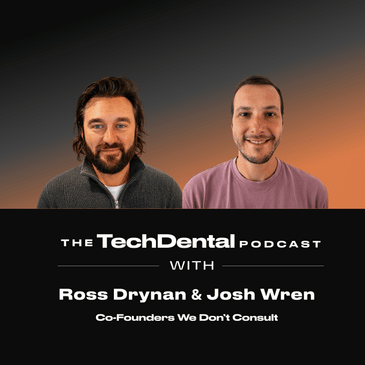
Ross Drynan and Josh Wren spent a combined 22 years inside Henry Schein ONE, the UK's largest dental software company. They watched product after product fail from the inside, not because the technology was wrong, but because nobody built the operating discipline to make it land. Then they left and founded We Don't Consult to fix it.
This is the episode for anyone building, buying, or backing dental AI right now.
We get into why the best product rarely wins, and what does. Ross breaks down the narrow set of go-to-market disciplines that actually decide adoption: the story, organisational alignment, making a busy clinician problem-aware, delivering outcomes they attribute to you, and the ability to tell that story afterwards.
We cover why most implementations die at the first post-sale interaction, why the kickoff call is a second sale and not a training session, and why "my team doesn't like change" is usually a leadership and change-management failure, not a technology one.
Ross explains why AI has not changed the adoption problem, it has magnified it. Weak leadership and culture plus AI equals an amplified mess. We talk about the Alignment Spine, the open-access lead generation model, and why you should market a diagnostic of the buyer's business, never the product itself.
We also go somewhere unexpected: Ross's consumer AI venture OurStoryMagic.ai, and the single thread connecting bedtime stories to early disease detection. Technology should close gaps that used to be closed by privilege, but only if the people building it have the discipline to make it land.
The episode closes on the ten-year split for UK dental AI. Get adoption right and early detection becomes the default, not a privilege. Get it wrong and the companies with the best models lose to the companies with the best brands, and the access gap widens.
In this episode:
What 22 years inside the UK's largest dental software company actually teaches you
Why the best product does not guarantee success, and the disciplines that do
The five go-to-market disciplines that decide whether dental tech wins or dies
Where implementation really dies inside a practice or DSO
Why the post-sale kickoff is a second sale, not a training call
How AI magnifies weak leadership and culture rather than fixing it
The open-access lead generation model and why you should never market the product
Why face-to-face and human skills get more valuable as AI scales
The OurStoryMagic.ai thread: closing gaps once gated by privilege
The ten-year outlook for UK dental AI, and the two futures ahead
About the guests:
Ross Drynan, co-founder of We Don't Consult. LinkedIn: https://www.linkedin.com/in/ross-drynan/
Josh Wren, co-founder of We Don't Consult. LinkedIn: https://www.linkedin.com/in/josh-wren/
We Don't Consult: https://www.linkedin.com/company/we-don-t-consult
Read the full written analysis: https://www.techdental.com/insights
Connect with TechDental: Host Dr Randeep Singh Gill: https://www.linkedin.com/in/drrandeep/ Web: https://www.techdental.com Email: info@techdental.com
🎧 Spotify: https://bit.ly/41UsqRO
🎧 Apple Podcasts: https://bit.ly/41pKL9b
▶️ YouTube: https://bit.ly/3JSfl5c
[00:00:00] If we do this right, early detection becomes the default, not a privilege. I am not neutral on which version we get. The absolute key thing you need is a go-to-market strategy that enables adoption. A solid product has got to deliver outcomes and it's got to be safe. Without that, the go-to-market plan will fall down eventually. You've both watched dental technology products come and go for over a decade. Most did not reach the people they were built for.
[00:00:30] Those views have actually hardened because AI hasn't actually changed the problem. It's magnified it. So if your leadership process and your culture is weak, AI will just magnify that. Yeah, we'll keep that off air. This is the Tech Dental Podcast, the strategic intelligence hub for leaders shaping the dental industry.
[00:00:54] We break down how AI, data and operating discipline drive performance and scale. I'm Dr. Randeep, let's dive in. There is a graveyard of brilliant health tech products, clinically validated, technically sound and built by people who genuinely understood the problem they were solving.
[00:01:18] The vast majority of these products lie completely unused and silently fail. Not because the technology was wrong, but because nobody installed the operating system. The vast majority of them to make it work. There is a gap between a revolutionary product that works and an organization that actually feels the impact. That gap is the subject of today's impact. That gap is the subject of today's episode.
[00:01:42] My guests have spent a combined 22 years inside Henry Shine One, the UK's largest dental software company. They've watched health tech products fail from the inside. They built the relationships. They ran the customer success. They led the sales. And then they left and built a company to fix what was broken. Ross Drinan, Josh Wren, welcome to Tech Dental. Thanks for having us. Good to be back.
[00:02:09] Before we get into this, I want to start with where you both actually came from. 22 years combined at Henry Shine One, that's not a short stint. What did that time actually teach you that you could not have learned anywhere else? After you, Josh? Yeah. In fact, me and Ross go back further than that. So we met in a sales role selling sheet metal, which is actually slightly more boring than it sounds.
[00:02:33] But we learned a lot in that. And it was a very transactional sales process. The difference we made on people's lives was very minimal. We might have saved them a few quid here or there. I think one of the big things that I learned quite quickly is that there's a real gap in a consultative approach to not just sales, but how SaaS businesses operate.
[00:02:58] And being able to go in and have real solid conversations with customers about their business, give them insight that they didn't know, and to really hit home on what that impact of change could be is absolutely massive. And I think that really was the start of our journey and the foundations to what built after that.
[00:03:20] Yeah, I completely agree. I think in terms of something that we learned that we couldn't learn anywhere else, we had a unique opportunity to work with every SaaS startup in our industry. And there was a key learning in that. And the key learning is you can have a really good product and you can still absolutely fail.
[00:03:40] And actually, the best product doesn't guarantee success. The thing that guarantees success or gives you the best chance is following a narrow set of disciplines in go-to-market that you can execute extremely well. And if you do that, you can probably beat those with products that are comparable or better than yours.
[00:04:02] It's the story, the alignment in the organization, your ability to go into a clinician who owns an organization, who is not problem aware, make them problem aware and show them a new way. It is then your ability to deliver outcomes in a structured way that they attribute to you. And then finally, it's down to your ability to tell that story.
[00:04:28] And these days as well, one of the things where organizations absolutely will fail is if the gap between idea, solution and execution is too big. You have to leverage AI to do almost everything to move quickly in an organization. So you've both watched dental technology products come and go for over a decade, some of them genuinely good.
[00:04:53] Most did not reach the people they were built for. At what point did you start understanding why? For me specifically, it was over the last couple of years. So the technology is really the reason a product dies. The reason a product dies is that a company has never built an operating discipline to get a cautious buyer, a busy clinician and a stretched delivery team to use it consistently.
[00:05:20] And that work is actually really unglamorous. It is invisible from the pitch deck. And it is the work that most founders avoid until they're already in trouble. I think to add to that, I think you make a really good point there, Ross. What I've seen is someone will come to market with a product that looks excellent. It really will help a customer overcome some significant pain that they're feeling. I think what often happens, they'll go to market and get lots of interest to begin with.
[00:05:50] Because typically what you get is the innovators going, what's this that's new? This is really exciting. And naturally we'll reach out and it gives us almost a full sense of the go to market plan and what's actually achievable. And as they go through that, they get their innovators engaged, get some good traction to begin with. As Ross says, you then get to the point where you're going to have to start persuading people, building really compelling messages to get people on the journey.
[00:06:18] And that for me is often a point where challenges start happening. And walk me through what that failure actually looks like on the ground, not the theory. Inside a dental practice or group, where specifically does the implementation die? So there's a couple of critical moments. I think there is a narrative. So most SaaS companies have a post-sale team. Usually they call it customer success. Some call it something else.
[00:06:48] And the problem often lands when the customer success team think that the sales team's job is to qualify every stakeholder in the practice to be an ideal persona. That is not correct.
[00:07:04] In our industry, the sales team's only job is to speak to a decision maker, help them understand a problem they didn't know they had, and then gain agreement that their solution fixes that problem and get the sale. Once that is done, it is no longer the salesperson's job. And actually you hear customer success teams say things like, they've overpromised.
[00:07:28] If you don't promise some things in sales, you're not going to sell. So you have to promise some things. It falls down in stage one where customer success teams are convinced that the only route is to train everybody on the product. That's not the job of customer success.
[00:07:49] The job of a customer success team is to design a path in partnership with each stakeholder in a practice or a DSO from where they are now to their model of success. And actually the first interaction, the kickoff call that a customer success team has with a new customer, and this can be digital as well.
[00:08:11] It doesn't have to be a human thing, can be digital as well, but that first interaction is not a demo. It is not training. It is a second sell. You are then selling to the associates in that practice or to the front desk in that practice or at a DSO, the operations team. You're selling the journey.
[00:08:33] And the best way to do that is to define what success looks like for them, what's in it for them, to create benchmarks, and then to set sail on that journey. You can train them later, but you have to engage them on why it's important to them, and you have to make it real to them. So a benchmark from day one and a target with key milestones identified and make it exciting for them as opposed to,
[00:08:58] hey, you've just bought our product, you've probably been told nothing about it, and I'm here to train you on it. You don't know what's in it for you. You don't know where we're looking to go, but yeah, I'm here to provide some training. It's not going to work. And it consistently falls down at that stage. Absolutely. And just to elaborate on that, Ross, one of the biggest things I've seen in the past is practice owner will make decisions.
[00:09:26] And they'll, for whatever that reason is, and they will quite often then let the process just run. And it's not uncommon to get on an onboarding call or a first interaction post-sale, and the team aren't aware of the change. I've heard of people moving PMS and finding out the day before that it's going to be happening. And one of the big things you hear is, oh, my team don't like change.
[00:09:53] And you need to tackle that head on because there's probably a few reasons they don't like change. One might be they've been burnt in the past by poor change management, and that's built up a fear of implementing new things. So a big part of it is really helping educate the decision maker on what this change management process looks like, how to get the team on board.
[00:10:17] And when the team are properly prepped to understand, you're going to get that engagement, you're going to get that eye in it, and you get off to a really good start. And Ross, in our previous Tech Dental episode, you said something that stayed with me. Technology does not drive adoption. Leadership, culture, and data hygiene do. Now that you're on the other side of the institutional infrastructure, has your view on that changed? My views change every day at the moment, I would say.
[00:10:46] It's that thing of a lot of people are building AI courses, for example. And the problem is, by the time you've built your AI course, five things from that course is out of date. So my opinion changes all the time. But specifically, those views have actually hardened because AI hasn't actually changed the problem. It's magnified it. So if your leadership process and your culture is weak, AI will just magnify that.
[00:11:14] And actually, or the team just doesn't use AI to go faster while your competitors are, which is even worse. I now think that adoption and your ability to grow is a function of leadership clarity. We design something with our clients called the alignment spine, where everybody aligns behind a set of behaviors, operating principle standards, and identifies the most important thing in the business.
[00:11:40] And if the leadership team can't articulate that very clearly, and everyone in an organization can't articulate that clearly, everything downstream of that becomes a problem. So you can design and optimize the perfect playbook, the perfect go-to-market.
[00:12:01] But if your culture isn't by design, and you have people in your business who are misaligned to the culture because you've just hired to fill a seat, doesn't matter what you've designed. Doesn't matter how clever you are, you will fail. And that's only hardened over time. Yeah, and I think with AI, there's obviously a lot of fear out there in terms of risk to jobs, that kind of stuff. And I understand why that's the case in certain roles.
[00:12:32] But I think what it's enabling, if used correctly, is it should unfairly unleash people within the team, reduce the unnecessary low value work, and enable them to focus on the highly valuable task, whether that's customer facing, whether that's innovating, whether that's improving process. And that culture piece is critical. They've got to be on board. They've got to be aligned. And they've got to be passionate about what you do.
[00:13:01] And if you do that, the people are still the greatest asset you'll have. AI is simply an enabler for them. There's maybe even one step further than that, Josh. And that's a trope, isn't it? This trope where people say, AI won't take your job. Someone using AI will take your job. And I hear that a lot. The reality is, AI should take a lot of jobs because a lot of jobs are dehumanizing. And they're repetitive. And they're just component labor.
[00:13:30] Quoting Daniel Priestley, it's designed for the industrial age. And it's out of date, a lot of work that people do. And so many people are so unfulfilled by the work that they do. And AI can actually solve that problem by removing all of the boring, repetitive, hard stuff so that you can focus on doing creative things and doing things that only human beings can do. A prediction is, face-to-face events will probably become bigger than they ever were.
[00:14:01] The importance of having a human that has got time to speak to you as a nervous patient will become more important. And human skills will become more important. So leveraging AI will set us free in the next couple of years from jobs that are dehumanizing. And I really am quite excited about that.
[00:14:21] Okay, if a product is genuinely good and solves a real problem, market forces should drive adoption without anyone needing to engineer the commercial infrastructure. Is the problem you're describing actually a sign that the products are not as good as the founders think they are? I don't know. I guess that can be the problem. And in B2C markets, I do think you can build an exceptional product that just scales without a face to it.
[00:14:49] And there are thousands of examples. In fact, you only have to look at how many billions of people use ChatGPT. None of them have spoken to Sam Altman, right? So you're going to be able to do that. But, and it is true in markets where the buyer can switch in 15 minutes and they can compare decisions. They've got time to sit and think. In other markets, absolutely. That you can build a great product and it will work.
[00:15:17] But the big problem that you've got in our market is everybody is extremely busy. Their focus is on care. Their focus is on patients, complaints, teams doing about 10 different jobs. And so it's very rare. I'm going to use another trope. It's very rare that they work on the business, not just in the business. So where you need to be in this position is if you've got a good product and you're confident in your product,
[00:15:46] first thing you need to realize is everything is downstream of your ability to drive leads. How do you drive leads to an audience of people who don't know they've got a problem and are too busy to talk to you? It's a hard problem to solve. The way that we recommend you do that is you build a model of open access where you feed into the market all of your thoughts, all of your intellectual property, and you give them away.
[00:16:12] So that could be guides on how to solve a certain problem. That could be video content. That could be courses. And you give that all away for free because people then begin to open up to you as an individual and the things that you talk about and the things that you do. And then the second part to that is you should never market a product. Because if you market a product, everybody else does that and you become quite commoditized. You need to market something of higher value than a product.
[00:16:42] And what's higher value than a deep diagnostic of what is going on in your business? So going to market with that is a much bigger thing. I'll give you an example. We have a product that does diagnostics and it delivers a kind of a blind spot review. So it delivers a deep review of a practice's operations, what's going on in their business, and it highlights key problems that your solution can solve.
[00:17:11] So what's in it for the prospect is they fully get to understand their business. And what's in it for the vendor? They get to sell their product. We then recommend that you have various other products for those who want you to achieve outcomes for them. So that can be deep training courses, deep consultancy that goes along your software.
[00:17:32] So the reality is unless you design a kind of a narrow bridge model, we call it, of going to market in that way, you're always going to struggle to get traction. Because we operate in a market where the people that you're selling to are so busy they're just not aware of their problems. And a great product, unfortunately, does not solve that.
[00:17:54] And just to add to that, I've been involved in sales processes quite a few times, but on the other side, as the buyers, we've been looking to expand our tech stack and what we've been using at different points in our career. And quite often the biggest deals I've signed off on and the most compelling, I've been sold way before I've seen the product.
[00:18:17] I've been chomping at the bit for the solution, not really knowing fully what it does, but I've just built up such an impression of the organization. And it's the credibility of it. And the way I look at it is you want to be seen as a business, as an expert in that space, not the product, whether that's in treatment acceptance, whether that's in marketing, whether that's in reporting. That expert in the sense of growing your business in a certain way.
[00:18:47] And when I've been on that side of it, it's been a no-brainer when you get to the product. It doesn't even matter because I know what it can deliver because everything that's been filtered through to me. So you've diagnosed a problem. Now tell me what the solution actually looks like. You founded We Don't Consult to fix this. What does the GTM infrastructure of a dental AI company look like and what actually drives adoption at scale?
[00:19:11] So I think there's quite a few things on this, and it probably goes back to what we spoke about a minute ago that you need the culture. Everything sits behind that and making sure you've got clear alignment. You then need to make sure that go-to-market plan is well thought out. You're looking beyond the product. You're looking at the issues that you're looking to solve, and you're building real compelling messaging around that.
[00:19:36] As Ross said there, the diagnostic, free content to the market, building that credibility gets you in that funnel. And then the next thing is how do you then evidence the outcomes that you're delivering? And that's a huge part of it and often something that's significantly overlooked. It's very easy for a practice owner to look at a bill at the end of the month and go, is this worth it? Subscription fatigue, it is becoming a real thing. And you just need to look at the market at how many options there are out there.
[00:20:06] So how do you ensure that your customers are reaching those desired outcomes? And that comes through real structured plans, clear objectives and goals that you're working to with clients, and the ability for your tech to be able to evidence the output is super, super critical. And I think it's that whole perception of how you come across as a team. If you're seen as trainers and you're left to your own device, you're going to have a real risk of future adoption.
[00:20:34] If you've got people working with your customers to ensure they are getting them outcomes, that then leads to advocacy. And it goes through that cycle. And that's absolutely critical. You're right, Josh. Josh, and I think coming back to something we said earlier, everything in a business is downstream of your ability to generate leads.
[00:20:58] And your post-sell should be, as in your customer success, your ability to drive outcomes should be your single biggest driver of leads. So the way to do that is exactly what Josh said. Design a journey that delivers an outcome that your customer knows they got because of you, because then their invoices become a no-brainer. But more importantly, they advocate for you.
[00:21:27] They give you case studies. And we operate specifically, if we talk about dental specifically, it's a tiny industry where everyone knows everyone. If you're getting outcomes for a practice, they will want to tell other practices about it. But it's no good just getting an outcome. It needs to be an outcome that they know they got because of you. We call that a verified outcome.
[00:21:50] If you get good at leads, you get good at sales, you get good at outcomes, you get more leads, you get more sales, you get more outcomes. And that is a flywheel that can go at a rapid pace if you operationalize it well. Josh, from your sales leadership background, what does a commercial conversation look like with a dental practice or group when it goes right versus when it stalls? What's the difference in the first five minutes of that conversation?
[00:22:20] Really good question. And it's actually a really simple answer. I see it time and time again. And it's going into the basics of sales. The times where it goes wrong are a really basic discovery or no discovery at all. And it's a product demo. And I've seen these countless times. And the problem you've got with that is a product demo without discovery is not tailored.
[00:22:49] It's boring, to be honest. And you're going to lose people. You need to make sure that you're fully understanding your prospect, what their current operations are. You vary that based on what you're selling. But you need to get that deep understanding. But I then take that a step further is as a salesperson and as organizations, you need to be the experts in that area.
[00:23:17] And that would often include questioning techniques that are designed to help prospect understand maybe an issue they didn't know they had. And that's a really important thing. So a big part of a successful sales conversation is really getting a prospect to think differently about their business, which is huge. And I think for me, that's the thing you ask about the first five minutes is be interested, be curious, and really open up those doors.
[00:23:46] And that then lays the foundations to take them for a really specific journey that ultimately ends with the salesperson having huge credibility and the practice maybe feeling urgency to make a decision. Ross, you moved from customer success to partnerships at Henry Shine One. That's quite an interesting transition. What does a partnership that actually drives adoption look like versus one that just looks good on the slide deck?
[00:24:13] Most partnerships fail the moment the agreement is signed. Both sides treat the signature as the win. It isn't. It's the start. A partnership that drives adoption has a named owner, first of all, on the partner side, whose biggest weekly investment is the relationship in that partnership. That can be from a technical perspective or a go-to-market perspective.
[00:24:41] Not necessarily a percentage of someone's time, but a person whose week is built around driving that partnership forward. Now, the partnership could be a key opinion leader. It could be a technical partnership. Each one becomes important, but somebody needs to own partnerships in an organization. It should have things like a weekly working rhythm with the partner's commercial team, their product team, and customer success teams.
[00:25:08] It should reduce the partner's cognitive load and burden at every stage if there's something in it for you that is huge and you get scale and distribution from it. So, the partners who treat those software companies who treat partnerships like just another channel won't get anything out of going into partnerships with other organizations. They should be treated like your biggest account because that's how important partnerships are.
[00:25:38] And the ones who decide to treat it like that rather than a bunch of logos on their website will significantly succeed. And one thing that I would say, a key point here, is technology in healthcare specifically is not widely adopted enough. And there's lots of reasons for that. But one of the reasons is it's so incoherent. There's so many different products out there.
[00:26:05] It's so confusing for so many small businesses and even DSOs. And the reality is you have to form strong partnerships where a workflow is taken care of to solve that problem. And that's what we're trying to do at Henry Shine One. Henry Shine One continues to do good work in that area. And they've got some really exciting things coming.
[00:26:28] But I would definitely say that if we all have a collective responsibility to drive technology into healthcare because it's the only way to make healthcare scalable for everyone, then partnerships has got to be treated like a first class citizen and like a big account, not a logo on your website. For a dental AI founder who's three to six months into trying to get into practices and just hitting walls,
[00:26:55] what's the one thing they are almost certainly doing wrong that nobody's told them yet? I'll go to Josh in a second. But I think the first thing they're doing is they're confusing demand for their solution with an awareness of the problem. So the market does not yet understand the problems that they have in the language that a founder is using. And until you've closed that gap, more pipeline just creates a bigger mess.
[00:27:21] So the fix really is not to spend more money on marketing. The fix probably is to stop those kind of pitching and get into some honest conversations with people you want as customers. Find out what their problems are and then just educate and build intellectual property and diagnostics around their severe pain, not your product.
[00:27:50] If you do that, you become unstuck. Then all you need to figure out is how to deliver outcomes and evidence them. Yeah, completely agree with you, Ross. And I'd probably fall back on the previous comments I made. Typically what's happened is it's, let me show you the product, which can work. But it can work with the innovators that just want the exciting new technology. But for the vast majority, it won't be enough of a pull.
[00:28:17] And it's building that engine around insight, consultative approach through the whole funnel is absolutely critical. Absolutely critical. I think the other thing as well is one of the things that we do find is, particularly during those early stages, founders have to wear a lot of different hats, right? Which means that they're often focusing on the most important thing at that time or what they feel is the most important thing at that time.
[00:28:46] Which often means other critical parts of the business are being left neglected and without that guidance and focus. And I think that's a big thing is making sure that you've got those foundations in place across all key areas. Yes, you're going to have to build it out. You're going to have to scale it. It's going to evolve. But how do you spread yourself in there enough and make sure that you've got eyes on all the key components? And particularly components maybe where the founder's not got experience in the past.
[00:29:14] Let me just push back again a little bit because there's an argument that the commercial infrastructure gap that you're describing is a feature, not a bug. It keeps weaker products out of clinical and business environments where they could cause harm. Is there a version of slow dental AI adoption that is actually protecting the end users? There is a version of that argument that is true. Guardrails in healthcare matter. Governance matters.
[00:29:42] The MHRA is right to tighten the AI assurance conversation. I'm not against that at all. But there is a darker version of that argument that I will not give air to. And that's the argument that says people, because some bad products might cause harm, slow adoption is fine. It's not fine.
[00:30:10] People are dying in this country today of conditions caught too late. And my mum was one of them. So yes, we need guardrails and we need the operating discipline that gets safe, evidenced, high quality tools into the hands of clinicians faster. But we need both things, not one or the other.
[00:30:36] I think what's really important here is we're saying that the absolute key thing you need is a go-to-market strategy that enables adoption. A solid product, it's got to deliver outcomes and it's got to be safe. Like their table stakes. And without that, the go-to-market plan will fall down eventually. The product is always the foundation. But it's the adoption that we're like where they go, where things typically fail. And that's a big part of what we believe.
[00:31:06] Ross, I want to step back from the commercial argument for a moment because you touched on it earlier. I know there's something more personal underneath all of this for you. You've written publicly about watching four generations of your family lose people to conditions caught too late. And that's a deeply personal framing. How did that experience shape where you've chosen to build? Yeah, four generations is a lot.
[00:31:34] I guess if I really think about it, it does come from my family, not coming from an affluent background. So my nan, she lost both her parents at 16. My grandfather died of a heart attack at 52. My mum was diagnosed with stage four breast cancer just a little bit too late. She lived a little bit longer, another three years.
[00:32:02] But then she died suddenly of a heart attack while we were on holiday, which was also completely preventable. And when I was, after all of this happened, I paid £2,000 for a full private health check where they do everything. Angiograms, the lot, the works. And I've done that every year since. The big problem that we've got is most people can't do that, right?
[00:32:28] Not everyone can go, I'm going to spend £2,000 a year and then I'll know I'm probably okay. And therefore we have a problem. And I'm aware of the unfairness of it, that earlier detection in this country is mostly a function of what you can afford to pay for. And that is an unacceptable thing. And that's what we're building against.
[00:32:52] If technology can make being a clinician more profitable, if AI can make early detection cheaper and more frequent and more available. And just to give you an example, right? I'm not, don't quote me on this, but let's say you've got a cardiologist that can do 10 angiograms a day. If that is AI enabled and goes to 20, how many more people can you screen for cardiovascular disease in this country? And how much cheaper does it become?
[00:33:22] So that's what we've got to work towards, right? That does come down to the ability of founders, because this will only be solved by businesses, is the ability of founders to create great products. But it's also the ability of those founders to go to market in a disciplined way that actually drives adoption that we need. And that is why WDC, We Don't Consult exists, because we can close that gap.
[00:33:51] Talk to me a little bit about our storymagic.ai. On the surface, it's a personalized bedtime stories app, but how does it connect to everything else you're doing? What's the thread that runs through it? Yeah, they seem completely unrelated, don't they? But really, the first thing to say is I felt like I had to get a bit more technical. And I've got this strong belief that you can do anything and learn to do anything, especially these days, right? It is no longer an excuse to say, oh, I need to be trained on that.
[00:34:20] I need to go on a course. Most things that require knowledge are solved by AI, right? So that's the first reason I started doing that. But the thread is the same belief. Technology should close gaps that used to be closed by privilege. So a personalized bedtime story used to require lots of time and energy and creative bandwidth of parents.
[00:34:47] And early detection used to require a private health budget. And both gaps are closable now. The question is whether the people building the technology have the discipline to make it land. Building our storymagic taught me something. I had told healthcare companies for over a decade, the hardest part of building a product is not the building.
[00:35:14] It's making someone care about it before they move on. And that's even harder in consumer apps. So health tech founders are facing the same wall, but with higher stakes than our storymagic, right? I have more sympathy for them now than I did a year ago and less patience with the ones who still won't do the unglamorous discipline work of going to market in an elegant way so that their product is adopted.
[00:35:44] Josh, I want to bring you in here. You're watching Ross build our storymagic alongside We Don't Consult. From the outside, what do you see in him that you probably cannot see in himself? Good question. So I think I go back a long way with Ross. And Ross, when I joined Henry Schein, mine was my first leader. I learned so much from him and really got me onto the path that I then trod.
[00:36:10] So I think there's probably not a lot I can say that Ross wouldn't see in himself because I'm quite, quite often will give the feedback. But I think the big thing I see in Ross, which has really inspired me, particularly as we've learned, we've launched WDC and Ross has launched our storymagic. It is around like just grabbing the bull by the horns and no excuses. As Ross says that you can learn anything.
[00:36:37] And I watched Ross do this and that really inspired me. I was probably my last year or two at Henry Schein 1. I maybe lost my mojo a little bit. I wasn't as energized and I wasn't keeping up to date with stuff as much as I should. And seeing what Ross did was so inspiring. And maybe that's probably a part of it.
[00:37:03] Maybe he doesn't quite realize how much he inspires people because I know he inspires a lot of people. But I was in a real crossroads of what I wanted to do with my career. And seeing what he did and how we went about it really set the tone for where we are now and how I operate day to day. Thank you, Josh. He's normally not that nice to me. Yeah, we'll keep that off air.
[00:37:26] We've been discussing the distance between a product that works and the organization that actually sees the change or the impact. So that's the gap. Is that the problem you're both trying to solve? And if it is, why has it taken this long for someone to build it? It's a good question. I think the crux of it is we've experienced in the past.
[00:37:49] We've had consultants that have come in, they've looked at P&L, they've asked a few questions, they've given some advice and they leave you to your own means. Or you notice that your sales process isn't quite as solid as it can be. So you get a sales trainer come in. And they come in for a couple of days and you learn some new bits and 80% of that knowledge is then lost as the day-to-day flows by. And we saw a gap there.
[00:38:20] And I think particularly with our experience in the industry puts us in a really fortunate position. The IP that we've been able to learn across multiple functions has been so valuable. And I think that's what's enabled us to look at how we can create a more embedded go-to-market partnership model. And yeah, there's some areas where there might be a bit of crossover.
[00:38:44] But I think all those things combined have really enabled us to come in with a bit of a niche proposal here. The other thing, and actually I will add one more thing to that. A big part of what we're doing is not just the advice and the execution. It's also developing the tools that will help enable this and align to what we're doing. And I think historically in the past, it's been difficult to do that kind of stuff.
[00:39:09] It's very easy now to get to a point where you've got an MVP product that can help support what you do. Link it in with your knowledge and your structures that you build upon. So I think we're now at a time which really enables this kind of thing to build quickly and to scale. Wow. You're so right, Josh. Ten years ago, you could be around someone with just years of intellectual property and years of experience.
[00:39:39] And the people that benefit from that are the people who work around them and maybe the people that have read a book that they've written. And that's probably about it. There's probably a bit more than that, but it's not that much. Now, people with lots of ideas, experience, pattern recognition can build products that productize that and give it to thousands of people instantly. And they don't need to be technical.
[00:40:09] So rather than having to go and raise two, three million to get going, build a team, all that kind of stuff, a small team of people with deep niche experience can build products for that niche and go to market with them, which makes this just the most exciting time ever. And that's what we're trying to do. We're not just going out and saying, hey, we've got a load of pattern recognition and advice.
[00:40:35] We deeply documented the things that we know to be true and the things that work. And we make them available to our clients via LLMs. We give a lot of it away, but we also build AI SaaS products that are not expensive to buy, by the way, but just scale that across entire organizations. We're starting with the sales and lead generation motion, but we're going to build customer success products as well because it is simple to do.
[00:41:04] And it enables more people to benefit from the work that we do at a lesser cost than a 12-month coaching retainer. So I think it's just a wonderful time to be doing something like this. In 10 years, what does the UK dental AI market look like if the adoption problem you're both describing gets solved? And what does it look like if it doesn't?
[00:41:28] 10 years from now, if we do this right, early detection becomes the default, not a privilege. So taking out of dentistry, for example, a mammogram isn't a once every three years event for women over 50. It is a continuous AI supported low cost loop that catches what wasn't caught from a mum, for example.
[00:41:57] Bringing that into dentistry, it's not the access problem that we've experienced over the last five years since the pandemic anymore. Everybody gets early detection on things that are really important. An untreated infection in the mouth is a huge problem that lots of people have and they can't get access to a dental practice. We can solve that problem with technology and the technology exists today.
[00:42:24] An angiogram is not the thing you get after a cardiac event. It is the thing that prevents a cardiac event. This is where we're looking to go. But we have to talk about if we do this wrong as well. If we do this wrong, the technology gets built and never reaches the people who need it. The companies with the best models lose to companies with the best brands. The NHS adopts things slowly because people have no idea how to go to market to them.
[00:42:54] The private market just widens the gap and the gap between those who have and can afford healthcare and those who can't gets wider and wider like the US model. And another generation of people watches preventable issues and deaths happen in the country that invented the modern hospital because the operating discipline to land the technology wasn't there.
[00:43:20] I am not neutral on which version we get. That's why WDC exists. We are pushing for version one tomorrow and we're going to do everything we can to bring that to life. Yeah, I think that's the thing that makes this really fulfilling.
[00:43:40] There's been countless examples of where one of the biggest frustrations I often have is when someone adopts technology and the first thing they say is, I wish I did it sooner. Yeah, and you hear it all the time. I mean, it's how do we close that gap? And I can use an example of my mum, and this is actually quite an embarrassing story considering I was leading a sales function for a big tech company.
[00:44:09] But my mum owned a salon 12 years or so and was completely paper-based, not digitized at all. And every year we'd have the same conversation, mum, you need to keep up the time. So this is going to completely transform your business. And the one thing I always got back was, oh, it's a big change. I don't think the team will get behind it. I'm not very technical and I can't afford it.
[00:44:39] I can't afford it. And a big part of that is how do you actually, people like that. And there's a lot of people in dentistry like that that we come across, understanding that actually the cost of doing nothing is way more. And also how that then flows into future developments. Like in order for that vision that Ross has described, one of the most important things is that practices are profitable and able to reinvest back into the practice.
[00:45:09] There's a lot of tools that can seriously impact a practice, help improve recall rates, retention rates of patient, ultimately into better outcomes, but better financial position to those practices. I think that's a key part that gets me super passionate about what we do. And that gets us one step closer to enabling that future of dentistry. We're coming to the end of the podcast now. And you know what that means, Ross. It's lightning round. I think it's your first lightning round, Josh.
[00:45:37] So we'll try not to put you on the spot, but it's quick answers. Okay. So here goes. The single most common mistake a dental AI company makes in its first 12 months of trying to get into practices. They go to market with a product, not a problem. The one question a dental founder should ask a potential customer before they build a single sales deck. Well, what's the biggest problem that they're facing?
[00:46:01] But I would actually caveat that I think the most important thing they need to do before they build a sales deck is the organization needs to define what that problem is and work backwards from it. The dental technology that should have worked but did not. I would actually say it's imaging and detection. There was a product around probably about five years before in the market that nobody adopted.
[00:46:30] And now it's a common place to have detection on x-rays and so on. So I guess it failed initially, but now it's more mainstream. But the problem is still there, right? It's that lag of the technologies available to wide adoption was, I think it was seven years, not five. So yeah, big gap. What does We Don't Consult look like in three years? You go first, Josh.
[00:46:59] There's a lot of opportunity for WDC in the future. I think a real split model whereby we offer really hands-on, intense, in-depth coaching and consultancy for clients and have a team behind us that can help us do that with experts from the industry.
[00:47:21] But I think a big opportunity for us long-term and for scale to have the wider, the biggest impact is to really build upon the SaaS function that we've got. Getting that into as many hands as tech providers in the industry and healthcare as a whole. And really enabling sales functions, customer success functions to have the right conversations, to deliver insight, real tailored approach in a really easy way.
[00:47:51] So it makes it a real foolproof way of being able to sell and have solid conversations. We need to be at a place where we have driven the adoption of technology across multiple healthcare industries at scale. If we do that, we've served our mission. Now it's a forever mission, but that's where we want to be. Ross, Josh, this has been a genuinely different conversation. I think this episode is going to be one for the builders and innovators in this AI-enabled era.
[00:48:21] Where can people connect with you and learn more? Well, we're on LinkedIn a lot. So you can find us on LinkedIn. You'll see a lot of our information, a lot of our musings, a lot of our guides on LinkedIn. So yeah, connect with us on there. We'd love to have a conversation. And to our listeners, if you're a dental AI founder, in-health tech, a DSO operator or investor who's just heard something in this episode that resonated,
[00:48:49] the full written analysis is on techdental.com forward slash insights. Subscribe, share and comment. All links are in the show notes. Until next time, I'm Dr. Randeep and this is Tech Dental. You've been listening to the Tech Dental podcast, strategic intelligence for dental leaders navigating structural change. If you're responsible for growth, performance or long-term value in this industry, make sure you're subscribed. I'm your host, Dr. Randeep.
[00:49:19] We'll see you next week.