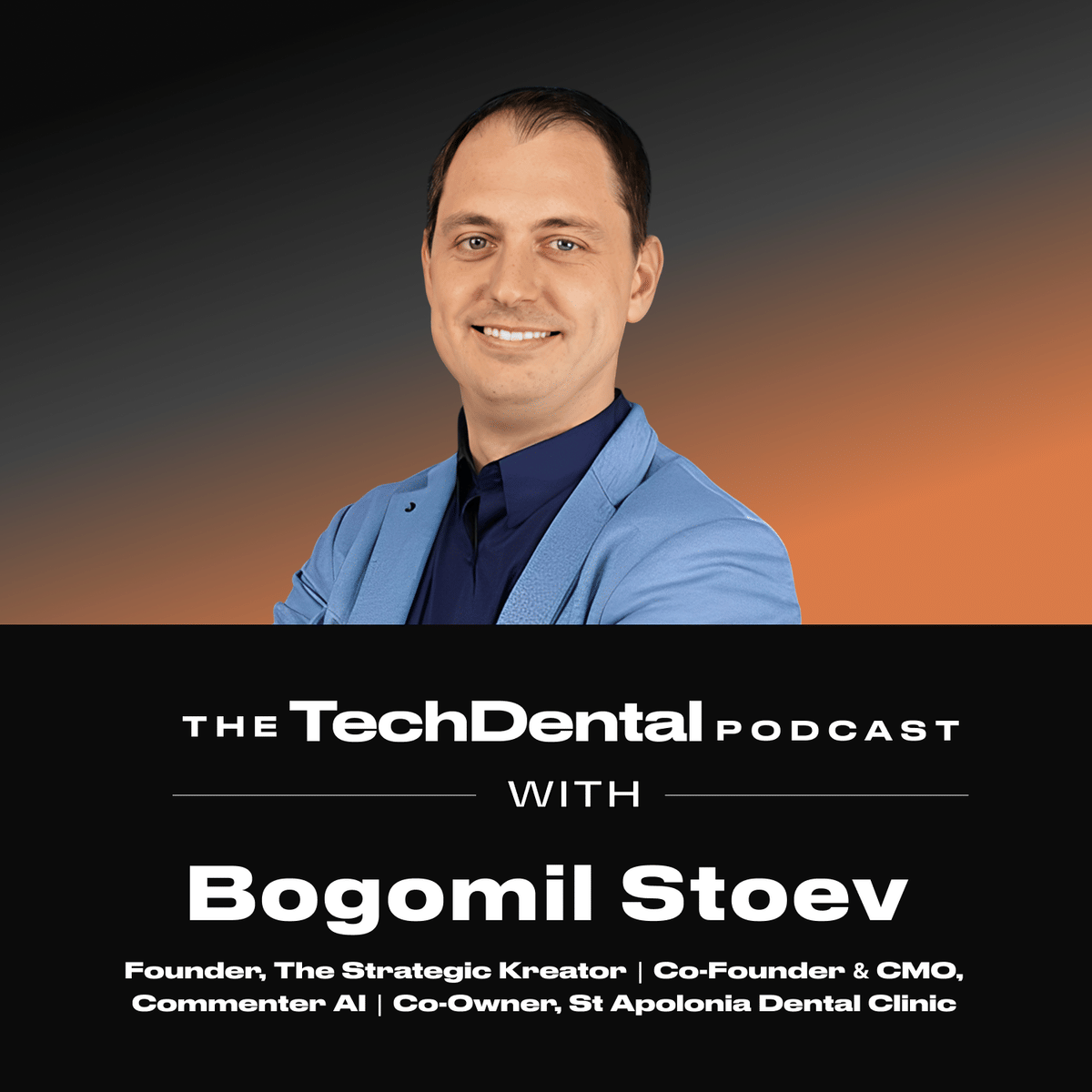
Direct answer: Bogomil Stoev, founder of The Strategic Creator, co-founder and CMO of St. Apollonia Dental Clinic, and co-founder of Commenter AI, argues that the central failure in dental patient acquisition is not a technology deficit but a strategic one: practices deploy an accumulation of tools without a coherent system for turning awareness into booked treatments, and in doing so they mistake activity for growth. His core framework, which he calls conversational visibility, prioritises LinkedIn profile authority, strategic commenting on the content of prospective patients, and DM-based relationship building over broadcast content that generates engagement but produces no revenue. AI, in Stoev's framework, is an enabler of this system rather than a replacement for it: it can handle up to 70% of the backend acquisition workflow, but the trust-building and transformation-selling that convert a prospect into a patient must remain human. The immediate action for any UK dental practice owner is to audit where their best existing patients actually came from, commit fully to that single channel, and build one reliable visibility and follow-up loop before attempting to scale.
Most dental practices in the UK have more technology than they are using effectively. They have practice management systems, CRMs, email platforms, social media schedulers, ad dashboards and analytics tools. They produce content. They run campaigns. They have pipelines, in theory. And yet the growth remains unpredictable, the cost per acquired patient continues to rise, and the return on the accumulated stack of tools remains stubbornly unclear.
Bogomil Stoev has been on both sides of this problem. As co-founder and CMO of St. Apollonia Dental Clinic, he has lived the operational reality of running a patient-facing dental business. As founder of The Strategic Creator, he has helped consultants, coaches and business founders build systematic inbound demand. And as co-founder of Commenter AI, he is building the AI infrastructure that he argues should sit at the base of a properly designed visibility system, not at the top of it.
His diagnosis of what goes wrong in dental patient acquisition is precise, and it begins not with a critique of the tools but with a critique of the relationship between tools and strategy.
"There is no tool that can help you to solve the human side of the things. You need a real system that helps you to build the trust that is needed before someone comes to your practice. You need to figure out how you can combine your strategy with the tech instead of seeing them separate in order to get the best results."
That distinction, between tech as a component of strategy and tech as a substitute for it, runs through everything Bogomil has built and everything he teaches.
The Bandage Problem: Why Tools Without Systems Produce Predictable Underperformance
Bogomil's metaphor for how most dental practices approach their technology stack is deliberately unglamorous: they use tools like bandages. Something is not working, so a tool gets applied. Another thing breaks, so another tool is layered on top. Nobody steps back to design the actual growth journey.
"A CRM filled with cold leads that no one nurtures is not a strategy. Most tools are like dashboards. They look impressive, but at the end they can't drive the decisions. There should be someone who knows how to build the whole system and figure out the answer of the question: how can we turn awareness into booked treatments, step by step?"
The consequence of this pattern is visible in the economics of dental advertising in the UK. As more practices compete for attention through paid channels without differentiated positioning or a coherent trust-building system, ad costs rise and conversion rates fall. Bogomil identifies this as a structural dynamic that will continue: paid attention is becoming more expensive precisely because the signal-to-noise ratio is deteriorating as more undifferentiated content floods the same channels.
The alternative he proposes is grounded in a principle borrowed from his work with consultants and coaches and applied directly to the dental context. Before asking for any commitment from a prospective patient, whether that commitment is booking an appointment, attending a consultation or accepting a treatment plan, the practice must have already given something of genuine value.
"The motto that I teach all coaches and consultants that I work with is that you need to make part of you the idea of give before asking for commitment. Because we are living in an age where we are looking for fast results, fast conversions, fast sales. But the thing is that we are moving away from that and people are sick of that."
For UK dental practices, this principle has a specific application. The value that can be given before commitment is not necessarily free treatment. It is insight, clarity and expertise that helps a prospective patient understand their situation better. The dentist who posts content on LinkedIn that helps someone understand whether their jaw discomfort might warrant investigation, or what the difference between various whitening approaches is, or what the realistic timeline for orthodontic treatment looks like, is building trust at scale before the patient ever calls.
Visibility Without ROI Is a Trap: The LinkedIn Framework for Dental Practices
Bogomil's framework for what he calls conversational visibility begins with a direct challenge to the metric by which most dental professionals evaluate their LinkedIn presence.
Engagement, likes, comments, reposts, produces a dopamine response that can masquerade as progress. The LinkedIn ecosystem rewards this by surfacing high-engagement content to broader audiences, which reinforces the behaviour. But engagement is not the output the practice actually needs.
"There is a saying which the LinkedIn nerds like me often use: likes don't buy food. Sales buy the food. Those that are looking to get something out of LinkedIn should stop focusing on metrics that don't matter and focus on those that can move the needle for the business. And if we're talking about LinkedIn, then this means profile views, conversations, and leads."
He cites a client who had been posting consistently on LinkedIn for nine months without generating a single sale. The content was performing well by engagement metrics. The problem was that it had been optimised for engagement rather than for the specific mechanism by which LinkedIn actually converts: conversations.
Within two weeks of shifting the strategic intent from engagement-first to conversation-first, that client closed a £3,000 contract. The platform had not changed. The audience had not changed. The content intent had changed, and that changed everything.
For dental practice owners and clinical leaders, the practical framework Bogomil recommends for someone with limited time on LinkedIn is structured around three activities in a specific priority order.
First, the LinkedIn profile must be rebuilt to answer three questions with complete clarity: who the practice helps, why patients should choose it, and why it is the only sensible choice. Without this foundation, the effort that follows will land on a profile that fails to convert the interest it generates.
Second, the majority of available time should go not into posting but into strategic engagement: identifying prospective patients or referral sources, tracking when they post content, and being among the first to leave a substantive, personalised comment that demonstrates genuine expertise. A well-placed comment that shows the commenter has read and understood the post generates a profile visit, a connection request or a DM at a rate that broadcast posting alone cannot replicate.
Third, the DM conversations that result from these interactions are where the actual patient relationship begins.
"I would just split my time to engagement, chatting in the DMs and sending DMs, and posting like once per week. This is what would definitely help the most and not trying to post content every single day by thinking that this can lead to something meaningful."
For UK dental practice owners who have dismissed LinkedIn as a platform for corporate professionals rather than patient acquisition, this framework is worth examining carefully. The independent dentist building a private patient base has a local patient population that is on LinkedIn. The principal building a referral network among GPs, consultants and corporate clients has prospects who are on LinkedIn. The practice manager responsible for corporate dental contracts has decision-makers who are on LinkedIn. The platform is not the limiting factor. The strategic intent with which it is used is.
For broader analysis of how digital patient acquisition connects to the operational infrastructure required to convert that demand, see The Front Desk Is a Revenue Engine, Not a Cost Centre: How Automation and AI Are Transforming Dental Operations.
Commenter AI: Conversational Visibility as Infrastructure
Bogomil's own AI tool, Commenter AI, is built as the operational backbone of the conversational visibility framework he teaches. It solves a specific friction point: identifying when target prospects post content, doing so before the optimal engagement window closes, and generating a substantive comment quickly enough to be among the first to respond.
The platform allows users to build a curated list of target accounts, tracks when those accounts post, and uses AI to draft a comment calibrated to the specific post content and the user's professional voice. The draft is always presented for review and editing, not automated to publication.
"It gives you the direction, but it doesn't do the action for you. It just tells you it's good to do this, but it's up to you to decide if you're going to do it or not, and if it's going to be exactly this way or you are going to edit it before you decide to pull the trigger."
The built-in CRM functionality allows conversation stages to be tracked as interactions move from comment thread to DM, enabling a practice or its marketing team to maintain visibility over where each prospective patient sits in the relationship journey.
The design philosophy behind Commenter AI reflects something important about Bogomil's broader view of AI's role in professional services. The tool is not an automation engine. It is a decision-support and time-compression tool. The human judgment, the edit, the contextual nuance, the relational warmth of the comment or the DM, remains entirely with the user. AI opens more doors more quickly than the user could open alone. Whether to walk through them, and how, is always the practitioner's choice.
"AI can do a lot of things, but in order to build real trust, AI can't fabricate that. AI is not that good on communication."
For analysis of where AI sits within the broader operational and patient engagement infrastructure of the modern dental practice, see People-First AI: Why Most AI Projects Fail in Dentistry (and How Leaders Get It Right).
The Transformation Sell: Why Dental Practices Are Marketing the Wrong Thing
One of the most common mistakes Bogomil identifies in how dental practices communicate with prospective patients is a focus on features and treatment processes rather than on the outcome the patient is actually seeking.
The impulse is understandable. Clinicians are trained to think in diagnostic categories, treatment sequences and procedural steps. They are genuinely in love with their craft, which means they naturally lead with what makes dentistry interesting to them: the range of treatments available, the quality of the materials used, the clinical protocols followed.
"People don't care about the features. They don't care which tool you're going to use to fix the problem. They're coming to you because they're looking for the transformation. They're looking for the end result. They're looking for chewing their favourite food again, having enough time with their family and not spending it on the dental chair, for example."
This is not a new principle in marketing, but its application in a clinical context requires a careful calibration. The transformation sell does not mean overselling outcomes or making promises that clinical reality may not deliver. It means anchoring the communication in the emotional reality of the patient's problem, speaking to the functional and social consequences of the condition they have, and positioning the practice as the partner in achieving the result they care about.
The LinkedIn post that explains what life looks like for someone who has avoided smiling in photographs for five years, and what changes when that changes, will generate more resonance with the right prospective patient than a post cataloguing the composite materials used in a cosmetic case. Both posts might share clinical expertise. Only one speaks to why the patient is actually looking for help.
The Future of Patient Acquisition: AI at the Backend, Human at the Front
Bogomil's projection for the next five to ten years of patient acquisition in dentistry is measured and specific. His estimate is that AI will be capable of handling approximately 70% of the backend acquisition workflow: outreach, reminders, scheduling, follow-up sequences, initial qualification. That is a significant reduction in the administrative and operational load on practice teams, and it compounds over time as AI capabilities develop.
But the 30% that remains is not a residual category. It is the category that determines whether the practice actually wins.
"AI will still not be able to do the trust part. Reviews and online trust signals, having an optimised profile on LinkedIn which posts content and engages with people from time to time, will be far more important than now. Micro content on TikTok, YouTube and LinkedIn will beat these long funnels with many ad campaigns and difficult strategies."
His prediction is that the practices which win the patient acquisition competition over the next decade will be those that do two things simultaneously: use AI to make the backend as efficient as possible, and use the time that frees up to become more human in the channels that build trust. The practices that automate their entire front of house and remove the human signal from their outward communications will pay a reputational price that the operational savings do not offset.
"People will need to see more from us, to see more of our human side as people, not as dentists. People will need to know more about how we think, what we go through and things like that. So it will be more about emotional connection and something that AI can't fabricate for sure."
His explicit warning about "move fast and break things" as applied to dental practice automation is worth taking seriously in this context. The phrase, borrowed from Silicon Valley startup culture, encourages rapid iteration and tolerance of failure. In a context where patient trust is the primary asset and reputational damage compounds quickly, breaking things in the service of speed carries costs that are not easily recovered.
"By breaking things, you are actually killing your opportunities because you are killing the trust in the process of trying to achieve something pretty fast. I would highly, highly recommend dentists to stay away from automations from day one because they can hurt you a lot more than they can give you."
The One-Channel Principle: What to Do When Everything Feels Overwhelming
For dental leaders who recognise the need to modernise their patient acquisition approach but are paralysed by the range of options available, Bogomil's final practical advice is deliberately reductive.
Do not attempt to be present on multiple channels simultaneously. Do not test a portfolio of tools in parallel. Instead, audit the existing patient base to identify where the best current patients actually came from, identify the single channel and system responsible for generating that quality, and invest fully in understanding and optimising that channel before expanding.
"Focus on one and as quickly as possible, especially if you are overwhelmed, make an audit and figure out where do your best patients come from today? I'm pretty sure that there will be one channel and one system which has its own tools that help you achieve that. And then when you figure this out, just double down on that."
The output of that focus is one reliable loop: from initial visibility, through meaningful conversation, to a follow-up system that moves a prospective patient from first contact to booked appointment in a repeatable and predictable way. That loop, built well and working consistently, is worth more than ten channels working inconsistently.
For UK dental practice owners navigating the current landscape of AI tools, digital marketing platforms and patient acquisition promises, the simplicity of this advice may feel counterintuitive. But it is grounded in something that the complexity of the tool landscape tends to obscure: that patient acquisition in dentistry is, at its core, a trust problem. And trust is built one genuine interaction at a time.
For analysis of how the data and operational infrastructure of a dental practice determines its capacity to convert acquired patient demand into revenue, see The Great Dental Reset: Why 2026 Will Reward the Prepared, Not the Big.
Key Takeaways
Technology without strategy produces dashboards, not growth. A CRM filled with un-nurtured leads is not a patient acquisition system. The missing element is always a human who can design the journey from awareness to booked treatment and deploy tools in service of that journey rather than as a substitute for it.
LinkedIn is a systematically underused patient acquisition channel in UK dentistry. Its highest ROI use is not broadcast content but strategic commenting on the posts of prospective patients, which generates profile visits, connection requests and DM conversations at a rate that broadcast posting cannot match.
Conversational visibility, the practice of being strategically present in the content conversations of prospective patients before they need your services, builds the trust that converts strangers into booked appointments more reliably and at lower cost than paid advertising campaigns in a saturated market.
Dental practices are consistently marketing the wrong thing. Patients are not buying treatments. They are buying transformations: the return of function, confidence and quality of life. Communication that anchors in the patient's desired outcome will consistently outperform communication that leads with clinical process or material quality.
AI will handle approximately 70% of the backend patient acquisition workflow in the next five to ten years. The 30% that remains, the trust-building, the human presence, the emotional connection that turns a prospect into a patient and a patient into an advocate, will become more valuable, not less, as the backend becomes more automated.
"Move fast and break things" is the wrong operating principle for dental patient acquisition. In a profession where trust is the primary asset, automating communications before the positioning, tone and system are proven can cause reputational damage that takes years to recover from. Validate the system manually first, then automate incrementally.
Before investing in new tools or expanding to new channels, audit where the best current patients actually came from. The answer will almost always point to a single channel and system. Doubling down on that one thing will generate more growth than spreading effort across multiple channels simultaneously.
About TechDental
TechDental is a strategic intelligence platform for founders, executives, operators and investors shaping the future of dentistry.
Through high-level analysis and systems-focused conversations, we explore how AI, governance frameworks and operating model design influence performance, scalability and enterprise value in dental organisations.
If you are building, scaling or investing in dentistry and want independent, systems-level insight into AI, governance and capital readiness:
For strategic advisory, board briefings or keynote speaking enquiries: www.techdental.com/advisory
The future belongs to those who deploy technology with discipline.
© 2026 RIG Enterprises Limited. All Rights Reserved. This article was authored by Dr. Randeep Singh Gill and is published under the TechDental brand, a trading name of RIG Enterprises Limited (Company No. 11223423), incorporated in England and Wales on 23 February 2018, registered at 1a City Gate, 185 Dyke Road, Hove, England, BN3 1TL. All editorial content, analysis, synthesis and intellectual property contained within this article are the original work of the author and remain the exclusive property of RIG Enterprises Limited. Opinions and statements attributed to named guests reflect the views of those individuals as expressed during recorded interviews and are reproduced here for editorial and informational purposes. No part of this article may be reproduced, distributed, transmitted, republished, or otherwise exploited in any form or by any means, whether electronic, mechanical, or otherwise, without the prior written consent of RIG Enterprises Limited. Unauthorised reproduction or use of this content may constitute an infringement of copyright under the Copyright, Designs and Patents Act 1988.