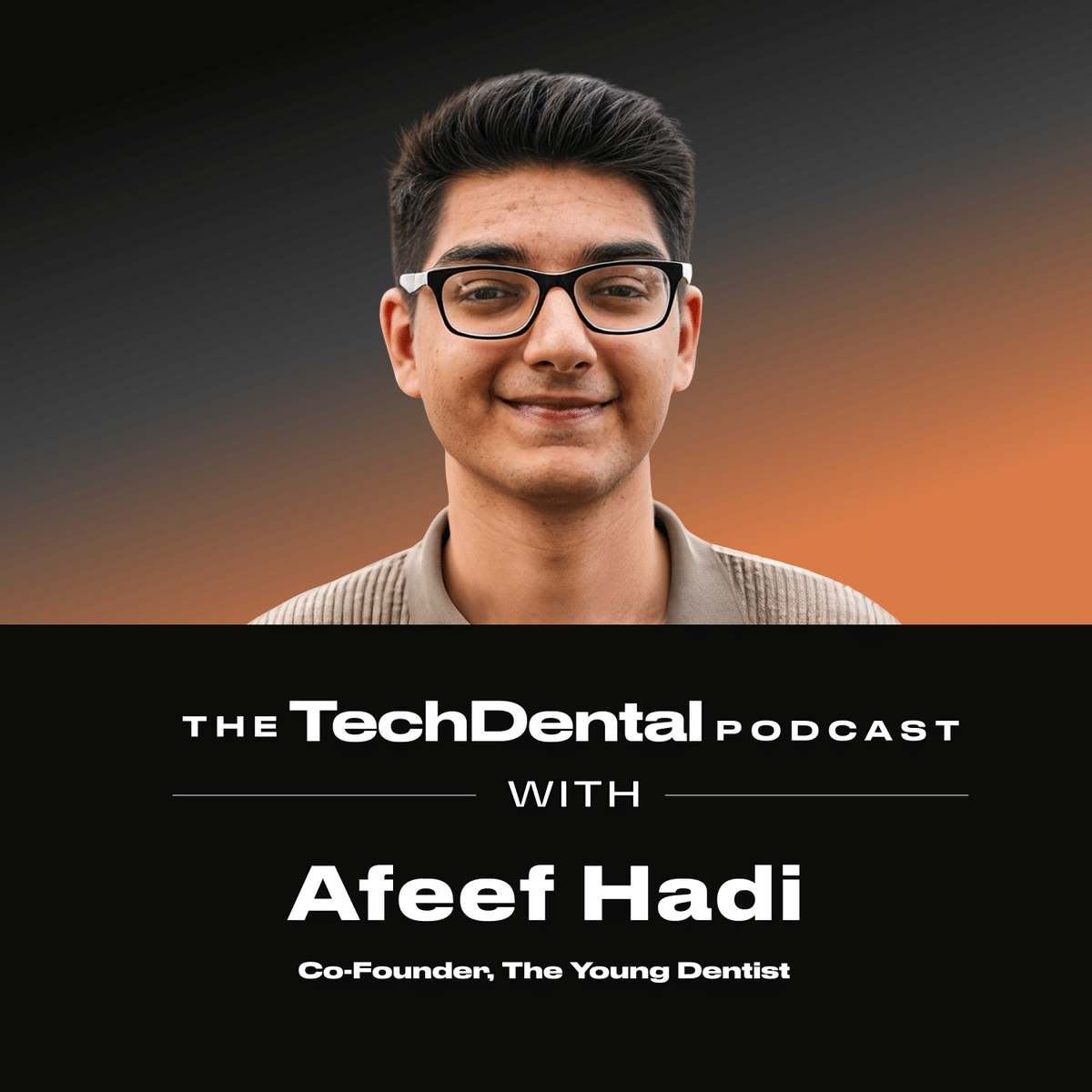
Direct answer: Afeef Hadi, co-founder of The Young Dentist and second-year dental student at King's College London, argues that the most significant gap in UK dental education is not clinical but human: communication, ethical selling, complaints handling and business literacy are the capabilities that separate exceptional dentists from average ones, and dental school currently does almost nothing to develop them. Having already built multiple technology ventures, won a national AI health tech competition, and conducted nearly 400 professional networking meetings before graduating, Hadi represents a generation of dental students who are entering the profession with entrepreneurial instincts and a native fluency with AI that their predecessors did not have. His platform, The Young Dentist, is designed specifically to bridge the gap between dental school and the wider industry ecosystem, giving students direct exposure to the technologies, business models and clinical innovations that will define the profession they are entering. The core action for dental school leaders, practice owners and technology providers is to engage this generation on their own terms: as curious, commercially aware, purpose-driven individuals who will shape the trajectory of UK dentistry far sooner than the profession expects.
There is a moment in Afeef Hadi's story that captures something important about where the next generation of British dental professionals is coming from. He is sitting in a small bedroom in Healing, a quiet village at the end of the train line in Northeast Lincolnshire. He has just posted an analysis of the Smile Direct Club bankruptcy on LinkedIn. The post reaches 20,000 people.
"To me, that was insane. Sat in my little bedroom in a bungalow in Healing, to reach 20,000 people around the world was insane. That was more people than the population of my whole village."
That realisation, that a student with no institutional backing, no budget and no professional credentials could build genuine reach and genuine influence by putting substantive thinking into the world, is the founding insight behind everything Afeef has built since. He is now a second-year dental student at King's College London, co-founder of The Young Dentist platform, a winner of the KCL Change Our City Challenge for an AI-powered clinical documentation tool, a finalist at the Red Bull Startup Studios competition nationally, and the host of a podcast designed to close the gap between dental school and the industry that students are about to enter.
He is 19 years old.
The significance of Afeef's story for the wider dental sector is not that it is exceptional, though it clearly is. It is that it is indicative. A cohort of dental students is entering the UK profession right now with entrepreneurial instincts, AI literacy, social media fluency and an impatience with the gap between what dental school teaches and what the profession actually demands. Understanding what drives them, what they see that their predecessors did not, and what they are building, is not an optional exercise in generational curiosity for dental leaders. It is an intelligence briefing on where the industry is heading.
The Curriculum Gap: What Dental School Is Not Teaching and Why It Matters
One of the most consistent findings from Afeef's 400-plus professional networking meetings across the dental industry is a structural mismatch between the competencies dental schools develop and the competencies that exceptional practitioners actually deploy.
When asked to name the single most important non-clinical subject that should be compulsory in every dental school, his answer is immediate and unambiguous: communication.
"I think every single clinician in the country has, if you want to provide the best course of care possible, you have to have exceptional communication skills. The best clinicians I've also seen just happen to be the best communicators. I don't think that's coincidence. I think there's a clear causal relationship to be investigated there."
The scope of what Afeef means by communication is broader than the term might suggest. It encompasses three distinct domains. The first is treatment plan explanation: the ability to translate complex clinical reasoning into language a patient can engage with and act on. The second is ethical selling: the capacity to show patients the genuine value of what is being offered without tipping into overreach or the perception of extortion that has, in his view, been cultivated by years of media narrative about dentistry. The third is de-escalation: the practical skill of managing anxious, distressed or behaviorally unpredictable patients in a way that preserves the clinical encounter and the patient relationship.
"Finding the way to calm yourself down and bring that down to a more amicable or professional level is definitely a skill that think we should master as clinicians."
Complaints handling belongs within the same communication framework and carries its own urgency. Dental students in clinical training are largely insulated from the type of complaint that emerges in private practice, where monetary exchange heightens expectation and the regulatory consequences of mishandling the response are significant. Graduates who encounter their first serious complaints without a framework for managing them are not just professionally exposed. They are personally vulnerable in a way that could have been prevented by structured preparation.
For an analysis of how the skills gap in UK dental education connects to the wider operational challenges facing the profession, see Dentistry's Quiet Skills Crisis And Why AI Won't Fix It Without Better Education.
The Student Card: Why Being Early Is a Strategic Advantage, Not a Limitation
One of the most counterintuitive arguments Afeef makes is about the value of student status itself as a competitive asset. The conventional wisdom is that professional influence and institutional access require credentials, experience and established reputation. His experience is the opposite.
"The student card, as I call it, is a very useful one. You're using it to set up rooms and get into conversations that maybe a clinician or a graduated dentist might struggle with, because you can really tap into your curiosity as a dental student and explore a lot of what's out there in the wider dental world."
The logic is precise. A student who approaches a technology founder or a senior industry figure does so without the implicit competitive framing that a qualified practitioner might carry. The curiosity is unambiguous and uncontested. The questions can be more open. The access is often more direct.
Afeef's observation that the technology founders and pioneers in dental are consistently open and receptive to student engagement is something that current dental students should act on immediately, and something that industry leaders might reflect on as a signal of their own appetite for genuine engagement with the next generation.
He also identifies something that is rarely articulated about the student perspective as a research tool: because students are not yet committed to any particular software platform or clinical workflow, they can evaluate the landscape without the confirmation bias that comes with existing investment. Their assessments of where technology is heading, and which tools are genuinely valuable, are structurally more objective than those of practitioners defending the systems they have already adopted.
The Young Dentist: Building the Bridge Between Dental School and the Wider Industry
The Young Dentist was founded from a specific observation that Afeef made through his networking: the dental industry comprises a vast ecosystem of suppliers, technology companies, equipment manufacturers, software developers, compliance specialists and business advisors, and dental students know almost nothing about most of it.
"Not many students are fully aware of the wide landscape that exists outside those four walls of the hospital. I want to kind of change that and raise more awareness and help these brands actually get more awareness generated amongst that younger, younger dental professional body."
The platform is built on a content model that is calibrated to the attention patterns and consumption habits of the audience it serves. Short-form video clips, highly edited for engagement and distributed across Instagram, YouTube, LinkedIn and TikTok, carry substantive insights from practitioners and innovators at the forefront of the profession. The podcast provides the long-form substrate from which those clips are drawn.
What distinguishes the model from conventional dental media is the explicit rejection of the corporate messaging register.
"It's very clear when someone's trying to sell something. Our goal with the TYD podcast was not to have a subliminal way that our partners could message and reach these students, but also a highly entertaining and engaging format of study."
The appetite Afeef has observed among students for genuine technology engagement is striking. When Dentally demonstrated the Pearl AI integration at a Young Dentist event at King's College London, the response from students was significantly stronger than might be expected from a generation that has not yet encountered these tools in clinical practice.
"When we showed the second opinion feature, similar to the integration that Pearl AI does, that was received very, very well by students. They were very keen to learn more about how it works, and it was really, really interesting to see how much of an appetite there really was for students to learn more about technology so they could integrate into their own clinical workflows."
This finding has a direct implication for technology providers in the UK dental market. The next generation of practitioners, those who will be choosing and advocating for clinical tools over the next three to four decades, is forming its first impressions of these platforms right now, at dental school, through platforms like The Young Dentist. The companies investing in genuine education-first engagement with this cohort are building a pipeline that those waiting for graduation are not.
The AI Opportunity as Students See It: Documentation, Diagnostics and Business Intelligence
Afeef's technology work prior to dental school gives his observations about AI in dentistry an unusual empirical grounding. His MedEcho project calculated that AI-powered clinical documentation could save NHS GPs approximately 20% of appointment interaction time, translating to a saving of £3 billion to £4 billion per year from the GP system alone. His PulseSync project, an AI-powered ambulatory blood pressure monitor with predictive lifestyle guidance, won an international medtech competition between King's College London and the National University of Singapore.
From that foundation, his view of where AI will deliver its next wave of impact in UK dentistry is both specific and structurally coherent.
"AI tools that have been used in other spaces in industry and healthcare cannot not be applied to the UK dental landscape. We'll see the rise of AI voice phone systems and the implementation of that in the future of the dental landscape. We're also going to see a lot more of the use of AI analysis of business functions and business analysis as a whole."
His observation about the future relevance of specialist financial expertise in dental groups is particularly sharp. He argues that the analytical capabilities being built into AI tools will increasingly displace the need for highly specialised individual expertise in areas like financial reporting, business performance monitoring and data-driven decision support.
"I think the days where you have to have a highly specialized individual with many, many years of financial experience backing your corporate or your group are going to be soon less relevant, because I think with the power of AI and analytical tools, more can be done in these spaces of analysis of business function than any individual can do."
For a generation entering dentistry with this as their baseline expectation of what technology can and should do, the practices and groups that are still managing business performance through spreadsheets and gut feel will feel profoundly behind.
For an analysis of how operational intelligence and data-driven business management are becoming the primary competitive differentiator in UK dental practice, see The Great Dental Reset: Why 2026 Will Reward the Prepared, Not the Big.
The Consolidation Thesis: What Dentistry Can Borrow from Pharma and Veterinary Medicine
Afeef's structural view of where UK dentistry is heading draws on a comparison with more mature healthcare markets that is as analytically grounded as it is ambitious.
He points to veterinary medicine and optometry as adjacent UK markets where corporate consolidation has already played out significantly. The parallels he draws are not rhetorical. They are based on EBITDA multiples, investor appetite and the structural characteristics of a business that combines the regularity of recurring patient relationships with the specialisation and defensible margin of clinical expertise.
"I think in the future what we'll see is a trend towards a similar marketplace where there are going to be more corporate buyers with greater consolidation. And I think there's going to be far more investor appetite to get into the dental space. The multiples, EBITDA multiples that are seen in the industry are comparatively higher to other healthcare niches."
His framing is not that consolidation is inherently desirable. It is that the structural conditions for it, recurring patient relationships, high professional barriers to entry, strong margins in private treatment, and a fragmented independent landscape with limited operational infrastructure, are all present and that investor capital is beginning to recognise them.
For dental practice owners navigating the current consolidation environment, this perspective from a student who has already mapped the industry more comprehensively than most newly qualified dentists is worth taking seriously. The trajectory Afeef describes is not a prediction. It is a pattern already visible in adjacent markets, now arriving in UK dentistry with the acceleration that AI-enabled operational efficiency and post-COVID corporate portfolio restructuring are providing.
For analysis of the operational infrastructure requirements that will determine which dental groups survive and benefit from this consolidation wave, see Scaling Dentistry Without Breaking It.
Networking as a Practice: The Intention-First Framework
With approaching 400 professional networking conversations logged before graduating, Afeef has developed a framework for professional relationship-building that is worth examining in its own right. It begins with a rejection of the standard networking playbook, the scripted questions, the pitch-and-receive dynamic, the checklist approach to professional encounter.
"I want to get a deeper understanding of the other person's intention. The why. I think that is the main driving factor behind everything we do as individuals. Everything that manifests in the world is an expression of willpower. If I can try to understand what someone's will is or what their intention is or what their why is, it gives me greater insight than any other technical question ever will."
The practical consequence of this approach is that Afeef enters professional conversations primarily in discovery mode. The goal is not to extract information or to establish a transactional connection. It is to understand the motivating logic behind what someone is building, which then creates the basis for either deep alignment or a clear understanding of where interests diverge.
This is a more sophisticated approach to professional relationship development than most dental professionals are taught, and its output is visible in the quality and seniority of the conversations he has been able to access as a student.
The vision for The Young Dentist in the decade ahead is built on the same intention-first logic at scale: a global network of hubs in the UK, Middle East, Far East, Europe and the US, connecting young dental professionals aged 18 to 34 around shared values of development, innovation and growth. Not a directory. Not a job board. A community organised around intention.
"The vision for TYD is essentially to be a global hub connecting different hubs of innovation across the world in commerce, in education and in shared values."
That is a 10-year goal being articulated by a 19-year-old in his second year of dental school. The dental industry would be well advised to pay attention.
Key Takeaways
Communication is the single most important non-clinical skill in UK dentistry and the one most consistently underdeveloped by current dental school curricula. It encompasses treatment plan explanation, ethical selling, complaints handling and de-escalation, and its absence is the most common differentiator between exceptional practitioners and average ones.
Student status is an underutilised competitive asset, not a limitation. Pre-graduation access to technology founders, senior industry figures and cross-industry insight is structurally easier for a student than for an established practitioner, because the curiosity is uncontested and the competitive framing is absent.
The next generation of UK dental practitioners is forming its first impressions of clinical AI tools right now, at dental school, through student-facing platforms and events. Technology providers investing in genuine educational engagement with this cohort are building advocacy pipelines that will compound for decades.
The structural conditions for accelerated consolidation in UK dentistry, recurring patient relationships, high professional barriers to entry, strong private treatment margins and a fragmented independent landscape, are already present. The trajectory towards a more corporate, investor-backed market is visible in veterinary medicine and optometry and is now arriving in dentistry with additional acceleration from AI-driven operational efficiency.
AI will progressively displace the need for highly specialised individual expertise in dental business intelligence, financial reporting and performance monitoring. The practices and groups building data infrastructure now will be able to deploy these tools effectively as they mature. Those managing performance through spreadsheets and intuition will face a compounding capability gap.
Professional networking conducted around the question of someone's underlying intention, rather than their immediate role or project, produces deeper alignment and more durable relationships than transactional information exchange. This applies as much to practice owners building supplier and partner networks as to students building their first professional connections.
The gap between dental school and the wider industry ecosystem is a structural problem with a market opportunity attached. The practices, technology providers and educational institutions that invest in bridging that gap for the 18-to-34 cohort will have first-mover advantage in shaping the professional formation of the generation that will run UK dentistry for the next 40 years.
About TechDental
TechDental is a strategic intelligence platform for founders, executives, operators and investors shaping the future of dentistry.
Through high-level analysis and systems-focused conversations, we explore how AI, governance frameworks and operating model design influence performance, scalability and enterprise value in dental organisations.
If you are building, scaling or investing in dentistry and want independent, systems-level insight into AI, governance and capital readiness:
For strategic advisory, board briefings or keynote speaking enquiries: www.techdental.com/advisory
The future belongs to those who deploy technology with discipline.
© 2026 RIG Enterprises Limited. All Rights Reserved. This article was authored by Dr. Randeep Singh Gill and is published under the TechDental brand, a trading name of RIG Enterprises Limited (Company No. 11223423), incorporated in England and Wales on 23 February 2018, registered at 1a City Gate, 185 Dyke Road, Hove, England, BN3 1TL. All editorial content, analysis, synthesis and intellectual property contained within this article are the original work of the author and remain the exclusive property of RIG Enterprises Limited. Opinions and statements attributed to named guests reflect the views of those individuals as expressed during recorded interviews and are reproduced here for editorial and informational purposes. No part of this article may be reproduced, distributed, transmitted, republished, or otherwise exploited in any form or by any means, whether electronic, mechanical, or otherwise, without the prior written consent of RIG Enterprises Limited. Unauthorised reproduction or use of this content may constitute an infringement of copyright under the Copyright, Designs and Patents Act 1988.