June 09, 2026 | 14 min read
🎧 Listen to the full episode: Spotify | Apple Podcasts | YouTube
Direct answer: Most dental tech products fail not because they were wrong about the problem, but because the company building them was wrong about everything around the product. Ross Drynan and Josh Wren spent 22 years between them inside Henry Schein ONE, the company behind the UK's most widely used dental practice management software. They argue that the best product does not guarantee success, that a narrow set of go to market disciplines does, and that most partnerships in dental tech die at the moment of signature rather than at the point of implementation. For founders, operators, and investors in dental AI right now, this is the playbook hiding in plain sight.
The Graveyard Most People in Dental Tech Are Building Toward Without Realising It
There is a graveyard of brilliant health tech products nobody uses.
Clinically validated. Technically sound. Built by people who understood the problem they were trying to solve. And completely unused. Sitting on shelves, on demo accounts, on PowerPoint slides at investor decks, on company websites that have not been updated in two years.
This is the structural fact most of the dental AI conversation refuses to engage with. The barrier is not the technology. The barrier is what happens around the technology. And the people who understand this most clearly are not the founders building the latest AI imaging platform. They are the people who spent the last decade inside the company that already won.
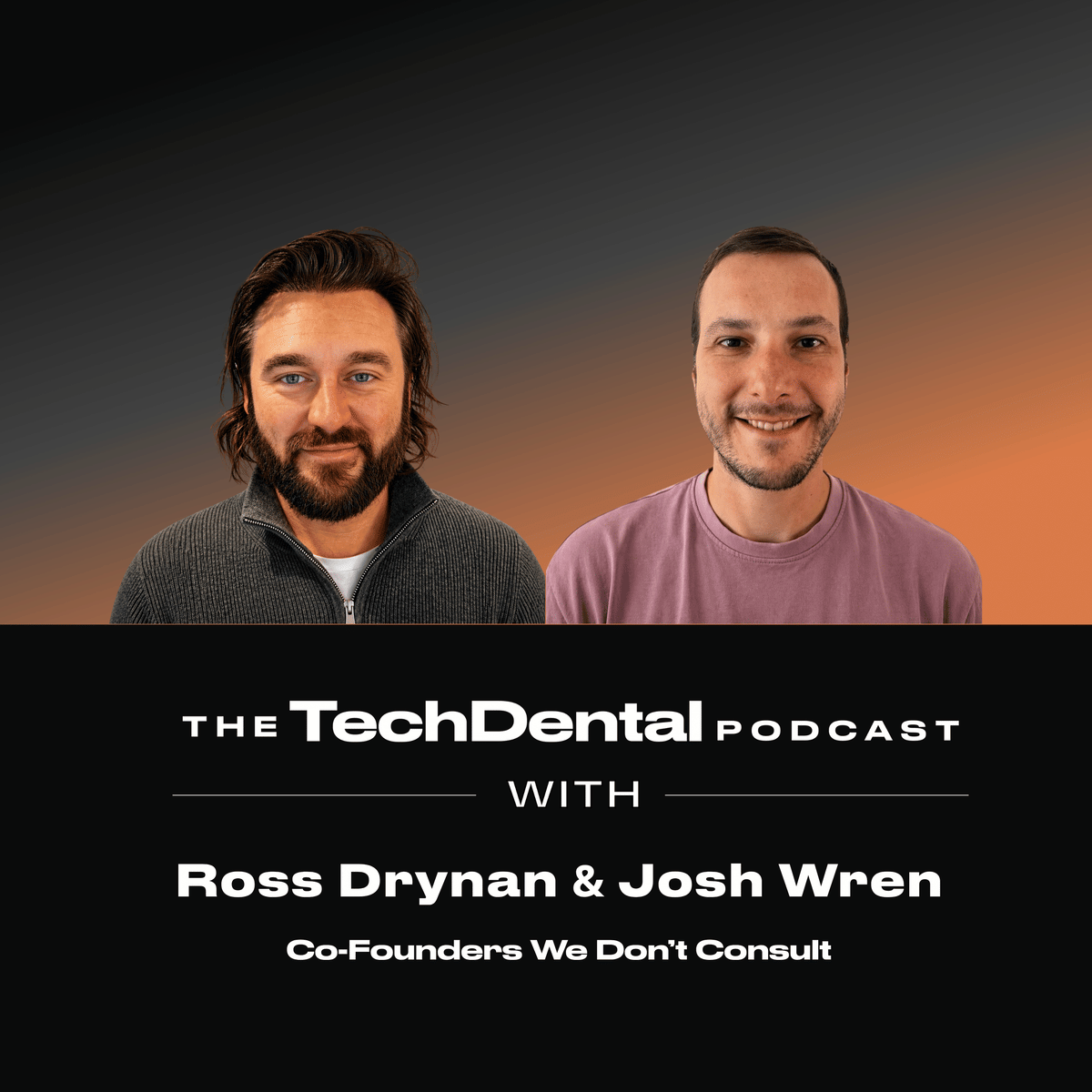
Ross Drynan spent over a decade at Henry Schein ONE. Josh Wren led sales there for years. Between them they watched every major UK dental tech product launch of the last decade. They saw the failures from the inside, before the press releases, before the rebrands, before the quiet wind-downs. They built the customer relationships, ran the partnerships, led the field sales, and then they left and started a company specifically to fix what they had watched go wrong over and over again.
That company is called We Don't Consult.
The name is the argument.
This is not a soft observation. It is a structural claim with significant commercial implications. And it has been validated repeatedly across the last decade of UK dental technology.
Why The Best Product Does Not Win
The intuitive model most founders carry into the dental tech market is that a superior product, deployed at the right time, will create its own pull. The best diagnostic AI will win the diagnostic AI category. The best practice management system will win the practice management category. The best patient communication tool will win the patient communication category.
This is not what actually happens.
"Actually the best product doesn't guarantee success. The thing that gives you the best chance is following a narrow set of disciplines in go to market that you can execute extremely well. And if you do that, you can probably beat those with products that are comparable or better than yours."
Ross Drynan
What actually happens is that the product with the most disciplined go to market wins, almost regardless of the underlying technical superiority of the alternatives. The dental tech graveyard is full of better products that lost to worse products with better execution.
The reason is not mysterious. Practice owners and DSO operators do not have the time, the attention, or the appetite to evaluate competing products on a purely technical basis. They are running clinical operations under operational pressure. The product they actually buy is the product that makes the case for itself clearly, addresses the structural pain they are already aware of, and demonstrates that the team behind it can actually deliver.
That is a sales and implementation problem, not a product problem.
Most dental tech founders get this exactly backwards. They invest disproportionately in product development on the assumption that the product will sell itself once it is good enough. They under-invest in the disciplines that actually decide the outcome. By the time they realise their product is not selling itself, the runway is gone, the team is exhausted, and the well capitalised competitor with a worse product has taken the category.
The Discovery Versus Demo Problem
Josh's framing of this is one of the most quietly devastating insights in the entire conversation.
"The times where it goes wrong is a really basic discovery, or no discovery at all. It's a product demo. And I've seen these countless times."
Josh Wren
Most dental tech sales calls open with the product. The founder, or the sales lead, walks the practice owner through the platform, demonstrates the features, shows the dashboard, runs the workflow. By the time the demo is over, the practice owner has either nodded politely and decided not to buy, or has bought something they will never deploy.
The discovery step that should have preceded this conversation was skipped, or rushed, or treated as a procedural formality before the real conversation about the product.
This is the moment most dental tech sales fail. Not at the point of pricing. Not at the point of contract. At the point of first contact.
A practice owner who is not problem aware cannot be product aware. They will sit through the demo, agree that the product looks impressive, and then go back to running the practice they were running before the meeting. The deal will not close. Or if it does close, the product will not get used.
"The biggest deals I've signed off on, the most compelling, I've been sold way before I've seen the product. I've been chomping at the bit for the solution, not really knowing fully what it does, but I've just built up such an impression of the organisation. It's the credibility of it."
Josh Wren
The discipline of discovery is not a soft selling technique. It is the structural prerequisite for any meaningful purchase decision in dental tech. The founders who internalise this build companies that grow. The ones who do not build companies that ship deals into pipelines that never convert.
The Story, The Alignment, And The Ability To Tell It
Ross's articulation of what actually determines whether a dental tech product gets adopted is worth quoting at length.
"It's the story, the alignment in the organisation. Your ability to go into a clinician who owns an organisation who is not problem aware, make them problem aware and show them a new way. It is then your ability to deliver outcomes in a structured way that they attribute to you. And then finally, it's down to your ability to tell that story."
Ross Drynan
Five disciplines, none of them about the product.
The story. The narrative the founder is telling about why this category exists, why now, and what changes for the buyer if they adopt.
The alignment in the organisation. Whether the founder's company is actually structured to deliver what the story promises, or whether the marketing department is making commitments the implementation team cannot honour.
The ability to make the buyer problem aware. The discipline of moving the buyer from unawareness, through awareness, into urgency, without rushing or skipping the steps.
The structured delivery of outcomes the buyer attributes to the founder's company. This is the part most founders miss completely. It is not enough to deliver value. The buyer has to be able to attribute the value to the right intervention. A successful AI deployment that the practice owner attributes to their own team's hard work is a churn risk dressed up as a renewal.
And finally, the ability to tell that story afterwards. Not just internally to investors, but externally to the market, to other practice owners, to the audience of buyers in the category who will make their decision partially on the basis of who else has made the same decision and what happened to them.
These are the disciplines. They are not glamorous. They are not the things that get talked about in product launch posts. But they are what decides whether the founder's company is around in five years or whether they are looking for a new role.
Why Partnerships Fail At The Signature
The other structural failure mode Ross and Josh saw repeatedly from inside Henry Schein ONE was partnership failure.
"Most partnerships fail the moment the agreement is signed. Both sides treat the signature as the win. It isn't."
Ross Drynan
The pattern is consistent across health tech. Two companies announce a partnership. Both press releases go out. Both teams celebrate. Both companies move on to their next priority.
Six months later, nothing has actually been integrated, deployed, or adopted. Eighteen months later, the partnership is quietly wound down, replaced, or simply forgotten.
The contract is not the outcome. The contract is the input. Everything that decides whether the partnership succeeds happens after the signature, and most of it requires a level of operational discipline that neither party committed to at the point of signing.
This is the structural reason We Don't Consult exists. The gap between what gets agreed in the contract and what gets delivered in practice is so consistent across health tech that an entire company can be built specifically to close it.
For dental AI founders entering into commercial partnerships right now, the question is not whether the partnership looks good on paper. The question is whether the partner has the operational discipline, the team structure, and the post-signature commitment to actually integrate, co-sell, and deliver. If those things are not in place, the partnership will fail. Not because the strategic logic was wrong, but because the execution discipline was absent.
The Uncomfortable Argument About AI And Jobs
The most provocative line in the conversation is Ross's, and it is worth sitting with.
"AI should take a lot of jobs, because a lot of jobs are dehumanising."
Ross Drynan
The mainstream argument is that AI taking jobs is a bad outcome that should be resisted or slowed. The honest argument is more uncomfortable. Many of the jobs that AI will replace are jobs that should never have existed in their current form. Repetitive, low judgement, soul eroding work that we kept giving to humans because we had no other option.
For dentistry, this argument has teeth.
The admin layer in most practices is exactly that kind of work. So is the manual scheduling, the chasing, the form filling, the data re-entry, the insurance reconciliation, the recall management, the patient communication that does not require clinical judgement. None of it is what people went into dentistry to do.
The interesting question is not whether AI takes those jobs. The interesting question is what the team does with the time afterwards. If the time gets redirected into deeper patient relationships, into clinical excellence, into the parts of the practice that compound, the practice gets structurally more valuable. If the time gets cut out of the cost base entirely, the practice becomes leaner but more brittle.
This is the question that should be sitting at the centre of every AI investment decision in dentistry right now. And it is being asked almost nowhere.
What This Means For Dental Tech Founders, Operators, And Investors
For founders, the implication is that under-investment in go to market discipline is the single most common cause of failure in dental tech. Product is the easy part. The sales motion, the discovery discipline, the implementation methodology, the partnership operational rigour, and the storytelling capability are what actually decide the outcome. Founders who under-invest in these because they believe a superior product will overcome them are systematically wrong.
For dental operators evaluating AI vendors, the implication is that the question to ask is not which product is best. The question to ask is which company has the operational discipline to actually deliver. Who is implementing this with you. Who needs to be involved for this not to fail. What checks are in place to ensure the AI is working.
For investors, the implication is that due diligence on dental tech startups should weight go to market capability significantly more heavily than it currently does. A founder with a mediocre product and disciplined execution will outperform a founder with a superior product and undisciplined execution. The investment thesis should reflect this asymmetry.
The graveyard of brilliant health tech products is not going to stop growing. The companies that avoid joining it are the ones that internalise this argument now, before the lessons cost them their next round, their next partnership, or their company.
Key Takeaways
The best product does not guarantee success. A narrow set of go to market disciplines does. Founders who under-invest in those disciplines build companies that fail regardless of how good the product is.
Discovery before demo is the single most underrated discipline in dental tech sales. Most founders skip it or rush it, and most deals die at the moment of first contact as a result.
The five disciplines that actually decide adoption are story, organisational alignment, problem awareness, structured outcome delivery, and the ability to tell the story afterwards. None of them are about the product.
Partnerships in dental tech fail at the signature, not at the implementation. The contract is the input, not the outcome. Founders entering commercial partnerships right now should diligence the partner's operational discipline far more heavily than their strategic logic.
The AI and jobs argument in dentistry is not whether AI takes the work. It is what the team does with the time afterwards. Practices that redirect the time into compounding activities get structurally more valuable. Practices that cut the time out of the cost base get leaner but more brittle.
The dental tech graveyard will keep growing. The companies that avoid it are the ones that learn this now.
This article draws on the TechDental conversation with Ross Drynan and Josh Wren, co-founders of We Don't Consult. Ross Drynan , Josh Wren and We Don't Consult. Full episode on Apple Podcasts, Spotify, and YouTube.
About TechDental
TechDental is a strategic intelligence platform for founders, executives, operators and investors shaping the future of dentistry. Through high-level analysis and systems-focused conversations, we explore how AI, governance frameworks and operating model design influence performance, scalability and enterprise value in dental organisations.
www.techdental.com | info@techdental.com
The future belongs to those who deploy technology with discipline.
Copyright Dr Randeep Singh Gill and RIG Enterprises Limited (Company No. 11223423) 2026. All Rights Reserved. TechDental is a trading name of RIG Enterprises Limited, incorporated in England and Wales on 23 February 2018, registered at 1a City Gate, 185 Dyke Road, Hove, England, BN3 1TL. Opinions attributed to named guests reflect the views of those individuals as expressed during recorded interviews. No part of this article may be reproduced without the prior written consent of RIG Enterprises Limited.