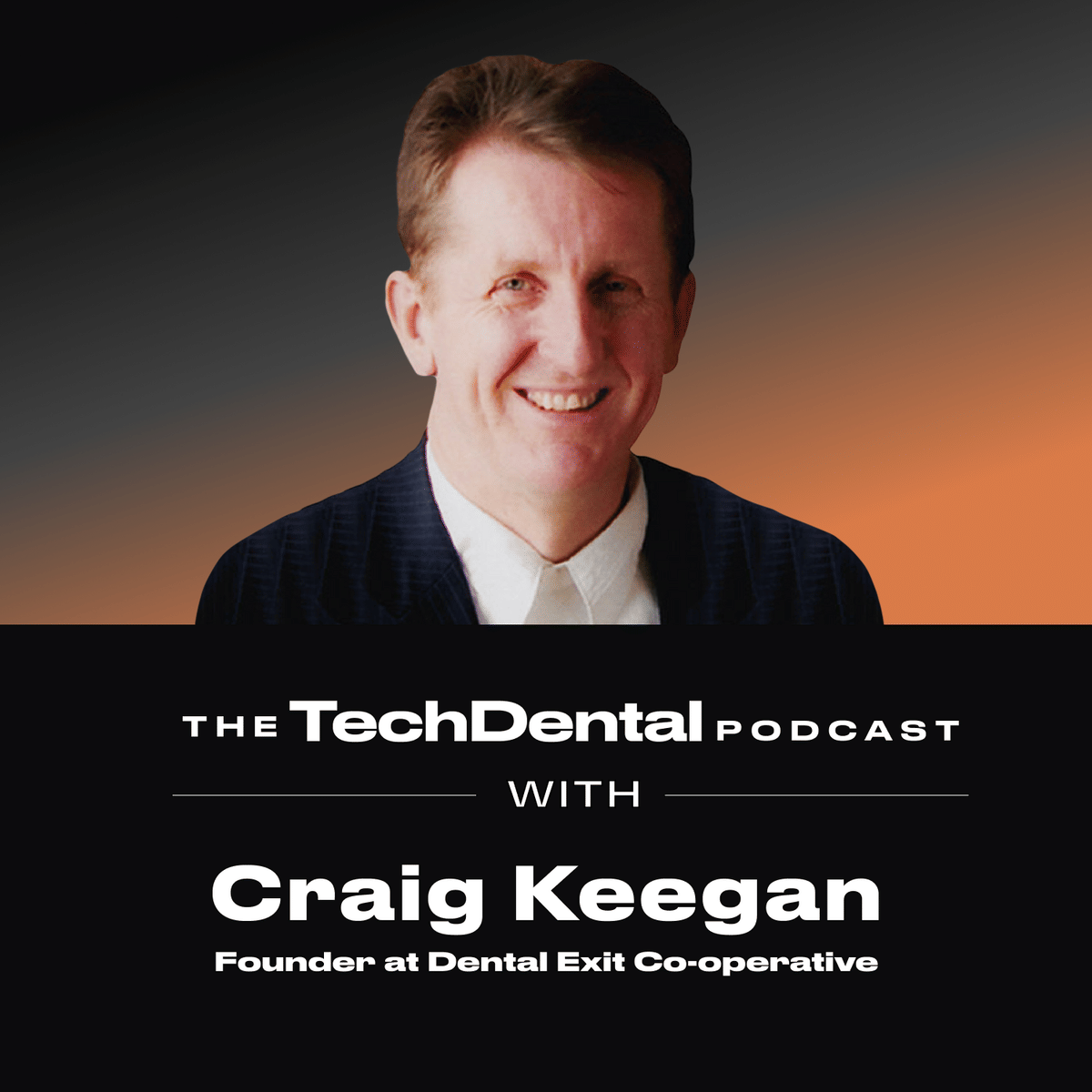
Direct answer: Most dental practice owners are working harder than their business value justifies. The gap between clinical revenue and true enterprise value is not a market problem. It is a systems problem. Craig Keegan, founder of the Dental Exit Cooperative, has spent two decades executing deals in the seven, eight and nine figure range across multiple sectors. His conclusion is consistent: practices that build the right operational infrastructure, implement AI in the right sequence and plan their exit from the moment they acquire can exit two or three times from the same business, generating multiples of what a traditional single sale would ever produce.
Why Do Most Dental Practice Exits Fail Before They Begin?
The majority of dental practice owners will sell their business once in their lifetime.
Most will leave significant value behind.
Not because the practice was not profitable. Not because the market was unfavourable. But because they never prepared it for sale in the way that maximises the multiple a sophisticated buyer is willing to pay.
Craig Keegan has watched this pattern repeat across sectors for two decades. When he turned his attention to dentistry, he recognised something familiar from his work in aged care.
"They're incredibly compassionate people, they believe in their clients and their clients' welfare, and they're incredibly skilled at what they do. But what they don't do, they don't do all of business. And businesses are made up of about 13 different pillars. And if you haven't got each one of those pillars working, it's just not going to work for you the way that it should."
The consequence is predictable. A practice owner works hard, generates good revenue and builds what feels like a thriving business. But from a buyer's perspective, what they have built is a job. The revenue is dependent on their presence. The systems depend on their decisions. The value walks out of the door with them.
"They're working really hard, they're making good money, but the value of their so-called business is not going up the way that it should be because they're working a job in essence."
This distinction, between a business that creates value independently of its owner and a practice that requires the owner to function, is the single most important concept in dental exit planning.
Everything Keegan has built through the Dental Exit Cooperative is designed to close that gap.
We examined how operational dependency on the principal affects practice value in Scaling Dentistry Without Breaking It
What Is the Right Way to Think About Dental Practice Systems?
The most common mistake dental practice owners make with business improvement is attempting to implement everything at once. The highest-return approach is to isolate one process, make it work correctly, document it and then move to the next.
This is not a philosophy of caution. It is a philosophy of compounding.
Keegan illustrates the principle with a case study that initially sounds trivial and turns out to be precise.
At a healthcare institution, he identified a five-figure annual saving by rotating one person twenty centimetres to the left and redirecting a category of waste into a different bin. The recycling cost disappeared. The saving was immediate and permanent.
The point is not the recycling. The point is the diagnostic approach.
"Sometimes that's all it takes is someone walking in with a different set of glasses and a different view and just making that 20-centimetre movement to the left to do something slightly different."
Most dental practices have dozens of these opportunities sitting unnoticed across their operational pillars. Finance, insurance, patient communication, staff scheduling, contract management, compliance. Each one represents a potential saving or efficiency gain that, once captured, can be replicated across every additional site in a group.
The process Keegan uses to surface these opportunities is methodical. Before engaging with any practice, he requires the principal to complete detailed forms documenting their day-to-day activities.
"In those forms, it will have: what do you do on a day-to-day basis? How long does it take you? What's the resource? Who's the person that is doing this? What's the value of that resource on an hourly basis? And then it does all the calculations to demonstrate to the owner how much these little tasks are costing them."
Most practice owners have never quantified the cost of how they spend their time. When they do, the picture is frequently striking. Hours of high-cost principal time consumed by tasks that could be systematised, delegated or automated.
That documentation exercise is the foundation of everything that follows, including the AI implementation strategy.
Where Is AI Genuinely Reshaping Dental Operations and Where Is It Still Noise?
AI is delivering measurable value in dental operations today in four areas: diagnostic accuracy through collective data analysis, patient monitoring through home-based assessment tools, financial transaction verification and fraud detection, and contract analysis. The noise is coming from practices that are attempting to implement AI without first fixing the underlying processes it is meant to serve.
Keegan's framing of AI in dental practice is one of the most operationally grounded assessments currently available.
His starting point is clear: the noise is not coming from people who are actually using AI effectively.
"The noise and hype is not coming from the people that are using it and that are implementing it. It's coming from everybody else that has no idea what to do with it and how to implement it. The people that are actually doing it are too busy getting it right and making it work."
The diagnostic application illustrates the potential at its most compelling. Keegan reframes the value proposition of AI-assisted diagnosis through the lens of a personal experience with a biopsy.
The relevant question is not whether one dentist can assess a scan accurately. It is whether the assessment would benefit from the pattern-matching capability of a million equivalent cases.
"Do I want one dentist looking at that biopsy, or do I want a thousand dentists through that have all looked at the same sort of thing, and then a thousand cases each for those dentists over the last 20 years? So I'm getting a million dentists basically looking at my one thing."
That is the clinical value proposition of AI diagnostic tools in plain terms.
The operational applications are equally significant. Keegan points to real-time transaction verification as an immediate and practical use case. Internal fraud between practice front desks and bank accounts is a documented problem. AI-powered transaction matching provides instant verification and automated alerts, closing a vulnerability that manual oversight routinely misses.
Contract analysis is another underused application. Insurance agreements, lease arrangements and supplier contracts contain clauses that can cost practices significant sums if not identified and managed. AI tools can analyse these documents in seconds and surface the relevant terms in plain language.
"With these tools, we're going to be able to analyse those contracts and actually understand them. Look for the clauses that are going to bite us later on."
The warning Keegan issues is equally important. AI deployed into a broken process does not fix the process. It accelerates the dysfunction.
"If you put that AI into something and it's not right, if you haven't got that system, that process set up, then all you're going to do is make it 10 times worse."
He cites an Australian bank that replaced 800 employees with AI on a Friday and were back recruiting those same employees by the following Wednesday. The failure was not the technology. It was the absence of tested, documented processes for the AI to operate within.
The principle for dental practices is identical. Fix the process first. Then implement the AI that serves it.
We examined why AI implementations fail when the operational foundation is not in place in People-First AI: Why Most AI Projects Fail in Dentistry
How Does AI and Data Infrastructure Affect Practice Valuations During Due Diligence?
AI and operational data infrastructure are beginning to influence dental practice valuations, primarily by demonstrating that the business can function independently of the principal. Practices where AI has reduced the founder's after-hours workload from three to four hours per night to thirty minutes present a materially different risk profile to buyers and command higher multiples as a result.
This is the commercial logic that connects the operational and the transactional.
Buyers, whether private equity, corporate groups or individual acquirers, apply a multiple to the underlying profit of a business. That multiple is influenced by risk. The single largest risk in most dental practice acquisitions is principal dependency.
"Where you're directly seeing it is where the dental founder of the practice is involved primarily. Because what we're finding is that AI is taking on some of those tasks and thereby reducing their after-hours work. They might be putting in three, four hours after hours each night, that's now being reduced to 30 minutes. That has a huge impact on the EBITDA and the valuation of the practice, because if you can take the founder out of the practice and put someone else in there, that's where the buyers actually see the true value."
The valuation impact operates through two mechanisms.
The first is direct: reduced principal involvement lowers the risk premium buyers apply and supports a higher multiple on the existing EBITDA figure.
The second is indirect: a practice with documented, AI-assisted systems demonstrates operational maturity. It signals to buyers that the business has been built with transferability in mind, which increases buyer confidence throughout the due diligence process and reduces the friction that causes deals to slow or fail.
The sequencing matters here. Keegan is explicit that the path to a high-quality exit runs through operational improvement, not directly to a transaction conversation.
"I keep saying focus in on the processes and the systems. We just take one of those, just one, and we get that right. Then you move on to the next one and you get that right. And you make these processes isolated so that they are not going to be interfered with any other process."
Once those processes are functioning correctly in one practice, they can be replicated across multiple sites in a roll-up without replicating the problems alongside them.
"If you've got it right in one and it's working, you can take it to another. If you've got it wrong at one and you try and take it to another, now you've just doubled your problems, tripled your problems. But if you get it right, then you move it on to all the others."
What Is a Dental Roll-Up and How Does It Unlock Value That Individual Practice Sales Cannot?
A dental roll-up is the aggregation of multiple independent practices under a single operational platform for the purpose of achieving a group valuation that exceeds the sum of individual practice values. The multiple arbitrage created by rolling up into a portfolio of thirty or more practices allows individual owners to realise between two and three times the exit value they would achieve by selling independently.
This is the mechanism at the core of the Dental Exit Cooperative model and one of the most underexplored value creation strategies in UK dentistry.
Keegan sets out the arithmetic directly.
A practice generating a valuation of £1.5 million on current performance can, through a structured growth programme over three years, be grown to a £2 million EBITDA business. Sold individually, that is a £2 million exit.
Sold as part of a group of thirty practices to a private equity buyer, the group valuation is a multiple of the combined EBITDA, not the individual practices. The same £2 million practice now contributes to a much larger transaction at a significantly higher group multiple.
"Their business is worth 1.5 when I walk in the door and say hello. We put it into the shared business group, we'll grow it to two million. Then, because I just happened to have another 29 dentists just like you, I'm now bigger, I'm more valuable."
The owner receives 70 per cent of the value attributable to their practice within the group transaction. On a £2 million underlying business sold at the group multiple, that equates to approximately £4.2 million in immediate proceeds.
"They're getting paid out at 70% of that. So it was valued at 1.5, it's now valued at two. We're selling it for six. They're getting paid out at 70% of that, so that's 4.2 million. That's for a business that's only worth two million if they went and sold it by themselves. They sell it with me, that's what they're going to get."
The remaining 30 per cent, approximately £1.8 million, stays invested in the private equity vehicle.
How Can Dental Practice Owners Exit Two or Three Times From the Same Business?
The multiple exit model works because private equity acquirers are structurally required to sell their portfolio within five years. The retained equity stake from the first transaction participates in the value growth of the second sale, which can itself generate a further retained stake that compounds into a third transaction. A practice owner who enters this cycle at £1.5 million can realistically exit with north of £10 million across two or three transactions from the same underlying business.
This is the concept that most dental practice owners have never been introduced to, and it fundamentally changes the return profile of practice ownership.
Keegan walks through the mechanics.
First exit: practice valued at £2 million within the roll-up, sold at group multiple for £6 million. Owner receives £4.2 million and retains a £1.8 million stake in the acquiring private equity vehicle.
Private equity is required by its fund structure to exit within five years. During that period, the portfolio grows. The retained £1.8 million stake, invested in a portfolio that the private equity firm is actively working to grow, is likely worth approximately £5 million at the time of the second exit.
"That private equity firm, what have they got to do? They've got to sell this again in five years. That 1.8 million is probably going to be worth about 5 million at that timeframe."
The owner does not have to exit fully at the second transaction. They can extract half, £2.5 million, and retain the remainder for a further five-year growth cycle.
"You can if you want to. Why not just take half? Stick another 2.5 million in there. Leave 2.5 million in there. Leave it for another five years where it'll grow up to what, six million? So you can exit two or three times this way. And you will make more and more each time you exit."
The total realised across this model, for a practice that enters the process at £1.5 million, can credibly reach eight figures across two or three transactions spanning ten to fifteen years.
That is a fundamentally different conversation from the traditional dental exit model.
What Deal Structures Should Dental Practice Owners Accept and Which Should They Avoid?
The most important deal structure distinction for dental practice owners entering a transaction is between private equity buyers and family equity buyers. Private equity is contractually required to exit within five years, which creates a definable and predictable timeline for earn-out completion. Family equity buyers have no such obligation and can hold indefinitely, delaying or preventing earn-out payments for years.
Keegan is direct on this point, and the distinction has significant practical implications for any practice owner evaluating offers.
"I don't think the PEs are the problem. What I would be very careful of is the family equity businesses. They're the ones that I would stay well away from. The reason for that is private equity needs to turn over the business every five years. The family businesses, they don't. They can keep them for much longer, which means you don't get paid out."
His second structural principle is equally clear. Always structure a dental practice acquisition as an asset purchase, not a business purchase.
An asset purchase acquires the operational assets of the practice, the equipment, the patient database, the goodwill, without acquiring the legal liabilities of the entity that owned them.
"I don't want the liabilities of the business. I don't want the legal suits of sexual harassment or whatever it is that's going on there that I won't hear about for another three years after I take over the business. I just want a nice clean purchase of a business that I can build and make better."
The due diligence framing is worth understanding from both sides of the table. From a seller's perspective, due diligence preparation begins three years before the intended exit date. From a buyer's perspective, there is a point at which continued pressure on the target business creates relationship damage that undermines the post-acquisition performance that justified the purchase price.
"There will be resistance, there will be lag, but you've got to have a good relationship. And if you keep pressuring them, there will not be a good relationship."
The statistic Keegan cites on M&A performance is sobering context for any practice owner considering a sale outside a roll-up structure: 83 per cent of mergers and acquisitions do not achieve their financial expectations within the first three years.
The leading cause is staff attrition. The average transaction loses 20 per cent of staff in the first year. The retention model Keegan advocates is straightforward: ask every key person where they want to be in three years and design a role that takes them there.
"Find out what these people want. That's how you do retention. Some will want money. Some won't. Some will want other things. But you don't find out that unless you ask them the question."
What Is Post-Sale Regret and How Do Dental Practice Owners Avoid It?
Post-sale regret is the experience of loss of identity, purpose and structure that affects a significant proportion of dental practice owners following an exit. It is predictable, preventable and best addressed by restructuring the founder's role within the acquiring organisation rather than creating a clean break from the business they built.
This is one of the least discussed and most consequential elements of the dental exit conversation.
Practice ownership is identity as much as occupation for many dental professionals. The practice is the structure around which professional relationships, daily routine, status and purpose have been organised for years or decades. When that structure disappears at a single point in time, the psychological and personal consequences can be significant.
Keegan's approach is to treat post-sale regret as a structural risk that should be designed out of the transaction, not a personal outcome that the founder must manage on their own.
The mechanism is role redesign.
A principal who does not want to continue clinical work but has operational knowledge of their market might become a regional or state manager for the group of practices they have just contributed to the roll-up. The transition is not from ownership to retirement. It is from practice ownership to group leadership.
"What do the next three years hold for you? Well, I want to go out and I want to do some business stuff and I want to do some administration stuff. Fine. Why don't I make you the state manager? And you can run all these. Would that be okay with you?"
The same logic applies to other key staff. A practice manager who has reached the ceiling of their current role might be invited to lead a cluster of five practices across the group.
The underlying principle is consistent with everything else Keegan advocates: ask people what they want before assuming you know.
"I want them to exit not just once, maybe twice, maybe three times, and take away a fortune that they've never even dreamt of."
What Does the Future of Dental Practice Ownership Look Like in the Age of AI?
Over the next five years, AI will compress the private equity hold period in dental group transactions, accelerate the shift towards preventive and home-based patient monitoring, and enable hyper-personalised population-level care predictions. The practices positioned to benefit are those that have built clean operational systems today that AI can serve rather than expose.
Keegan's forward view is characterised by genuine optimism about the clinical and commercial potential of AI in dentistry, grounded in a clear assessment of where the profession currently sits in the adoption cycle.
The patient monitoring revolution he describes is already beginning.
"Where we're going to be going very soon with dentistry is home kits. The home kits, where they can go in and they can hire out for a night a tool to go into your mouth, take photos of your mouth, check your mouth out, and they'll do that every three months rather than every six months."
The revenue implications are compounding. A hiring fee for the device. A processing fee for the assessment. A higher appointment frequency for patients flagged as requiring closer monitoring. All of this delivered without the friction of a full clinical appointment.
The predictive analytics application is where Keegan sees the most transformative long-term potential.
"We're going to be able to predict gum disease and be able to say, okay, you're in this demographic, you're living in this region, you're going to get gum disease in the next 18 months. We're going to put a programme in place right now to prevent that from happening."
That level of population-level, individual-specific prediction is not science fiction. It is the logical output of the data accumulation that AI diagnostic platforms are already beginning to build.
For practice owners evaluating where to invest in the current cycle, the implication is clear. The practices that build structured, documented, AI-ready operational systems today will be the practices that can absorb and act on that predictive capability when it arrives.
The people dimension remains non-negotiable throughout.
"This is all about people. Everything. It's all about people. The AI, the roll-ups, the client, everything comes back to the people side of it."
We examined the relationship between technology adoption, operating model design and long-term practice value in AI Didn't Fix Dentistry. Intelligence Will.
Key Takeaways
Most dental practice owners are building a job, not a business. The gap between clinical revenue and enterprise value is a systems problem, not a market problem.
AI deployed into a broken process makes the dysfunction worse, not better. Fix the process first, then implement the AI that serves it.
The highest-impact AI applications in dental practice operations today are diagnostic analysis, home-based patient monitoring, real-time transaction fraud detection and contract analysis.
AI that reduces a principal's after-hours workload from four hours to thirty minutes directly increases the EBITDA multiple a sophisticated buyer will apply.
A practice owner who sells independently for £2 million can realistically achieve £4.2 million in the same transaction through a roll-up structure, with additional retained equity participating in two or three further exit events.
Private equity is structurally preferable to family equity in dental transactions because the five-year exit requirement creates a predictable and definable earn-out timeline.
83 per cent of mergers and acquisitions do not achieve their financial expectations within three years. The primary cause is staff attrition. Retention starts with asking people where they want to be in three years.
Post-sale regret is preventable. The solution is role redesign within the acquiring group, not a clean break from the business the founder built.
Exit preparation starts on the day of acquisition. A three-year preparation window is the minimum for meaningful valuation optimisation.
About TechDental
TechDental is a strategic intelligence platform for founders, executives, operators and investors shaping the future of dentistry.
Through high-level analysis and systems-focused conversations, we explore how AI, governance frameworks and operating model design influence performance, scalability and enterprise value in dental organisations.
If you are building, scaling or investing in dentistry and want independent, systems-level insight into AI, governance and capital readiness:
For strategic advisory, board briefings or keynote speaking enquiries: www.techdental.com/advisory
The future belongs to those who deploy technology with discipline.
© 2026 RIG Enterprises Limited. All Rights Reserved. This article was authored by Dr. Randeep Singh Gill and is published under the TechDental brand, a trading name of RIG Enterprises Limited (Company No. 11223423), incorporated in England and Wales on 23 February 2018, registered at 1a City Gate, 185 Dyke Road, Hove, England, BN3 1TL. All editorial content, analysis, synthesis and intellectual property contained within this article are the original work of the author and remain the exclusive property of RIG Enterprises Limited. Opinions and statements attributed to named guests reflect the views of those individuals as expressed during recorded interviews and are reproduced here for editorial and informational purposes. No part of this article may be reproduced, distributed, transmitted, republished, or otherwise exploited in any form or by any means, whether electronic, mechanical, or otherwise, without the prior written consent of RIG Enterprises Limited. Unauthorised reproduction or use of this content may constitute an infringement of copyright under the Copyright, Designs and Patents Act 1988.