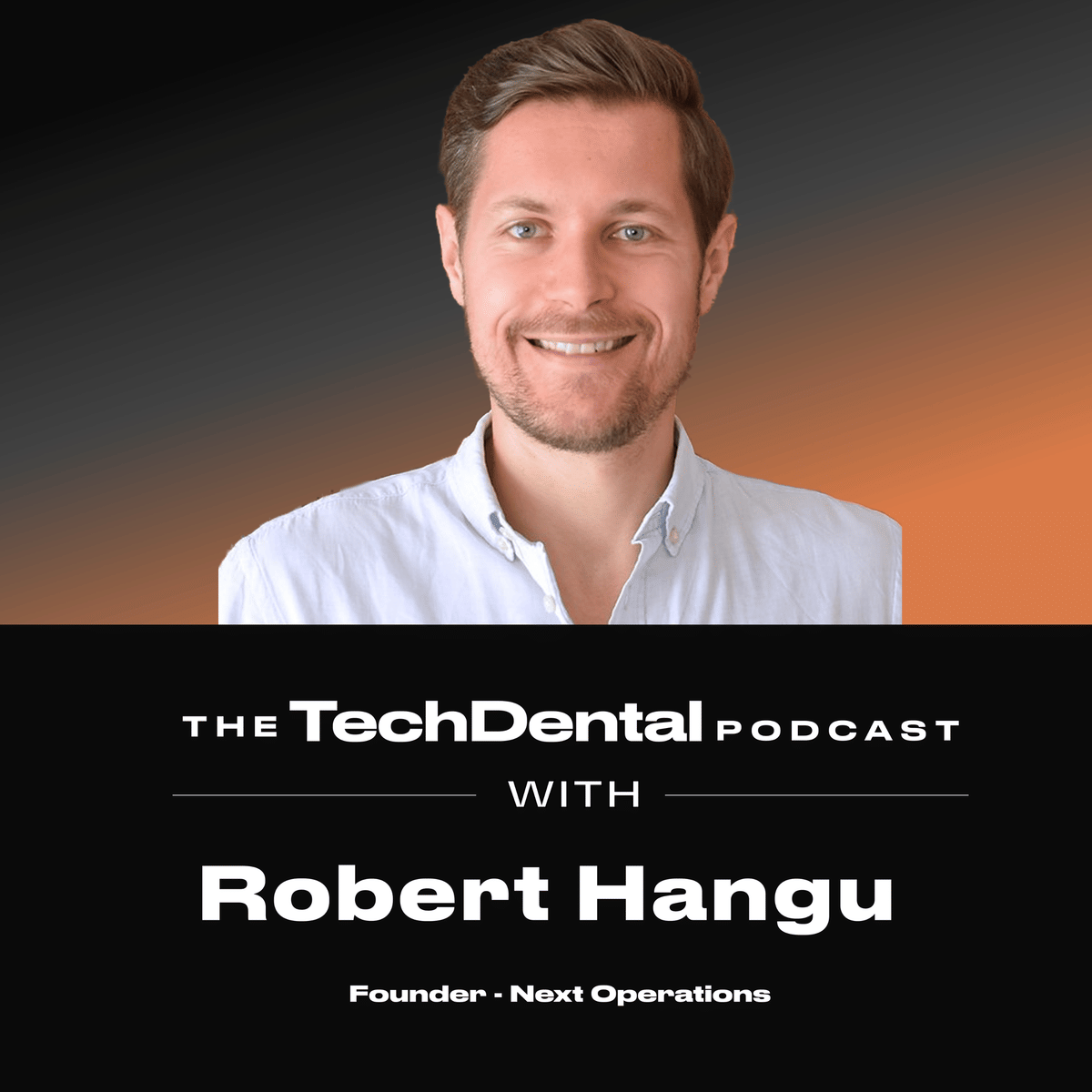
Direct answer: Robert Hangu, founder of Next Operations, argues that the single most costly mistake dental groups and practice owners make with AI is deploying it before they have structured, documented and audited the workflows, decision rules and data that the AI will be trained on, producing systems that embed the same operational dysfunction at scale rather than eliminating it. Drawing on experience designing AI-powered call handling and front-desk systems across healthcare, property management and home services businesses, Hangu demonstrates that 30% to 40% of inbound calls are missed by even high-performing reception teams during peak periods, and that a further 20% to 30% of calls occur outside opening hours when no human is available to respond. His core argument is that AI does not create operational leverage, it amplifies whatever operational discipline already exists, which means the practices that will gain the most from AI are those that have done the foundational work of documenting their processes, cleaning their data and assigning ownership over decisions before any technology is introduced. The primary action for UK dental leaders is to treat AI readiness as a systems audit rather than a technology purchase, because the value of the tool depends entirely on the quality of what is underneath it.
There is a phrase Robert Hangu uses that cuts through most of the noise in the current dental AI conversation: AI does not create discipline, it enforces whatever discipline already exists. It is a short formulation with significant operational consequences. Every practice management consultant, every technology vendor and every conference keynote in the dental sector is currently promising that AI will transform operations. What Hangu is saying, based on hands-on experience deploying AI systems across high-volume call environments in healthcare and adjacent industries, is that transformation requires something to transform from, and if what the AI finds underneath is fragmented data, undocumented workflows and unassigned decision ownership, the transformation will be a faster version of the existing dysfunction.
He describes the wave of AI enthusiasm that arrived in the dental sector from late 2022 onwards with a term he coined early: AI cowboys.
"It was this hype that AI can do everything, and you would have these people who came from adjacent industries, particularly tech, especially marketing and sales, and they would repackage themselves as AI specialists. They were lacking the solid foundations, the decision-making skills to decide which system to choose over the other. Plus they were very loud and outspoken on LinkedIn. So that reminded me a lot of cowboys."
The image is precise. Cowboys move fast, make noise and often extract value from land they do not own and will not maintain. The dental practices that bought AI tools from loudly self-branded specialists in 2023 and 2024 are, in many cases, now sitting with implementations that answer basic FAQs about opening hours but cannot book an appointment, cannot check for scheduling conflicts and cannot integrate with the practice management system. The tool was purchased. The system never existed.
Hangu's work at Next Operations starts where most AI vendors finish. Before any technology is specified, before any agent is built, before any prompt is written, he sits with the humans who hold the knowledge the system will eventually need to carry.
The Silent Revenue Leak That Every UK Practice Has But Almost Nobody Measures
The case Robert Hangu makes for AI-powered call handling is grounded in numbers that practice owners consistently underestimate until they measure them for the first time.
"Even the best front desk teams miss 30 to 40% of incoming calls during peak time. And 20 to 30% of calls happen out of the opening hours. Most clinics have an autoresponder or they redirect the potential patients to their website to book an appointment. They think they feel like they are covered by this."
They are not covered. A patient calling during the lunch rush, when the reception team is managing arrivals, handling checkout, answering questions from a patient in the waiting room and trying to process end-of-morning notes simultaneously, has a coin-flip chance of being answered. A patient calling at 7 p.m. on a Tuesday to book an urgent appointment gets an autoresponder message and, if they are motivated enough, a web booking form that may or may not show them the right clinician type or the right appointment category.
But the patient calling a different practice, one that already has an AI-powered voice agent with deep integration into its practice management system, gets through immediately. Their question is answered. Their appointment is booked. They do not call back.
"Not picking up the phone means basically losing real revenue. And we often see that these front desks don't have a written system or process. So the first thing we do is we try to gather all the knowledge that they have, try to structure it in a proper way, create core scripts, and then we feed it into the AI and train it."
The financial model here is not speculative. For a UK private dental practice seeing 80 to 100 new patient enquiries per month, a 30% miss rate at peak time represents 24 to 30 conversations that never happened. At an average new patient value of £500 to £800 across initial examination and subsequent treatment, the monthly opportunity cost of an unstructured phone handling operation is measured in thousands of pounds, not hundreds. At group level, across ten or twenty practices, the number becomes material enough to show up on an EBITDA conversation.
What makes this leak particularly insidious is that it is invisible to the practice. The calls that were not answered do not appear in any report. There is no missed opportunity line in a practice management dashboard. The revenue was never booked, so it cannot be tracked as lost. It simply never existed, and leadership has no mechanism to see what they are missing without specifically instrumenting their phone infrastructure to capture the data.
For analysis of how the front-of-house communication function in UK dental practices has been reframed as a revenue asset rather than a cost centre, see The Front Desk Is a Revenue Engine, Not a Cost Centre: How Automation and AI Are Transforming Dental Operations.
Surface Integration vs. Deep Integration: Why the Distinction Defines ROI
One of the most practically important contributions Robert Hangu makes in this conversation is his delineation between what he calls surface level integration and deep, API-level integration. The distinction is not technical pedantry. It is the difference between a tool that answers questions and a tool that replaces a workflow.
"Surface level integration is a very simple voice solution or AI voice agent that just answers very simple questions like, when are your opening hours or where can I find your clinic or do you offer parking? And the problem with these solutions is they don't really offer deep help, deep information. Because most of the time the patient wants to know about what the clinic offers, or they want to book an appointment right away. And they don't want to have a double booking."
A surface-level agent can be built in hours using a general-purpose large language model, a basic FAQ document and a voice interface. It costs very little and it does very little. It cannot access the practice's appointment schedule. It cannot check clinician availability. It cannot know that the requested appointment slot was filled three minutes ago by a patient who called on the other line. When it attempts to confirm a booking, it either fabricates an outcome or kicks the patient to a human anyway, negating the purpose of the automation.
Deep integration means the AI agent has live, read and write access to the practice management system. It can query current availability, confirm the appointment type against the correct clinician profile, book the slot, send confirmation and update the patient record, within a single, continuous call.
"Think of it as a human receptionist, but available 24/7 around the clock. They don't get tired. This is why this deep integration is so important, because only that level of integration allows for a real offloading of work from the front desk to the AI."
For UK dental group operators currently evaluating AI call handling products, the question to ask of every vendor is specific: does your system write to the practice management system in real time, or does it generate a booking request that still requires human confirmation? The answer to that question will tell you whether you are buying deep integration or surface automation, and the difference in operational value between those two things is not incremental. It is categorical.
The Data Problem That AI Doesn't Solve and Leaders Often Don't See
The most structurally underappreciated insight in Hangu's analysis is his account of how fragmented data and undocumented workflows interact with AI training. Most dental leaders understand, at some level, that AI requires clean data to perform well. What they typically underestimate is how much of the operationally critical data in their practice has never been written down anywhere.
"Most of the day to day practical things, they're unspoken. Maybe a front desk might have a particular script that they have been trained on, but then over time, over the months and years that they work in the clinic, some things might change. They might adopt their own style, or they might realise some things work, some things don't. And oftentimes they don't get back to change that script."
The consequence of training an AI system on outdated or incomplete documentation is a system that behaves according to the written rules rather than the operational reality. It will quote appointment policies that changed eight months ago. It will follow a call script that the front desk stopped using after finding that a different sequence worked better with anxious patients. It will handle payment discussions in the way the practice intended when it opened, not in the way the practice actually handles them now.
"We end up training the system with a particular script. But then when we test it with the actual front desk or with particular patients, then we get the feedback: why doesn't the AI respond in such and such way? And then we realise that the expectation was different than the actual training data, because there was never a time when somebody got back and rewrote the data."
This is not a technology problem. It is a knowledge management problem that technology has made newly urgent. The unwritten operational knowledge held in the heads of experienced reception staff, the institutional memory of how things are actually done rather than how they were designed to be done, is precisely the knowledge that an AI system needs to function effectively, and it is the knowledge that no practice has ever previously had a reason to formally extract and document.
Hangu's process addresses this directly. His engagement begins with a structured knowledge-gathering exercise that interviews every stakeholder involved in patient-facing communication, maps the actual workflows against the documented ones, identifies the gaps, and produces a training corpus that reflects operational reality. Only then does the AI training begin.
For a discussion of how data hygiene and workflow documentation underpin AI readiness in dental group operations, see AI Didn't Fix Dentistry: Intelligence Will.
AI as a Valuation Lever: What Sophisticated Buyers Actually Look For
Hangu's perspective on how operational AI infrastructure affects the valuation and transactability of a dental business is directly relevant to the current consolidation dynamics in UK dentistry, where private equity-backed DSOs, emerging groups and trade acquirers are actively competing for independently owned practices.
His framing is precise and commercially grounded. AI does not create a premium in its own right. What creates a premium is the operational reality that well-implemented AI reflects: a practice that can serve more patients with the same headcount, that has documented and repeatable processes, and that is not dependent on specific individuals to function.
"If leveraged correctly, AI can be an enormous operations automator. You can have the same clinic serve more patients and have more revenue with the same staff. That means you have increased revenue with the same expenses, which also means you can expand your operations to a second location, a third location, with the same staff."
The financial model underlying this argument is straightforward and maps directly onto how acquirers evaluate dental businesses. A practice generating £1.2 million of revenue with a headcount that can absorb £1.5 million of revenue, because AI handles the scheduling, recall, FAQ triage and out-of-hours inquiry functions, has a structural profitability advantage that compounds at scale. Each additional location added to the group inherits the same AI infrastructure without a proportional increase in administrative headcount.
Beyond the unit economics, Hangu identifies a softer but equally significant signal that AI-ready operations send to sophisticated buyers.
"Going beyond that, it also shows that the business owner has a proactive attitude, that they think in terms of adopting new technologies, in terms of making things more efficient. These are also signs that they might be somebody who's easy to work with to make the transition to the new owner as easy as possible."
In the context of dental practice acquisitions, the transition risk, the period between deal completion and operational stabilisation under new ownership, is consistently identified as one of the most significant sources of value erosion. A practice whose operations are documented, systemised and partially automated carries substantially lower transition risk than one where the operational knowledge lives entirely in the principal's head. That risk differential has a real value in any acquisition conversation.
For analysis of how operational readiness and technology infrastructure affect the value of UK dental practices in a consolidation market, see The Great Dental Reset: Why 2026 Will Reward the Prepared, Not the Big.
Building an AI-Native Dental Organisation: Where to Actually Start
Hangu's description of what an AI-native dental organisation looks like in practice rather than theory is notable for beginning with attitude rather than architecture. The technology decisions are secondary. The first question is whether the leadership has the orientation to make the technology deliver anything useful.
The objections he encounters most often from practice owners are predictable, and he addresses each of them directly.
"Many clinic owners, when they first get in touch with the possibilities of AI, start to be scared. They would say something like: but we already have a great front desk, we don't need AI. Or: we are too small for AI. Or: AI won't work for us. But actually these are exactly the reasons why they need AI."
The "great front desk" objection is the most important to unpick. The front desk team can be genuinely excellent and still structurally incapable of answering every call during a busy clinical morning, or responding to a booking request at 9 p.m. The quality of the human team and the capability of AI to extend that team's reach are not in competition. They are additive. The practice that frames them as competitive will underinvest in automation and continue to lose the out-of-hours and peak-time calls that its team cannot physically handle.
The size objection is similarly misplaced. A single-site private practice receiving fifty to sixty new patient enquiries per month has as much to gain from AI call handling as a ten-site group. The revenue at risk from missed calls scales linearly with enquiry volume, and the cost of an AI voice agent does not scale proportionally.
Beyond the attitudinal prerequisite, Hangu identifies two structural requirements for building AI-native operations. First, the commitment to extract and document the knowledge currently held only in people's minds. Second, the willingness to treat the initial AI implementation as the beginning of an iterative improvement process rather than a completed project.
"Once they're open to it, it's actually being ready to put in this extra work to make AI work. Collecting all the data from the silos, from the heads of the employees, of the operators, and putting them all in a structured manner. And as they go along, as they are using AI, actually refining the system, coming back every once in a while and saying: what can we improve now?"
The performance ceiling of the AI system is not set at the moment of deployment. It is raised iteratively as the organisation learns what the system handles well, what it mishandles, what new scenarios arise that were not anticipated in the original training, and what the patients' actual experience of the system reveals about the quality of the underlying documentation. The practices that treat this iterative refinement as ongoing operational discipline, rather than a post-launch burden, are the ones that achieve the 2× to 5× operational efficiency gains Hangu cites as the upper end of what well-implemented AI delivers.
The Three Signals That Define AI Readiness
Hangu's lightning round answers at the close of the conversation are worth treating as a diagnostic checklist for UK dental leaders assessing their own AI readiness.
On the manual task in dentistry that should already be obsolete, his answer is immediate.
"It's definitely appointment booking."
Manual appointment booking in 2026, whether handled by a human answering a call, a patient navigating a web booking form, or a front desk staff member processing a request that came in overnight by email, represents unnecessary friction in a transaction that AI can handle more accurately, more quickly and at any hour. The continued prevalence of manual appointment booking in UK dental practices is not evidence that the problem is difficult. It is evidence that the operational infrastructure to solve it has not yet been built.
On the red flag he looks for when reviewing AI implementations that have already been deployed.
"It's the quality of the training data and the structure of how these documents are being fed into the AI."
This is the diagnostic test that reveals whether a practice has bought an AI tool or built an AI system. A tool has been configured with general-purpose information and launched. A system has been trained on practice-specific, accurate, up-to-date documentation that reflects actual operational reality. The distinction between them, in performance terms, is the difference between an agent that frustrates patients and an agent that handles their needs completely.
On the skill future dental leaders must develop beyond clinical excellence.
"They must develop a sense of whether a particular automation can help that particular situation."
This is not a request to become technically literate in machine learning or prompt engineering. It is a request to develop the operational judgment to distinguish between workflow problems that AI is well-suited to solve and those that require human presence, clinical judgment or relationship-based communication that no current AI system can replicate. That judgment is a leadership competency, and it is one the dental profession has not historically needed to develop.
For a broader discussion of how people-centred leadership and operational discipline interact with AI adoption in dental organisations, see People-First AI: Why Most AI Projects Fail in Dentistry (and How Leaders Get It Right).
Key Takeaways
30% to 40% of inbound calls are missed by even high-performing dental reception teams during peak periods, and a further 20% to 30% of calls occur outside opening hours. This represents a quantifiable, ongoing revenue leak that is invisible in standard practice management reporting because the missed opportunity was never booked.
Surface-level AI integration, voice agents or chatbots that answer FAQs but cannot book appointments, check availability or access the practice management system, delivers minimal operational value and risks damaging patient experience. Deep, API-level integration that gives the AI agent genuine read and write access to live scheduling data is the threshold below which AI call handling is not worth deploying.
The most critical bottleneck to effective AI implementation in dental practices is not the technology. It is the unwritten operational knowledge held in the minds of experienced front desk staff: the scripts that drifted from their original form, the handling variations that evolved over years of patient interaction and the informal rules that were never documented. Extracting this knowledge before training any AI system is not optional. It is the primary determinant of whether the system reflects operational reality or an outdated design intention.
AI-ready operations, documented workflows, clean data and systems that function without sole dependence on specific individuals, are now a visible signal in acquisition due diligence. Buyers interpret operational AI infrastructure as evidence of lower transition risk, higher scalability and a leadership posture that is easier to work with during post-completion integration.
A well-implemented AI operations layer can enable a dental practice to serve approximately double its current patient volume with the same administrative and reception headcount, because 50% to 80% of routine communication tasks, scheduling, rescheduling, FAQ handling and out-of-hours enquiries, can be fully automated. The economics of that headcount leverage improve further at each additional site added to a group.
The "we already have a great front desk" objection to AI adoption reflects a category error. The quality of the human team and the capability of AI to extend that team's reach are additive, not competitive. The best reception team in the UK cannot answer five simultaneous calls at 7:30 a.m. before the practice opens. An AI system can.
AI readiness assessment should be treated as a systems audit before it is treated as a technology purchase. The questions to ask are: are our workflows documented accurately? Is our training data current? Do we know who owns each decision in the patient journey? If the answers are no, the AI will encode dysfunction rather than resolve it.
About TechDental
TechDental is a strategic intelligence platform for founders, executives, operators and investors shaping the future of dentistry.
Through high-level analysis and systems-focused conversations, we explore how AI, governance frameworks and operating model design influence performance, scalability and enterprise value in dental organisations.
If you are building, scaling or investing in dentistry and want independent, systems-level insight into AI, governance and capital readiness:
For strategic advisory, board briefings or keynote speaking enquiries: www.techdental.com/advisory
The future belongs to those who deploy technology with discipline.
© 2026 RIG Enterprises Limited. All Rights Reserved. This article was authored by Dr. Randeep Singh Gill and is published under the TechDental brand, a trading name of RIG Enterprises Limited (Company No. 11223423), incorporated in England and Wales on 23 February 2018, registered at 1a City Gate, 185 Dyke Road, Hove, England, BN3 1TL. All editorial content, analysis, synthesis and intellectual property contained within this article are the original work of the author and remain the exclusive property of RIG Enterprises Limited. Opinions and statements attributed to named guests reflect the views of those individuals as expressed during recorded interviews and are reproduced here for editorial and informational purposes. No part of this article may be reproduced, distributed, transmitted, republished, or otherwise exploited in any form or by any means, whether electronic, mechanical, or otherwise, without the prior written consent of RIG Enterprises Limited. Unauthorised reproduction or use of this content may constitute an infringement of copyright under the Copyright, Designs and Patents Act 1988.