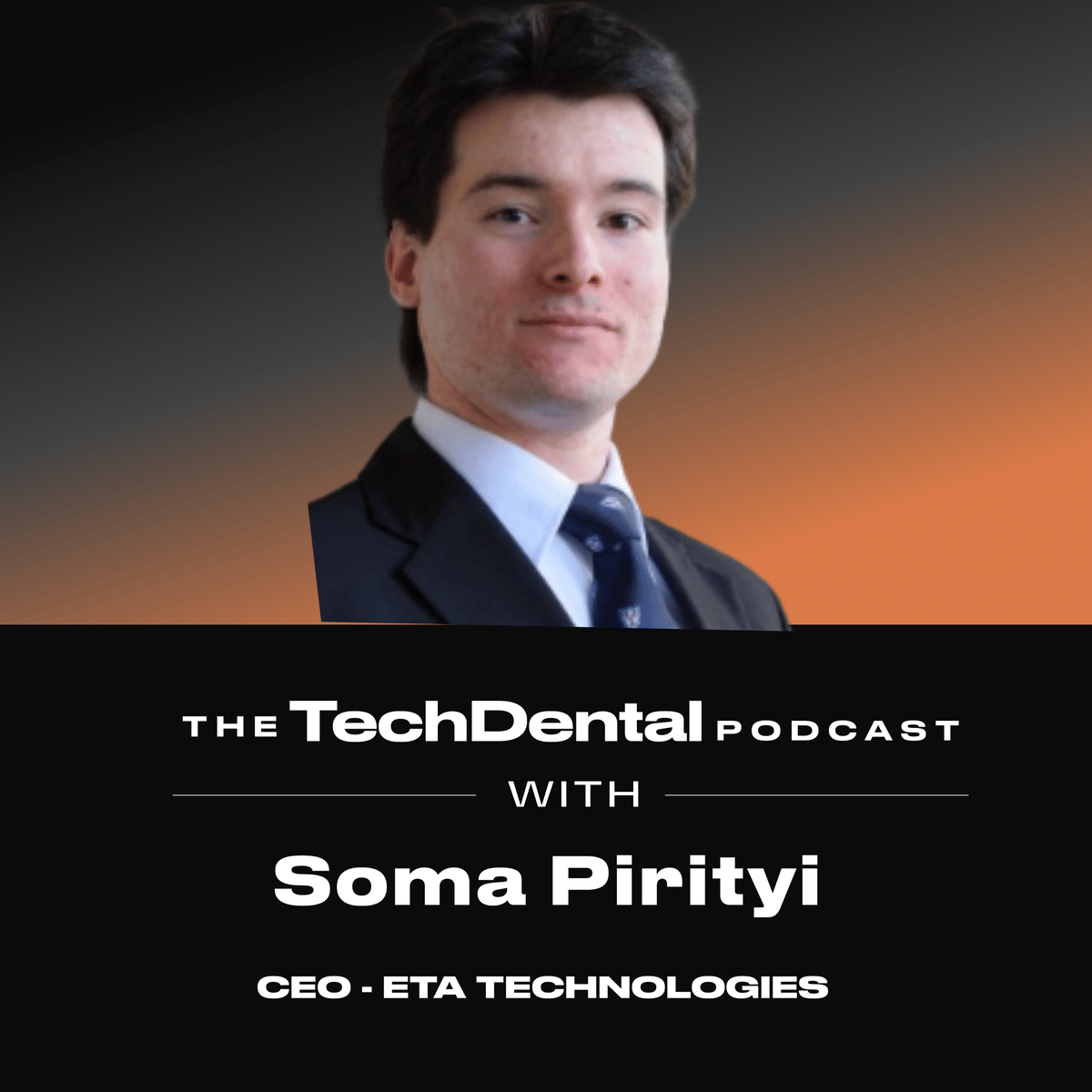
Direct answer: The dominant narrative around dental group performance focuses on EBITDA, acquisition multiples, technology investment and clinical standards. The data tells a different story. 65% of businesses fail due to team-related issues. Not strategy. Not capital. Not market conditions. The people around the table. Soma Pirityi, Forbes 30 Under 30, former venture capitalist and founder of Etter Technologies, has spent the past decade building the scientific infrastructure to measure what most organisations leave to instinct. His psychometric AI platform has assessed more than 10,000 startup and leadership teams, generating the benchmark data that allows leadership chemistry, misalignment and burnout risk to be scored against the profiles of teams that have already succeeded and failed. For dental DSO leaders, PE investors and dental group CEOs, the implication is direct: the most consequential variable in your organisation's performance is the one you are currently not measuring.
Why Does Every Business Problem Eventually Come Back to the Team?
The standard diagnosis of why businesses underperform focuses on the visible: strategy execution failures, capital constraints, market timing, product-market fit. These are the explanations that appear in board reports and post-mortems.
Pirityi's argument is that these explanations are accurate but incomplete. They describe symptoms. They do not identify causes.
"65% of businesses fail due to team-related issues, which is kind of shocking. Because if you ask people what their biggest worries are, of course, number one, running out of money, not finding the product-market fit quickly enough, not generating enough sales. But if you really dissect those issues, you need to realise that every single problem, every single obstacle is basically up to the people and down to the team."
The logic is not abstract. A business that runs out of money does so because the team did not generate sufficient revenue, did not manage costs effectively, or did not raise capital in time. A business that fails to find product-market fit does so because the team pursued the wrong hypotheses for too long, or lacked the self-awareness to pivot when the evidence was clear.
"What a business or a startup really is, is a group of people who design a technology, execute on the business plan and ultimately make such difficult, sometimes impossible decisions to pivot or perhaps not to pivot."
For dental groups, this framing reorients the entire conversation about operational improvement. Before asking which technology to deploy, which acquisition to pursue or which geography to expand into, the prior question is: does this leadership team have the alignment, capability and interpersonal chemistry to execute whatever decision is made?
Pirityi's observation from five years as a venture capitalist and multiple entrepreneurial exits is unambiguous.
"Get the team right and normally the rest will follow almost automatically. However, if the team is not right, it doesn't matter how much early stage traction you are able to generate. Down the line, ultimately you and your investors are going to pay the price."
What Are the Big 20 Factors That Predict Whether a Leadership Team Will Succeed?
Through primary research involving 150 experienced venture capitalists and secondary academic research, Etter Technologies identified 20 proven predictive factors that determine whether a leadership team has the characteristics to build a high-performing organisation. These factors go beyond the familiar metrics of resilience and risk appetite to include dimensions such as synergistic support and conscientiousness calibration that are rarely discussed and almost never measured.
The research methodology Pirityi used to develop the platform's predictive model is worth understanding, because it grounds the platform in empirical evidence rather than psychometric theory.
"I was extremely lucky because, working in venture capital, venture capital works like a mafia. If you are in, you are in, they treat you like family. Very quickly I was able to personally conduct interviews with 150 really seasoned investors, people who have seen the good, bad and the ugly. I was asking them just one question: we all agree around the table that investors invest in people. Tell me what are the factors. Tell me how a good team should look like."
The platform then benchmarks individual and team scores not against abstract norms but against the actual profiles of teams that have succeeded and teams that have failed.
"As of today, what I am most proud of and possibly what is the most valuable asset beyond the proprietary technology of our company, is that we have tested 10,000 startup teams, good ones and bad ones equally. And that's how we generate those target ranges."
The target range concept is what separates Etter's output from a conventional psychometric score. The platform does not tell you that your risk orientation scores 7 out of 10. It tells you whether 7 out of 10 places you inside or outside the range occupied by teams that have achieved the outcomes you are pursuing.
The conscientiousness example illustrates why this matters.
"If you are too conscientious, you have a tendency to be perfectionist. You are just polishing and polishing your product, you never release it to the market because you are so afraid to disappoint your clients. Lack of conscientiousness on the other side, well, simply you are like the Wolf of Wall Street. You just sell and make those gigantic promises, but you never deliver. An exceptionally good startup team must be somewhere in the middle. On a scale of 0 to 10, how much is too much, how much is too little is really, really difficult to measure."
For dental group leaders, the practical meaning of this is significant. A leadership team that scores too high on conscientiousness will delay product launches, over-engineer systems and resist the speed of execution that scaling demands. A team that scores too low will oversell capabilities, underdeliver on commitments and damage the trust that patient retention and clinician recruitment depend on.
We examined the relationship between leadership decision-making culture and organisational performance in People-First AI: Why Most AI Projects Fail in Dentistry
What Does 70% Leadership Team Misalignment Actually Look Like in a Dental Organisation?
70% of startup and scale-up leadership teams are misaligned, according to Etter Technologies' research. In dental groups, this misalignment most commonly manifests as divergent visions for the organisation's future direction, incompatible philosophies on hiring and team development, and different orientations toward growth velocity and capital structure. These misalignments are invisible in financial reporting but predictably destructive to execution.
Pirityi identifies the most common forms of leadership misalignment with a precision that dental group leaders and their investors will recognise immediately, even if they have never articulated the problem in these terms.
The first is divergent exit orientation.
"Some people are gearing up for an IPO. Meanwhile, others have an ambition to stay private and grow the company until the eternity. Two completely separate visions. You would expect that if they are rowing in the same boat, the direction is set and crystal clear. But in reality, when you look deeper, you realise that yes, they are on the same boat on paper, but they are rowing in completely different directions."
In a dental group context, this maps directly onto the tension between PE-backed leaders who are optimising for a five-year exit event and founder-clinician leaders who are building for legacy and clinical mission rather than financial return. Both orientations are legitimate. Combined in the same leadership team without acknowledgement or resolution, they create the friction that slows every significant decision.
The second is the rich versus king divergence.
"There are two types of entrepreneurs. The rich, Elon Musk would be an excellent example, is obsessed with valuation. They are more than happy to give board seats, to give control, to give power to a lot of people, as long as the valuation is skyrocketing. The king is almost the exact opposite, someone who is obsessed with control. They are normally really cautious about giving up equity and control. Their model is more bootstrapping and less raising capital."
Neither orientation is wrong. But a leadership team where some members are optimising for valuation and others are protecting control is not aligned. And an unaligned leadership team cannot make consistent, decisive decisions about capital allocation, acquisition strategy or technology investment.
"As a team, you must be aligned: are we rich, or are we king? And this is something we see a lot of times, that people have a completely different plan, vision and agenda for where the company should go."
The third dimension of misalignment is hiring philosophy: whether the organisation prioritises attitude and cultural fit over demonstrated skill, or expertise and track record over enthusiasm. Both approaches have produced successful organisations. The damage occurs when co-leaders hold conflicting beliefs on this question without ever surfacing the disagreement.
We examined how misaligned leadership cultures affect scaling outcomes across dental groups in Scaling Dentistry Without Breaking It
How Should Dental Group Leaders and PE Investors Use Psychometric AI in M&A and Due Diligence?
Psychometric AI is being adopted by PE firms and investment groups not primarily as a positive validation tool but as a red flag identification system. In a due diligence context where financial metrics are typically presented at their most favourable, independent quantification of leadership team alignment, burnout risk and growth orientation provides the counter-signal that sophisticated investors increasingly recognise as essential to de-risking acquisitions.
The use case that emerged unexpectedly from Etter's early deployment is one that dental group leaders preparing for capital events should understand clearly.
PE clients are using the platform not to confirm that a leadership team is exceptional, but to find the reasons not to invest, or to identify the specific risks that will require mitigation post-acquisition.
"By the time an opportunity lands on our table, by the time we move this business into due diligence, we just see so many reasons why we want to invest. We are not looking for another one. In fact, we are looking backwards. We are looking for a reason why not to invest. They use the report not necessarily as a box-ticking exercise. They are looking for the red flags."
For dental group leaders presenting to PE, this reframes the entire preparation strategy. The conventional board pack demonstrates financial performance, growth trajectory and clinical standards. The leadership team slide shows impressive credentials. Neither addresses the questions that sophisticated investors are actually asking: are these people aligned on exit strategy? Is the CEO on the verge of burnout? Does the COO's risk orientation match what the next phase of scaling will require?
A team that proactively presents independently validated psychometric data alongside its financial deck is signalling a category of self-awareness and governance maturity that most dental groups at the same stage cannot match.
"When you turned your little bit failing team into absolute superstars and rock stars, get back to the investors and say: last time you didn't invest because, for example, we were too conscientious or everybody in the team was on the verge of burnout. Guess what? We fixed it. And it's not just me saying that, but actually there's a third party service who is testifying that this is where we were six months ago, and as a result of following their instructions and doing the blueprint strategy, here we are."
The monitoring application is equally relevant for investors managing portfolio companies. Financial metrics report on what has already happened. Psychometric monitoring tracks whether the team is growing together or growing apart, whether burnout risk is increasing under the pressure of rapid scaling, and whether the leadership chemistry present at investment is being maintained as the organisation expands.
"The quarterly report looked absolutely amazing, like stunning sales numbers. Two weeks down the line, the CTO quit and we were like, what was going on? If you just see the financial metrics, this company is healthy, this company is growing, everything seems alright. But a business is just a group of people. You need to get a quantified overview of what is going on inside the team."
We examined the operational and governance signals that separate investor-ready dental businesses from those that attract discounted multiples in The Great Dental Reset: Why 2026 Will Reward the Prepared, Not the Big
What Is Synergistic Support and Why Is It the Most Underrated Trait in High-Performing Teams?
Synergistic support is the capacity of team members to understand and respond to the specific emotional and recovery needs of their colleagues rather than projecting their own preferences onto others. It is, according to Etter's research, the most underrated trait in high-performing teams and the least measured by investors and hiring managers.
Pirityi's explanation of this concept describes a failure mode that is common in dental group leadership teams and almost never named.
"There are a lot of different personalities in the team, which means that people switch off and switch on differently. I see teams on a daily basis where the CEO is someone who is really loud: if they have a bad day, they just need to hit the pub and hit it hard. Meanwhile, the CTO is someone who is a little bit more modest. If they have a bad day, they just need to go home, switch off all the electric devices, sit in the dark, have a calm moment, and three hours later both of those people will be back in the office completely calmed down."
The failure occurs when the CEO, with genuinely good intentions, offers the CTO the support mechanism that works for the CEO. The invitation to go to the pub does not help the CTO recover. It escalates the situation.
"Synergistic support means that you understand what are the needs and desires of the others and you don't try to push your own agenda. You always need to be careful that for sure you have a good intention, but you need to have the right synergy in order to provide the synergistic support. Not many people talk about it. Even less are measuring it."
In dental group operations, where leadership teams combine clinical and commercial backgrounds with fundamentally different professional cultures, this kind of mismatch creates friction that is attributed to personality clashes or communication failures when the underlying issue is simply a lack of understanding of how different team members process pressure. Measuring it allows it to be addressed. Leaving it unmeasured means it accumulates until it becomes a retention or performance crisis.
We examined how leadership culture and team dynamics affect burnout and performance at scale in Burnout in Dentistry Is Not a Wellbeing Crisis
How Will Psychometric AI Become the Gold Standard in Investment Due Diligence?
The transformation of venture capital and private equity from relationship-driven, gut-feel investing to data-driven, model-supported decision-making is following the same pattern as the transformation of hedge funds in the 1980s and 1990s. Within five to ten years, psychometric AI assessment will be a standard component of leadership due diligence in the same way that financial modelling is standard today.
Pirityi draws the comparison with the hedge fund industry to ground this prediction in a historical precedent that investment professionals will recognise.
"I would draw this comparison: as much as venture capital and private equity is changing from almost like a betting business into a proper, financially and mathematically backed industry, the same change happened in the 1980s with the hedge funds. Nowadays if I tell you 'hedge fund', you think about people sitting in front of six or nine monitors, a lot of algorithm going on. But if we go back 40 years, a couple of guys sitting in a room, always on the phone. Hey, let's buy IBM, it's a sure winner."
The shift that followed was comprehensive: hiring mathematicians over salespeople, replacing conviction with models, converting an intuition-based industry into an algorithm-supported one. 90% of hedge funds are now completely model-driven and data-driven.
"The same revolution is happening right here and right now in venture capital and private equity. I easily can imagine that in the next five or ten years this psychometric AI is going to be the gold standard for early stage investment and equally in later stage investment, de-risking the human factor."
For dental group CEOs and founders preparing for capital events in the next three to five years, the implication is practical and immediate. The PE investors evaluating dental assets in 2028 will arrive at due diligence with expectations around leadership data that most dental groups are not currently building towards. Those that are will occupy a different position in the negotiation.
The pre-plan investment trend Pirityi identifies in Silicon Valley, where million-dollar checks are written on the basis of people data alone with no revenue and no product, represents the logical endpoint of this shift. When financial due diligence cannot differentiate between early-stage opportunities, leadership chemistry becomes the only reliable signal.
What Is the Leadership Mindset That Separates Founders Who Scale from Those Who Stall?
The most consequential leadership distinction in scaling organisations is not between resilience and fragility, but between the capacity to distinguish giving up from quitting. Leaders who confuse these two concepts persist in failing strategies out of stubbornness and miss the pivots that would have preserved their core vision. The leaders who scale consistently are those who combine high resilience with high adaptability, and who build teams aligned to their specific leadership culture rather than teams assembled around individual brilliance.
Pirityi's framework for resilience is more nuanced than the version most leadership development programmes offer.
"You must differentiate between giving up and quitting. Because from a communication standpoint, the whole industry is not doing a very good job of washing those two things together. If you are stubborn and you are just bashing your head against the wall and you try to be the smartest guy in the room, maybe it's going to work, but the probability is very low. Meanwhile, if you go with an open heart, if you listen to the criticism, listen to the feedback, try to build it in, and sometimes you realise that we need to pivot, we need to abandon a certain idea so the company and the vision can survive."
The hiring alignment principle is the structural counterpart to this individual resilience framework.
Using the contrasting examples of Steve Jobs and Bill Gates, Pirityi draws out a distinction that is directly applicable to dental group board composition and senior team assembly.
"Jobs was a classic visionary slash dictator. I have my own agenda. Either you submit to me or I will bulldoze you out of the picture. Gates, on the other hand, was somebody who was a little bit more soft. He said, look, I don't really have an agenda. I want to surround myself with really smart people, open up the floor, provide them with the best possible equipment and make sure everybody is equal partner. Two completely different approaches, but equally successful."
The critical error is assembling a team whose members are comfortable in one culture and placing them in the other.
"Never recruit a person who is comfortable with the Steve Jobs environment in a Bill Gates team, and of course, vice versa. Find the people who are a good match, a good fit with your leadership style, with the company culture you want to create. And if someone is extremely skilled and an individual lone wolf genius but not a good match with the team, hire fast, fire even faster."
For dental group leaders building or restructuring their senior teams, this principle has immediate practical application. The question is not whether a candidate is excellent in the abstract. It is whether they will thrive in the specific culture of that organisation, under that CEO's leadership style, in that growth phase.
We examined the relationship between leadership culture, team retention and clinical workforce performance in Why the Future of Dentistry Depends on Trust, Not Just Technology
Key Takeaways
65% of businesses fail due to team-related issues. Every strategic, financial and operational failure traces back, on examination, to a people decision or a people dynamic. This is the number the dental industry is not tracking.
70% of leadership teams are misaligned and don't know it. The most common forms in dental groups are divergent exit orientation, incompatible growth philosophy (rich versus king), and conflicting hiring methodology. None of these appear in financial reporting.
Psychometric AI benchmarks leadership against 10,000 real teams. The platform scores characteristics not against abstract norms but against the actual profiles of teams that have succeeded or failed, generating target ranges rather than raw scores.
PE investors use psychometric reports to find red flags, not green lights. In a due diligence context, independent quantification of leadership alignment, burnout risk and growth orientation provides the counter-signal that financial metrics cannot.
Synergistic support is the most underrated and least measured team trait. The capacity to understand and respond to colleagues' specific needs, rather than projecting one's own preferences, is a stronger predictor of high performance than individual skills or credentials.
90% of hedge funds are now model-driven. The same transformation is underway in PE and VC. Psychometric AI will be a standard due diligence component within five to ten years. Dental groups that build this capability now will be positioned ahead of that expectation.
Resilience requires the ability to pivot, not just to persist. The distinction between giving up and quitting is the most consequential leadership skill in scaling organisations. Stubborn persistence in failing strategies is not resilience. It is a risk factor.
In the AI era, team quality is the primary differentiator. As execution tools become commoditised and accessible to everyone, the quality of human judgement and leadership chemistry becomes the only sustainable competitive advantage between organisations that scale and those that stall.
About TechDental
TechDental is a strategic intelligence platform for founders, executives, operators and investors shaping the future of dentistry.
Through high-level analysis and systems-focused conversations, we explore how AI, governance frameworks and operating model design influence performance, scalability and enterprise value in dental organisations.
If you are building, scaling or investing in dentistry and want independent, systems-level insight into AI, governance and capital readiness:
For strategic advisory, board briefings or keynote speaking enquiries: www.techdental.com/advisory
The future belongs to those who deploy technology with discipline.
© 2026 RIG Enterprises Limited. All Rights Reserved. This article was authored by Dr. Randeep Singh Gill and is published under the TechDental brand, a trading name of RIG Enterprises Limited (Company No. 11223423), incorporated in England and Wales on 23 February 2018, registered at 1a City Gate, 185 Dyke Road, Hove, England, BN3 1TL. All editorial content, analysis, synthesis and intellectual property contained within this article are the original work of the author and remain the exclusive property of RIG Enterprises Limited. Opinions and statements attributed to named guests reflect the views of those individuals as expressed during recorded interviews and are reproduced here for editorial and informational purposes. No part of this article may be reproduced, distributed, transmitted, republished, or otherwise exploited in any form or by any means, whether electronic, mechanical, or otherwise, without the prior written consent of RIG Enterprises Limited. Unauthorised reproduction or use of this content may constitute an infringement of copyright under the Copyright, Designs and Patents Act 1988.