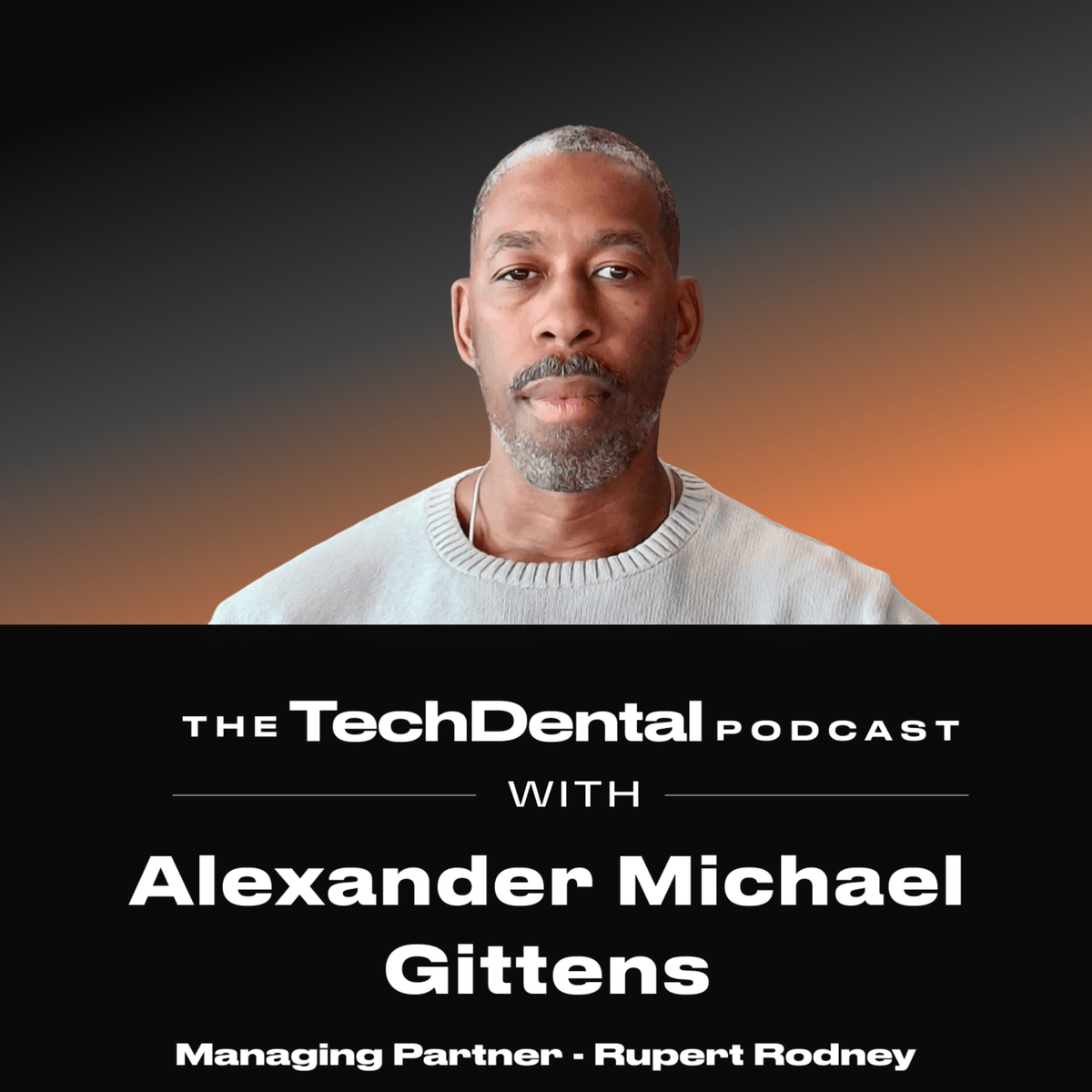
Direct answer: Alexander Michael Gittens, global strategist and founder of Rupert Rodney, argues that the primary obstacle to AI adoption in dental organisations is not technology but clarity: the documented alignment between market, product, service and messaging that most practices have never fully established. His trademarked "clarity gap" framework shows that AI introduced into an organisation without this foundation will amplify existing chaos rather than resolve it. For dental leaders in the UK, his model of trustworthy AI, built on a curious human-in-the-loop and a rigorous feedback loop benchmarked against the organisation's own best work, offers a practical governance framework for responsible deployment. His analysis of trust as the foundational variable in private equity valuation reframes operational maturity from an internal discipline into an external investor signal. The core takeaway is that clarity is not a precondition for AI adoption. It is the strategy itself.
There is a word that Alexander Michael Gittens returns to throughout every conversation about strategy, AI and leadership. It is not technology. It is not automation. It is not scale.
It is clarity.
AMG, as he is known globally, is the founder of Rupert Rodney, a strategy and AI consultancy whose work has generated billions in value across more than 400 businesses worldwide. He bridges corporate strategy and machine learning in a way that is rare: not as a technologist who learned to speak the language of business, but as a strategist who reached the limits of human bandwidth and turned to AI to extend his best decision-making without compromising his values or his health.
His framework for trustworthy AI, and the clarity discipline that underpins it, has direct and urgent implications for dental leaders in the UK navigating the intersection of AI adoption, workforce culture and investor readiness.
The central argument AMG makes is deceptively simple. AI does not create clarity. It exposes whether clarity already exists. And in an organisation where it does not, AI is not a solution. It is an accelerant for the existing chaos.
The Clarity Gap and What It Actually Costs a Dental Organisation
AMG trademarked the term "clarity gap" after working with hundreds of organisations and consistently finding the same thing. The problem was rarely strategy. It was rarely marketing. It was a fundamental misalignment between three things: the market being pursued, the product or service being offered, and the messaging being used to connect them.
"You would think it would be the quality of their strategy or the quality of their marketing. No, most leaders are pretty good at those things. What happens is there are fundamental misalignments."
For dental groups operating across multiple sites in the UK, this misalignment is compounded by the operational complexity of multi-site management, the tension between NHS contract obligations and private revenue development, and the persistent challenge of workforce consistency across locations. When those misalignments are not resolved before AI is introduced, the technology does not fix them. It amplifies them.
AMG's diagnostic framework begins with a single question: what does this organism need to thrive? He deliberately uses biological rather than hierarchical language to shift focus from job titles to the specific outcomes each role and process is responsible for generating.
"We don't want to look at these people as positions in a company. We want to look at the responsibilities. What are they responsible for and how does that optimise this organisation as an organism?"
The practical application for UK dental practices and groups is precise. Before any automation is introduced, every workflow must be traceable to a specific outcome. Every process must have a named owner, a documented rationale, and a clear answer to the question of why it exists and when it was last reviewed. In an environment shaped by CQC requirements, NHS compliance documentation and clinical governance obligations, the tendency is for process to accumulate without being interrogated. AMG's framework demands that interrogation as the precondition for any meaningful technology adoption.
The scalability test he applies is borrowed from an unlikely source: McDonald's. For a dental group moving from 3 to 10 to 30 sites across the UK, the goal is a system so well mapped it can be replicated without degradation. "You want to have a system that is so tight and so well mapped that you can control C, control V and just copy and paste it." That level of operational precision is what separates controlled expansion from chaotic over-extension.
For deeper analysis of the operational architecture required to scale dental organisations without losing control, see Scaling Dentistry Without Breaking It.
Trustworthy AI: The Human in the Loop Is a Strategic Discipline, Not a Safety Feature
AMG's framework for deploying AI responsibly is built on two interlocking mechanisms: the human in the loop and the feedback loop. The distinction between them matters enormously for dental leaders evaluating where human judgment remains non-negotiable.
The human in the loop is not a compliance checkbox. It is an active, curious intelligence that interrogates AI outputs against lived operational experience. AMG frames the disposition required through Walt Whitman's instruction to "be curious, not judgmental." A reviewer who approaches AI output defensively will either dismiss useful recommendations or approve them without scrutiny. A reviewer who approaches the same output with genuine curiosity, asking why the AI reached a particular conclusion and whether it could be right, is the one who makes the system stronger over time.
"The human in the loop allows you to make changes at critical vertices as you move forward."
The feedback loop is the mechanism AMG built into his own practice through the creation of a digital twin: a contrarian, rigorous AI character called I AMG whose sole function is to benchmark every output against the best work the organisation has previously produced. It scores outputs for technical precision, stylistic consistency and quality relative to the organisation's own highest standard. The principle is directly transferable to dental organisations: AI systems improve when they are evaluated against a defined standard of excellence, not merely against average performance.
"The way I like to think about it is there's a line in Julius Caesar where Caesar says men are flesh and blood and apprehensive. We all get tired. But the feedback loop takes the best that we've ever done and compares it with this output."
In the UK dental sector, where AI applications now span radiograph analysis, revenue cycle management, appointment optimisation and patient communication, the combination of a genuinely curious human review process and a rigorous feedback loop is what distinguishes responsible AI deployment from technological experimentation at patients' expense.
For further analysis on why organisational culture rather than algorithmic failure is the primary cause of AI underperformance in clinical environments, see People-First AI: Why Most AI Projects Fail in Dentistry (and How Leaders Get It Right).
Trust, Competency and Character: What Private Equity Is Actually Evaluating
For UK dental group operators navigating a private equity landscape that has reshaped the sector significantly over the past decade, AMG's analysis of what investors are actually assessing deserves careful attention.
The conventional framework for PE due diligence focuses on EBITDA multiples, patient revenue per chair, NHS contract security and margin performance. AMG argues that underneath all of these financial metrics is something more fundamental: trust. And trust, in his formulation, is built from three components operating in combination: competency, character and consistency.
"In order for someone to invest in you, in order for someone to back you, there's a fundamental human thing that's happening that goes right back to our amygdala. It goes right back to our reptilian brain and that is trust."
The practical implication for dental leaders preparing for investment or acquisition is that operational systems and leadership behaviour are not separate from valuation. They are the evidence base from which trust is inferred. An investor conducting due diligence cannot yet know the operator they are assessing. What they can observe are the patterns of behaviour embedded in how the organisation is run.
"They are borrowing the trust of the way you operated in the past and the way you set up your systems before they can establish their own trust with you."
This reframes operational maturity from an internal management concern into an external signalling mechanism. Clean data, documented workflows, AI systems operating within a governance framework and a leadership team that consistently acts with integrity whether or not it is being observed: all of these are trust signals. And trust, in AMG's framework, is the single most important variable in whether investment happens and at what terms.
For UK dental groups currently positioned for exit or investment, this is not an abstract observation. The consolidation wave accelerating across the UK and European dental markets means that the acquirer field is experienced and discerning. The organisations that attract the best terms look, from the outside, exactly like AMG's McDonald's: replicable, consistent and trustworthy even without the founder in the room.
AI Does Not Replace Culture. It Exposes It.
AMG's diagnosis of why teams resist AI adoption is one of the most practically useful frameworks in this conversation. His starting point is a comic strip thought experiment. In the first panel: who wants change? Every hand goes up. In the second: who wants to lead the change? A small minority remain. In the third: who wants to change themselves? The room is empty.
"We all want change, but we're not willing to change ourselves."
The solution is to ensure that the first AI systems introduced into an organisation are ones where the benefit is immediately visible and personally meaningful to the people closest to the change. His example in a dental context: use AI first to optimise scheduling in a way that genuinely improves the working lives of hygienists and front desk teams. Build trust through demonstrated benefit before introducing systems that ask more of people. Sequence the change so that it builds a culture of openness rather than a culture of resistance.
"By making change part of the fabric and the culture of the business by first asking what change actually provides value for all three parties, you start to build trust."
In the UK dental context, where workforce retention is a significant operational pressure and where clinical teams have often experienced technology rollouts that added administrative burden rather than reduced it, this sequencing principle is not optional. It is the difference between an AI implementation that compounds in value over time and one that stalls after the initial deployment.
This connects directly with the analysis in Burnout in Dentistry Is Not a Wellbeing Crisis, which argues that burnout in dentistry is a systems design failure rather than a resilience problem. When AI is introduced into a system already generating excessive administrative pressure, without first addressing the design of that system, it accelerates the problem rather than resolving it.
The Equations for Legacy: Why Daily Decisions Are the Only Strategy That Compounds
AMG closes with a framework for leadership that moves from the operational into the philosophical, but with immediate practical application for leaders building dental organisations for the long term.
His equation for what he calls greatness is expressed as BPM multiplied by BPI: Best Possible Me, multiplied by Biggest Positive Impact. The multiplication is intentional. If either variable is zero, the entire equation resolves to zero. A leader generating significant impact while abandoning their own values is operating on borrowed time. A leader maintaining personal integrity while creating no meaningful external impact is not leading at all.
"If I'm only out there doing things for other people and trying to create an impact, but I'm ignoring my values, my passions, the things that make me me, well, we've got a zero on one side of the equation. So the whole thing equals zero."
The companion equation addresses the question his clients consistently asked in response: how do I know what to do in any given moment? AMG's answer is structured around three variables: why, how and what. Why are you doing this? To be the best version of yourself and create the biggest positive impact. How are you going to do it? With full commitment, as though your legacy depends on this moment. And therefore: what do you say yes to?
"You can't say yes to a hundred things. So now I have to be ultra careful what I say yes to."
For dental founders and group operators in the UK making daily decisions about where to allocate attention, capital and leadership bandwidth, this framework is clarifying. The organisations that will be remembered are not necessarily those with the largest footprints at exit. They are the ones where the quality of care, the integrity of leadership and the design of systems created genuine compound value for patients, teams and communities over time.
Viktor Frankl's principle, which AMG returns to throughout the conversation, provides the foundational orientation: that the last human freedom, the one that cannot be taken regardless of circumstances, is the freedom to choose one's attitude. For dental leaders navigating regulatory complexity, workforce pressure, NHS contract uncertainty and rapid technological change, that freedom is not motivational language. It is a strategic anchor.
"Life is 10% of what happens and 90% of the way that I respond to it. And if I respond in alignment with my values and I'm willing to do hard things where I'm likely to fail, then as long as I get back up, I'm heading in the right direction."
Key Takeaways
The clarity gap, the misalignment between market, product and messaging, is the primary obstacle to sustainable growth in dental organisations and must be closed before AI is introduced or scale is pursued.
Trustworthy AI requires two interlocking mechanisms: a human in the loop that interrogates outputs with genuine curiosity, and a feedback loop that benchmarks performance against the organisation's own highest standard rather than average output.
Private equity and strategic investors evaluate trust, built from the combination of competency, character and consistency, as the foundational variable in any investment decision. Operational systems and leadership behaviour are the evidence base from which that trust is inferred before a relationship exists.
AI does not replace culture. It reveals it. The first systems introduced should create immediate, visible value for the people closest to the change, building the cultural foundation for deeper integration rather than generating resistance that stalls the programme.
The equation for leadership legacy is Best Possible Me multiplied by Biggest Positive Impact. If either variable is zero, the product is zero. Leaders who sacrifice their values in pursuit of impact, or who maintain integrity whilst creating none, are not operating the equation correctly.
The freedom to choose one's attitude in the face of external pressure, whether from NHS constraints, workforce challenges, consolidation dynamics or technological disruption, is not a motivational principle. It is the non-negotiable foundation of effective dental leadership.
About TechDental
TechDental is a strategic intelligence platform for founders, executives, operators and investors shaping the future of dentistry.
Through high-level analysis and systems-focused conversations, we explore how AI, governance frameworks and operating model design influence performance, scalability and enterprise value in dental organisations.
If you are building, scaling or investing in dentistry and want independent, systems-level insight into AI, governance and capital readiness:
For strategic advisory, board briefings or keynote speaking enquiries: www.techdental.com/advisory
The future belongs to those who deploy technology with discipline.
© 2026 RIG Enterprises Limited. All Rights Reserved. This article was authored by Dr. Randeep Singh Gill and is published under the TechDental brand, a trading name of RIG Enterprises Limited (Company No. 11223423), incorporated in England and Wales on 23 February 2018, registered at 1a City Gate, 185 Dyke Road, Hove, England, BN3 1TL. All editorial content, analysis, synthesis and intellectual property contained within this article are the original work of the author and remain the exclusive property of RIG Enterprises Limited. Opinions and statements attributed to named guests reflect the views of those individuals as expressed during recorded interviews and are reproduced here for editorial and informational purposes. No part of this article may be reproduced, distributed, transmitted, republished, or otherwise exploited in any form or by any means, whether electronic, mechanical, or otherwise, without the prior written consent of RIG Enterprises Limited. Unauthorised reproduction or use of this content may constitute an infringement of copyright under the Copyright, Designs and Patents Act 1988.