
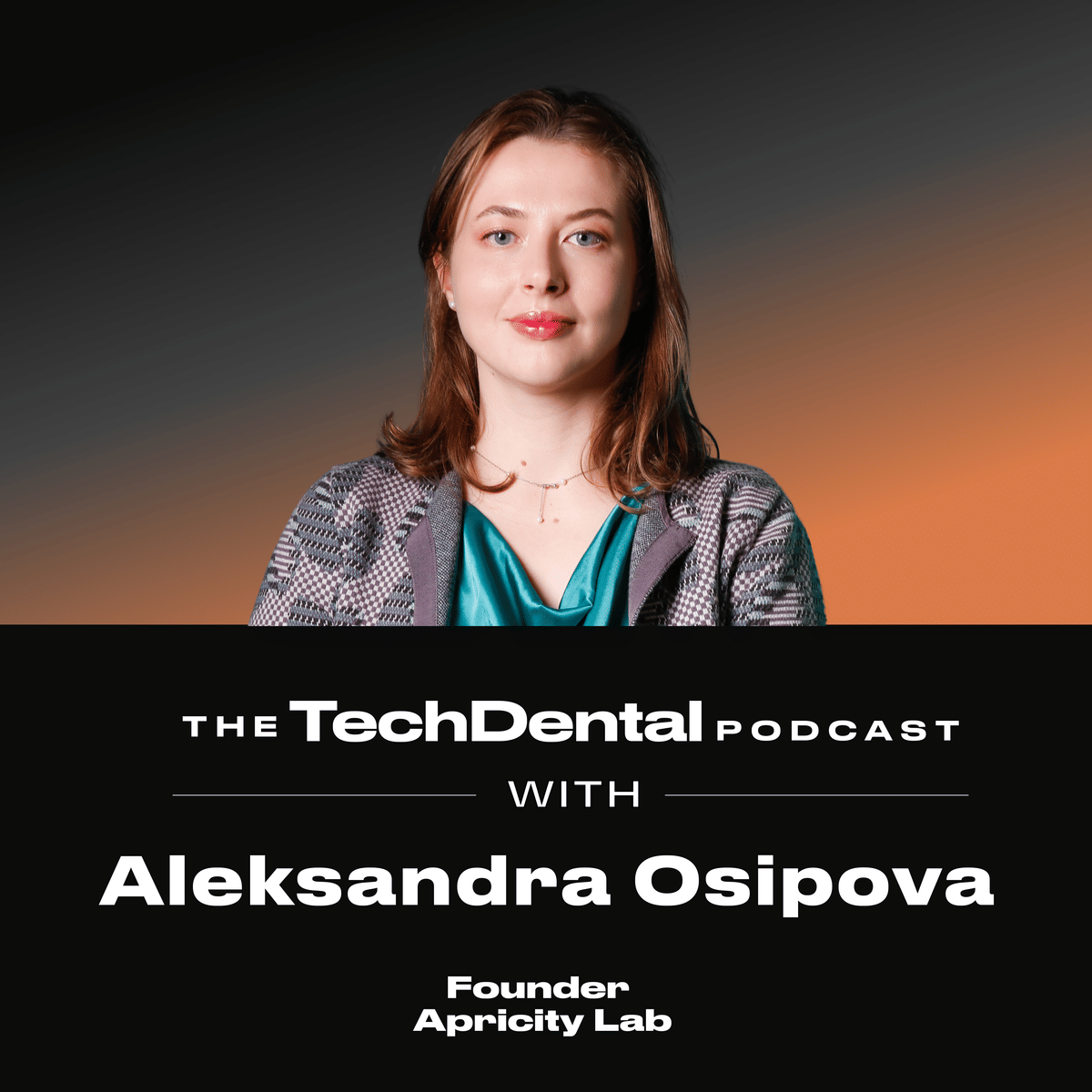
Direct answer: AI adoption in dentistry is failing not because the tools are inadequate but because the organisational conditions required for those tools to succeed do not yet exist in most practices and groups. Culture, data integrity and leadership clarity determine AI outcomes more reliably than any technology selection decision. Aleksandra Osypova, four-time founder, patented AI innovator and former Chief AI Officer, now leads Upricity Lab, where she works with complex organisations to implement AI in ways that are thoughtful, sustainable and human-centred. Her framework, built across multiple industries and refined at the intersection of AI engineering and organisational design, offers dental leaders the clearest available roadmap for what responsible, high-return AI adoption actually requires.
What Is Actually Real in the AI Landscape and What Should Dental Leaders Ignore?
The pace of AI development has created a specific and damaging problem for dental leaders: the inability to distinguish between what matters and what does not.
New models, new tools and new benchmarks arrive almost weekly. For operators already managing complex clinical and commercial environments, this generates what Aleksandra describes as cognitive overload that prevents strategic action.
Her reframe is precise.
"AI is very real and at the same time there are lots of conversations that are not productive at the moment. What's real is AI helping businesses to solve problems, to scale businesses, to engage people. AI is here to scale the processes that we decide to scale with AI."
The pressure to chase the latest release is itself a distraction. What matters is not novelty but fit.
"Even if we use a technology that was released a year ago or half a year ago, we would be completely fine to solve what we need to solve in our businesses."
For dental leaders evaluating AI investment, the productive question is not which model is most current. It is which process, if enhanced by AI, would generate the most measurable return for the organisation as it currently operates.
The organisations that get this right start with the problem, not the tool.
Why Do Most AI Projects in Dentistry Fail Before They Deliver Results?
The primary cause of AI project failure in dental organisations is not technical inadequacy. It is the absence of the cultural and structural conditions that allow AI to function. Tools deployed into broken processes or resistant cultures do not fix the underlying problems. They expose them faster.
Aleksandra has seen this pattern repeat across industries from her position as Chief AI Officer and as a founder working inside complex scaling environments.
"Many companies treat AI as a pill to solve absolutely everything. The reason why AI pilots fail is because there is no culture that supports AI experimentation, there is no culture that supports engagement. And sometimes we just throw AI at broken processes and expect that it will do magic."
This is the finding that most vendor conversations do not surface. AI applied to a fragmented operation does not resolve the fragmentation. It accelerates it.
As explored in the TechDental analysis of what actually breaks when dental groups scale, the pattern is consistent across technology categories. The breaking point is rarely the tool itself. It is the operational architecture, or absence of one, that surrounds it.
The practical implication for dental leaders is direct. The prerequisite for any AI investment is an honest assessment of the organisation's current state: its processes, its data, its culture and its leadership alignment. Without that foundation, the investment produces noise, not clarity.
"It is solvable. But it requires starting in the right place."
What Does People-First AI Actually Mean for a Dental Organisation?
People-first AI means deploying technology to enhance the capacity of existing clinical and operational staff, not to reduce headcount. For dental organisations, this distinction determines whether AI adoption generates cultural momentum or cultural resistance.
The framing matters because how AI is introduced to a workforce shapes everything that follows.
"It means that we do not speak about replacing people with AI. We can enhance capacity. You can enhance the capacity of your current admin and ops people so they can work better, provide better services, have more clients booked. If the business treats AI as a tool to help their team achieve greater results, that approach is people-first, or human-centric."
The displacement narrative is not only inaccurate in most deployment contexts. It is operationally counterproductive.
"When you say we replace you, the person who hears it just does not want to contribute to the work anymore."
For a sector already managing significant workforce pressures, this framing carries real cost. The relationship between staff engagement and operational performance in dental organisations is direct and measurable. Introducing AI through a narrative of threat rather than empowerment accelerates disengagement and increases the likelihood of adoption failure.
The alternative framing, AI as a force multiplier that allows people to do more of the work that matters, is not merely a communication preference. It is the structural condition under which successful adoption becomes possible.
How Should Dental Leaders Use Systems Thinking to Structure an AI Rollout?
Systems thinking applied to AI adoption means treating technology implementation with the same diagnostic rigour applied to clinical care: diagnosis first, treatment plan second, implementation third, review fourth. Dental professionals are already trained in this methodology. The challenge is applying it to organisational problems rather than clinical ones.
Aleksandra draws this parallel deliberately, because it is the frame most likely to translate immediately for clinical leaders.
"Medical professionals and dental professionals can relate to systems thinking because before doing any operation or any treatment, you do a diagnosis, you make a treatment plan, you prepare tools, you have a team that supports you, you perform the operation and then you follow up. This is the core of systems thinking."
Applied to AI, the methodology is identical. Identify the specific business problem. Map the surrounding processes. Locate where value is being lost. Define the scope of the intervention. Implement iteratively. Measure. Adjust.
"It is rarely that an AI solution will solve absolutely everything from the first goal. It is work in iteration. We have a rollout, we see how it works, we receive the feedback, we adjust models, adjust processes, timing."
The iteration principle is critical. Aleksandra uses the example of automated patient communication: if feedback indicates that responses feel robotic, or that message frequency is creating friction, the system is adjusted. The metric stabilises. The team moves to the next problem.
Crucially, the people doing the operational work are the most important source of iteration intelligence.
"They know the business best and we need to listen to them. We build the system of how we engage people into this work. And the intersection of this gives good results. Give it at least 90 days, because you put in a lot of work that is human-related and process-related."
Why Is Data Integrity the Single Most Important Determinant of AI Success in Dentistry?
Data integrity determines AI outcome more reliably than any other variable. AI tools are only as good as the data they are trained and operated on. For dental organisations holding years of clinical and operational records, the quality, structure and governance of that data is the strategic prerequisite for any AI investment that will produce reliable returns.
Aleksandra is direct about this.
"AI is only as good as the people who implement it and the models it runs on. But also only as good as the data we feed it. With data, we either capture the biases and carry them forward, or we understand that and modify the database to provide a better solution. You need to teach AI what good is and what bad is. And there is no other place for that than your historic data."
For dental organisations, this means an honest audit of existing data before any AI deployment. What data is held? How is it structured? What biases or gaps exist? Who owns it? How is it currently governed?
The GDPR and European AI Act dimensions compound the complexity. Aleksandra advises a layered approach.
"When we speak about GDPR, it is important to understand that there are layers of data accessibility. People who are on the administrative job at the dentistry clinic may not need to have access to the medical history of the patient. You think about the layers of data protection, the access of the data."
For AI tools deployed in clinical decision-support or diagnostic functions, the compliance burden is highest. For administrative automation, such as appointment booking, recall and patient communication, the risk profile is lower but the data governance requirements remain.
The instruction is to begin with risk assessment: identify the AI solutions the organisation wants to deploy, assess the regulatory risk level of each, and sequence implementation from lower-risk to higher-risk as governance matures.
How Do Leaders Measure Whether Their Organisation Is Ready for AI?
Organisational AI readiness can be assessed across five stages of maturity, from awareness and scepticism through to strategic reinvention. Most dental organisations currently sit between stages one and two. The key diagnostic is not technology capability but cultural and structural readiness: whether the team is engaged, whether processes are documented and whether leadership has a strategy rather than a wish list.
Aleksandra has developed a five-stage maturity framework that provides dental leaders with an honest diagnostic tool.
Stage one is awareness paired with scepticism: the organisation knows AI exists but is not actively engaging with it. Stage two is passive experimentation: team members use generative AI tools informally without strategic direction. Stage three is creative application, where the organisation begins to use AI for coaching, feedback and targeted automation. Stage four is operational deployment, where AI is actively performing functions previously managed by staff. Stage five is the transformation stage, where leadership thinks through an AI lens and begins to redesign processes based on what the organisation's AI capabilities make possible.
"On the fifth stage, you start inventing processes that are more agile or more suitable for the tools that we have now."
The readiness signals Aleksandra looks for before advising implementation are specific.
"Start with your team, start with engagement. Understand how people currently use AI in the company and what matters to them. At the same time, understand the compliance and infrastructure requirements. Once your core team is engaged in the AI transformation journey, you can start writing your AI strategy."
The AI strategy, she is careful to clarify, is not a document that lives in a folder. It is a living operational guide.
"The AI strategy is a guidance: how we use AI, how do we use prompts, how do we anonymise data, how do we store prompts. Writing a good prompt is intellectual property. You can replicate it again and again."
What Is Shadow AI and Why Does It Represent a Material Risk for Dental Organisations?
Shadow AI, also referred to as bring-your-own-AI, is the use of AI tools by staff without organisational awareness, policy or governance. For dental organisations handling sensitive patient data under GDPR and the European AI Act, this represents a compliance exposure that is likely already present in most practices and groups.
Aleksandra is direct about how widespread this phenomenon is.
"There is a huge problem of shadow AI. It is when the company does not have a policy and does not say these are the tools you can use and this is how. But instead they close their eyes and say, whatever you do, just do it and we will figure it out later."
The risk is not hypothetical. Staff across dental organisations are already using generative AI tools for documentation, communication, research and administrative tasks. Without policy, those tools may be processing patient data in ways that violate data protection obligations, or generating outputs that carry regulatory or reputational risk.
The counterintuitive solution is not restriction but structured openness.
"Allowing people to share how they are already using AI, and bringing this up and saying this is the new standard of how we solve this problem, can help the engagement."
Creating regular forums, Lunch and Learn sessions, and structured spaces for staff to discuss AI use normalises the conversation and allows leadership to shape it. The outcome is not only compliance risk reduction. It is the surfacing of operational intelligence from the people closest to the work.
"They know the business best. We need to listen to them."
How Does Employee Wellbeing Directly Affect AI Technology ROI and Patient Experience?
Burnout and staff disengagement are not separate from technology ROI. They are the primary determinants of it. An organisation that deploys AI into a workforce already operating beyond capacity will not free capacity. It will add complexity to an already degraded operational environment.
Aleksandra frames this as a long-term strategic question, not a wellbeing initiative.
"If our employees are burned out or they do not have resources provided by the organisation to be high performers, then we will see lower quality of service and it will not be a long game. If we only hire people to do a job and take all of their resources to perform it, then we do not have a long-term strategy. It is a lose game for employees and business."
The alternative is equally clear.
"Engaging your best people in a new technology, in AI transformation, is the best role because they feel that they are participating, they feel that they are heard, and they see that they have the space to develop themselves as professionals. So they have more motivation to contribute."
This is the mechanism through which people-first AI generates operational return. Not by reducing headcount but by increasing the engagement and capability of the workforce already in place.
The AI tools that remove low-judgement, repetitive tasks from clinical and operational staff are most effective when those staff are psychologically resourced to use the capacity that is freed. An organisation that addresses wellbeing as a precondition for AI adoption will extract materially more value from that investment than one that treats it as an afterthought.
What Leadership Traits Will Define Success in an AI-Driven Dental Organisation?
The leadership traits that will define AI-era success in dentistry are curiosity, systems thinking and leading by example. These are not soft competencies. They are the structural conditions under which AI adoption succeeds or fails at the organisational level.
Aleksandra is precise about what each means in practice.
Curiosity is the primary trait, because it is how leaders navigate genuine uncertainty without retreating into false certainty.
"Curiosity is how we can not only survive in uncertainty but thrive in it. Ask good questions. See how other people are solving this. Create the space where people can communicate."
Systems thinking is the discipline that separates reactive technology adoption from strategic transformation.
"From the moment how you diagnose the processes to your AI strategy, to your implementation plan, to the long-term vision, incorporate all of this in the systems thinking."
Leading by example is the cultural signal that determines whether adoption becomes an organisational behaviour or remains the project of a few enthusiasts.
"It is really important for employees' wellbeing and engagement to see that I am not the only one doing the work. We are all together doing this."
For dental group leaders, the practical implication is direct. If leadership is visibly engaged in AI learning, experimentation and iteration, adoption across the organisation follows. If leadership delegates AI to a single enthusiast or external consultant and steps back, the culture reads the signal and the project stalls.
The curiosity principle also applies at the individual level.
"Definitely curiosity, because that is how we can survive in uncertainty. And not only survive but thrive."
Key Takeaways
Most AI projects in dental organisations fail not because of technology limitations but because the cultural and structural conditions required for success do not yet exist. Culture, process clarity and data integrity are the real determinants of AI ROI.
People-first AI means deploying technology to enhance staff capacity, not replace it. The displacement narrative is not only inaccurate in most contexts. It actively generates the resistance that causes adoption to fail.
Systems thinking is already embedded in clinical training. Dental leaders who apply the same diagnostic rigour to organisational problems as to clinical ones will make better AI implementation decisions than those who select tools before defining problems.
Data integrity is the single most important variable in AI outcome. Clean, structured, well-governed data is the prerequisite for any AI investment that will produce reliable returns. Tools applied to poor data produce poor outputs faster.
Shadow AI is already present in most dental organisations. Addressing it through structured openness rather than restriction reduces compliance risk and surfaces operational intelligence from the staff closest to the work.
Organisational AI maturity progresses through five stages. Most dental organisations sit between stages one and two. The move from passive experimentation to strategic deployment requires documented processes, engaged teams and a living AI strategy.
Employee wellbeing is not separate from technology ROI. Organisations that address burnout and disengagement as a precondition for AI adoption will extract materially more value from that investment than those that do not.
The three leadership traits that define AI-era success in dentistry are curiosity, systems thinking and leading by example. These are the structural conditions under which AI adoption succeeds at the organisational level.
About TechDental
TechDental is a strategic intelligence platform for founders, executives, operators and investors shaping the future of dentistry.
Through high-level analysis and systems-focused conversations, we explore how AI, governance frameworks and operating model design influence performance, scalability and enterprise value in dental organisations.
If you are building, scaling or investing in dentistry and want independent, systems-level insight into AI, governance and capital readiness:
For strategic advisory, board briefings or keynote speaking enquiries: www.techdental.com/advisory
The future belongs to those who deploy technology with discipline.
© 2026 RIG Enterprises Limited. All Rights Reserved. This article was authored by Dr. Randeep Singh Gill and is published under the TechDental brand, a trading name of RIG Enterprises Limited (Company No. 11223423), incorporated in England and Wales on 23 February 2018, registered at 1a City Gate, 185 Dyke Road, Hove, England, BN3 1TL. All editorial content, analysis, synthesis and intellectual property contained within this article are the original work of the author and remain the exclusive property of RIG Enterprises Limited. Opinions and statements attributed to named guests reflect the views of those individuals as expressed during recorded interviews and are reproduced here for editorial and informational purposes. No part of this article may be reproduced, distributed, transmitted, republished, or otherwise exploited in any form or by any means, whether electronic, mechanical, or otherwise, without the prior written consent of RIG Enterprises Limited. Unauthorised reproduction or use of this content may constitute an infringement of copyright under the Copyright, Designs and Patents Act 1988.