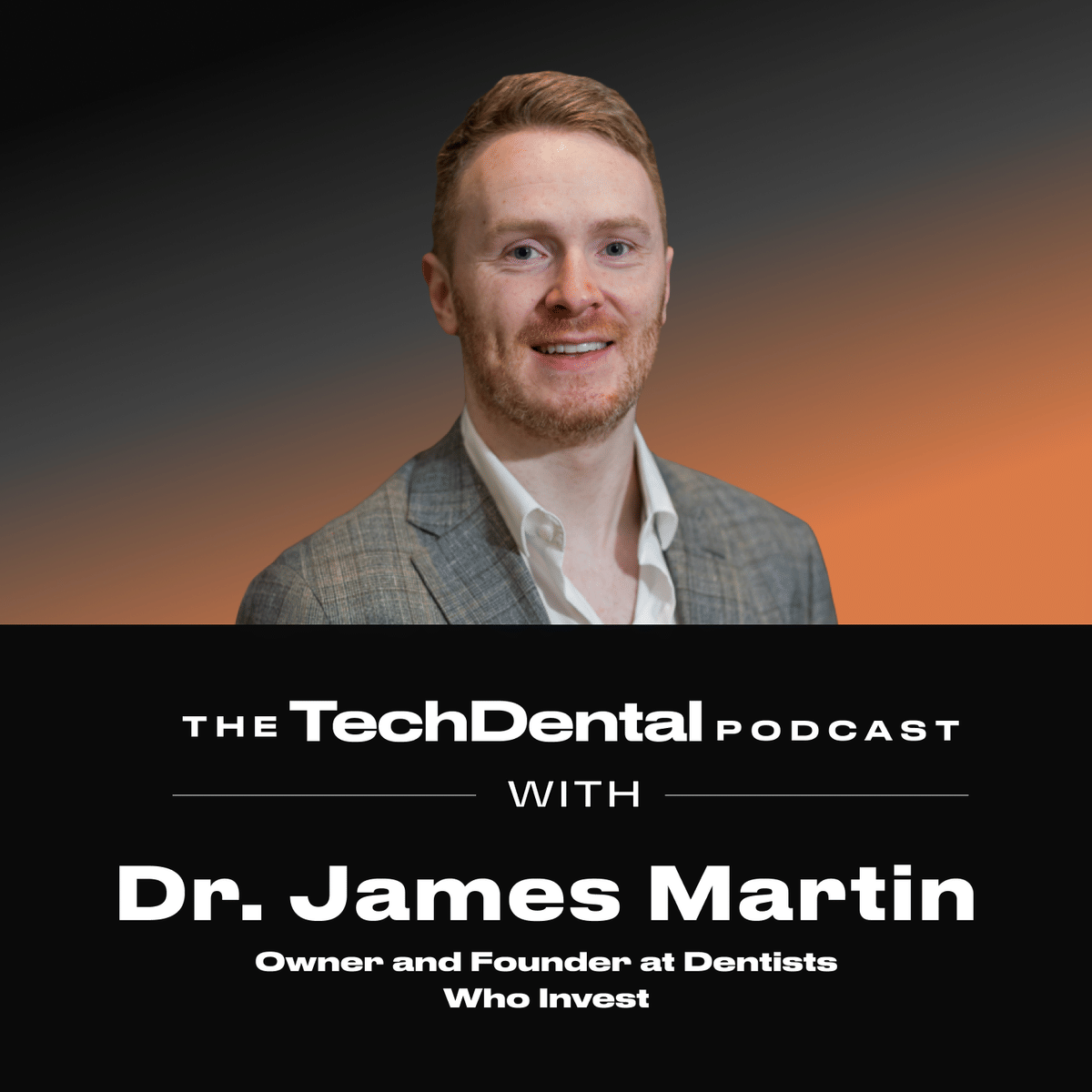
Direct answer: Dentists are increasingly recognising that clinical excellence alone does not build wealth or freedom. The combination of financial literacy, structured investment strategy and AI-powered practice management tools is creating a new archetype of dental professional: one who understands leverage, controls their time and builds assets that work independently of their hours. Dr James Martin, founder of Dentists Who Invest and Videre Financial Planning, is at the centre of that movement.
What Is the Real Problem Dentists Have With Money?
Dentistry trains clinicians. It does not train business owners, investors or wealth builders.
That gap has consequences.
Most dentists exit dental school with significant debt, a strong clinical skill set and almost no framework for understanding tax efficiency, investment strategy or the structural decisions that determine long-term financial outcomes.
The result is a profession full of high earners who are, in many cases, significantly underserved when it comes to financial guidance.
Dr James Martin, founder of Dentists Who Invest and fixed-fee wealth management firm Videre Financial Planning, identified this gap not through strategic planning but through lived experience.
After qualifying from Leeds University Dental School in 2016, Martin developed a parallel interest in finance and investing. A knee injury in 2020 gave him time to act on it. He started a Facebook group. The response told him everything he needed to know.
"I thought, okay, cool. There's gotta be a group where dentists talk about money and finance, right? Like that's just gotta exist, like surely. And I almost didn't start it because of that. And then I did my research and I was like, man, no one's actually done this."
That gap, once identified, turned out to be significant.
The group grew rapidly, not because of a marketing strategy, but because the demand was already there. Latent, unmet and substantial.
"It was the level of interest that it got that gave me that feedback. The world gave me that feedback to indicate to me that there was something here more than any sort of initial strategic move or planning."
This is an important signal for anyone thinking about where the whitespace in the dental profession still sits. The financial education gap for dentists is not closed. It has barely been opened.
Why Do Most Dentists Underperform Financially?
The core issue is not income. It is financial literacy, tax efficiency and investment strategy.
Martin's experience working with dentists through Videre Financial Planning and the Dentists Who Invest community consistently surfaces the same pattern.
Dentists earn well. But their financial decisions are often shaped by inherited assumptions, generational advice and a lack of exposure to the structures that actually build long-term wealth.
"A lot of us are conditioned to think about money in a certain way that is not even necessarily that accurate whenever you put it under a microscope."
Property is a useful example.
For the generation of dental practice owners who built their wealth in the 1980s, property was an exceptional vehicle. Tax treatment was favourable. The market was expanding. The conditions were structurally supportive.
Those conditions no longer exist in the same form.
Martin is direct on this point. The UK government's current tax treatment of property investment, particularly for higher earners, makes it a far less efficient vehicle than many dentists assume. Meanwhile, world equity funds and pension structures, including ISAs and SIPPs, consistently outperform most alternative asset classes over time. Yet these remain poorly understood across the profession.
"I was reading the other day that 95% of people in the UK don't have an ISA. That's the level that we're at."
The habit of asking questions, testing assumptions and approaching financial decisions with structured scepticism is, in Martin's view, the single most important shift a dentist can make.
"When we're educated, we make better decisions. We make better outcomes. And when you educate yourself on money and finance, the literal main objective is to get your time back and live your life."
This framing matters.
Financial literacy is not about accumulation for its own sake. It is about purchasing freedom. The freedom to choose how, when and whether to practise. That reframe changes the motivation entirely, and with it, the level of engagement.
We explored the related question of how dental practice owners are thinking about long-term value creation in The Great Dental Reset: Why 2026 Will Reward the Prepared, Not the Big
How Is AI Changing Financial Planning for Dental Practices?
AI is beginning to transform financial planning for dental professionals by automating data processing, generating bespoke financial models and surfacing tax optimisation opportunities that would previously have required significant adviser time to identify.
Martin's firm, Videre Financial Planning, is already integrating AI into the financial planning process in practical ways.
The model is straightforward: a dentist inputs their financial data into a standardised sheet. AI processes that data against their stated goals and objectives and generates a draft financial plan. That plan then receives human review and sign-off before implementation.
"What someone will be able to do is input their data into a sheet, standardised sheet, and say, here's how much money I have, here's my goals, here's my objectives, what's the most efficient way to achieve this? It's a lot more fluid now, a lot more ways that you can adapt that to the specific needs of what someone wants. Still needs a human to sign it off, but you've got to make sure it's correct."
The significance of this model is not the technology itself. It is the access it creates.
High-quality, personalised financial planning has historically been expensive and time-consuming to produce. AI compresses both the cost and the time. The result is that genuinely bespoke financial guidance, previously the preserve of high-net-worth clients with dedicated advisers, becomes accessible to a much broader range of dental professionals.
Martin has also developed an AI-powered tax calculator tool, designed specifically for dentists, that illustrates the practical potential clearly.
"You input all your data and then it tells you all your potential tax deductible expenses based on your profession. So you type in dentist and it just comes up with them. And it keeps a track on how much you're earning every month. It gives you suggestions for things that you can do, should you want to increase your earnings, and also gives you suggestions for who you might speak to whenever it comes to your investment strategy based on having a conversation with you and based on understanding your objectives."
This is the direction of travel for financial services in dentistry.
Not the replacement of advisers. The amplification of their capacity to deliver value at scale.
The analogy to other AI applications in professional services is direct. As we have covered extensively at TechDental, AI does not remove the expert from the equation. It removes the friction that prevents the expert's knowledge from reaching the people who need it.
How Should Dental Practice Owners Think About Operational Technology?
Dental practice owners systematically underestimate the commercial value of operational technology, particularly CRM systems, which represent one of the most accessible and highest-return technology investments available to any practice.
Martin's technology recommendation, when pressed to name a single indispensable tool, was not an AI diagnostic platform or a complex analytics suite.
It was a CRM.
"A really solid CRM. That's what I'm gonna say. Even though that's pretty basic, basically, like that's, everyone should have that. There's still so many dentists that don't have that. Customer relationship management software. The time that has saved me over the years through organising it and creating little automations and stuff. It's just nuts. I feel like every practice should have that."
This is not a conservative recommendation. It is a precise one.
The operational value of a well-implemented CRM in a dental practice is compounding. Patient communication is automated. Follow-up sequences run without manual input. Data on patient behaviour, appointment patterns and treatment acceptance becomes visible and actionable.
The practices that have not implemented this infrastructure are, in effect, leaving measurable revenue and clinical capacity on the table every single day.
The next frontier, as Martin observed, is AI integration at the point of patient communication.
"Some of the amazing stuff that you see nowadays is where it plugs into your phone system. It drafts up the email that you're gonna send to the person afterwards as you're talking based off the conversation. It rates you in terms of your politeness and behaviour on the call."
For practice owners who are already operating lean teams, this level of automation is not a luxury. It is a structural advantage that directly affects patient experience, staff capacity and ultimately, profitability.
We examined the operational intelligence layer in more depth in From Front Desk to Control Plane
What Is the Right Way for Dentists to Approach AI Adoption?
The most effective entry point for dentists approaching AI for the first time is not practice-wide implementation. It is identifying the specific, repeatable tasks in their daily workflow where AI can reduce friction, then building outward from there.
Martin's framing of AI adoption is characterised by pragmatism rather than evangelism.
He positions himself as one step ahead of the sceptics rather than at the frontier of AI development. That positioning is deliberate and instructive.
"I would say go try out ChatGPT if you haven't already, because there's still a lot of people who sit in that camp. And then what I would then do after that, if you've already tried that out and you're maybe thinking to yourself, okay, cool, this is cool, but I don't immediately see how it's gonna help me. Maybe just have a real think about the stuff that you're doing on a day-to-day basis, which AI can help you with or make much faster."
The principle he describes is essentially prompt engineering applied to professional life.
Identify the tasks that consume disproportionate cognitive load relative to their strategic value. Document the inputs and outputs. Then systematise them through AI.
"Anytime you find yourself thinking about something a lot, maybe just train your brain to think to yourself, right, how can I get ChatGPT involved in this? And that's when all the good stuff happens. That's when the doors start to open."
Martin also uses AI to generate CPD content at scale from podcast transcripts, using a system of standardised prompts to produce questions that are then reviewed and approved by a human before publication. The result is that every piece of long-form content becomes a CPD-accredited learning resource, dramatically increasing the value of each episode to the audience.
This is a precise model for how any dental organisation, whether a single practice or a multi-site group, should approach AI content and education workflows.
The technology does not replace the judgement. It removes the bottleneck between the judgement and the output.
We covered the broader question of why AI adoption stalls in dental organisations in People-First AI: Why Most AI Projects Fail in Dentistry
What Does Breaking the Link Between Time and Money Actually Mean?
Breaking the link between time and money means building income streams, business systems and investment assets that generate value independently of the hours a dentist is clinically active. It is the central ambition of financial planning for dental professionals and the core purpose of the Dentists Who Invest platform.
This concept sits at the heart of everything Martin has built.
Clinical dentistry, in its default form, is a time-for-money exchange. Every pound earned requires a dentist to be present, active and performing. There is no leverage. There is no compounding. There is no income when the clinician is absent.
The shift Martin describes, from time-based income to asset-based wealth, requires a reorientation of how dentists think about their working hours, their practice structure and their financial decisions.
The leverage framework he references comes from Naval Ravikant's Almanac, a book he describes as one he thinks about every day.
The principle: we all have the same amount of time. The difference between those who build exceptional outcomes and those who do not is their ability to identify and deploy leverage. Capital, technology and systems that work independently of direct personal effort.
AI, in this context, is a leverage tool.
It extends the output of a single expert. It enables a financial adviser to serve more clients with higher quality. It enables a practice owner to maintain patient relationships and operational oversight with less direct involvement. It enables a content creator to generate CPD resources from a single conversation.
"AI is a tool that helps you do that as well, incidentally."
The dentists who understand this framing will approach AI adoption differently from those who see it as a cost-saving measure or an experiment.
They will ask not how much time it saves today. They will ask what it makes possible tomorrow.
How Should Dentists Think About Contrarian Decision-Making?
The dentists most likely to build exceptional financial and professional outcomes are those who have developed a structured habit of questioning default responses and seeking non-consensus paths in situations where the majority would act predictably.
Martin's approach to decision-making offers a practical framework for dental practice owners navigating the current period of rapid change.
When facing a decision, he applies a single filtering question: is this what most people would do?
"Whenever I find myself in a situation where I have an inclination to react a certain way or take a certain course of action, I often think to myself, hmm, but is that what the majority of people would do now? And if I reflect on myself and I think, yes, they probably would, then that is like a little red flag in my head."
The logic is not contrarianism for its own sake. It is a recognition that average inputs produce average outputs, and that exceptional outcomes require deliberate deviation from the default path.
This applies directly to the decisions dental practice owners are currently facing around technology adoption, financial structure, staffing models and capital allocation.
The majority are hesitating on AI. The majority are still operating without structured financial plans. The majority are deferring the decision to implement operational technology until the pressure becomes impossible to ignore.
The minority who act early, not recklessly but deliberately, will find themselves with compounding advantages that become progressively harder to close.
Martin also challenges one of the most commonly repeated pieces of startup and business advice: "if it sounds too good to be true, it probably is."
"I hate that, man. I literally think that's lame, right? Because you're assuming that you have all the information to make that decision up to this point, right? But the reality is that if you never put yourself out there and had those experiences, you're unable to say whether or not that's a good opportunity."
The implication for dental practice owners is precise.
Scepticism applied uniformly does not protect you from bad decisions. It also protects you from good ones. The skill is not avoiding risk. It is developing the judgement to distinguish between risks worth taking and risks worth avoiding. That judgement only comes from exposure and experience, not from caution at a distance.
What Is the Long-Term Vision for Financial Education in Dentistry?
The long-term vision for dental financial education is a profession where every dentist has access to objective, high-quality financial guidance regardless of income level, practice type or career stage, delivered through community, technology and transparent advisory models.
Martin's ambition for Dentists Who Invest extends well beyond the current Facebook group.
He envisions the platform becoming the definitive open-source resource for dental financial information across every relevant topic: indemnity, accountancy, tax planning, investment strategy, pension structures and beyond. A destination that dentists return to whenever a financial question arises, with the confidence that the guidance they receive is vetted, objective and dentist-specific.
The model he describes, a community-first platform that earns trust through consistently valuable free content and then supports those who want deeper engagement through structured financial planning, is precisely the model that works at scale in professional communities.
"When we do that, then it will grow by itself. It will grow and expand as a business, as an operation without us even necessarily really marketing it per se, which is the sweet spot, just by word of mouth. But you only can do that whenever you know that the product is killer."
The financial literacy gap in dentistry is not unique to the UK. Martin has already observed that the American equivalent, whilst it exists, is built around entirely different financial instruments and tax structures. The UK-specific guidance gap remains significant.
The practices, platforms and advisers who close that gap in the next five years will occupy an extremely strong position in a profession that is simultaneously facing consolidation pressure, rising operational costs and a generation of younger dentists who are more financially aware and more demanding of transparent, ethical advice than any generation before them.
We examined how consolidation and capital dynamics are reshaping the profession in Scaling Dentistry Without Breaking It
Key Takeaways
The financial literacy gap in UK dentistry is structural and largely unaddressed. High income does not translate automatically to financial freedom without the right knowledge and systems in place.
AI is beginning to transform financial planning for dental professionals by compressing the cost and time of delivering bespoke, personalised financial guidance at scale.
A well-implemented CRM is the single highest-return operational technology investment available to most dental practices today, yet adoption remains surprisingly low across the profession.
Breaking the link between time and money requires deliberate decisions about leverage: capital, technology and systems that generate value independently of clinical hours.
The most effective approach to AI adoption for dentists is to start with specific, repeatable daily tasks and build outward, rather than attempting whole-practice implementation from the start.
Contrarian decision-making, the habit of questioning the default response before acting, is one of the most consistently valuable frameworks for dental practice owners navigating rapid change.
Financial education is not about accumulation. It is about purchasing the freedom to practise and live on your own terms.
About TechDental
TechDental is a strategic intelligence platform for founders, executives, operators and investors shaping the future of dentistry.
Through high-level analysis and systems-focused conversations, we explore how AI, governance frameworks and operating model design influence performance, scalability and enterprise value in dental organisations.
If you are building, scaling or investing in dentistry and want independent, systems-level insight into AI, governance and capital readiness:
For strategic advisory, board briefings or keynote speaking enquiries: www.techdental.com/advisory
The future belongs to those who deploy technology with discipline.
© 2026 RIG Enterprises Limited. All Rights Reserved. This article was authored by Dr. Randeep Singh Gill and is published under the TechDental brand, a trading name of RIG Enterprises Limited (Company No. 11223423), incorporated in England and Wales on 23 February 2018, registered at 1a City Gate, 185 Dyke Road, Hove, England, BN3 1TL. All editorial content, analysis, synthesis and intellectual property contained within this article are the original work of the author and remain the exclusive property of RIG Enterprises Limited. Opinions and statements attributed to named guests reflect the views of those individuals as expressed during recorded interviews and are reproduced here for editorial and informational purposes. No part of this article may be reproduced, distributed, transmitted, republished, or otherwise exploited in any form or by any means, whether electronic, mechanical, or otherwise, without the prior written consent of RIG Enterprises Limited. Unauthorised reproduction or use of this content may constitute an infringement of copyright under the Copyright, Designs and Patents Act 1988.