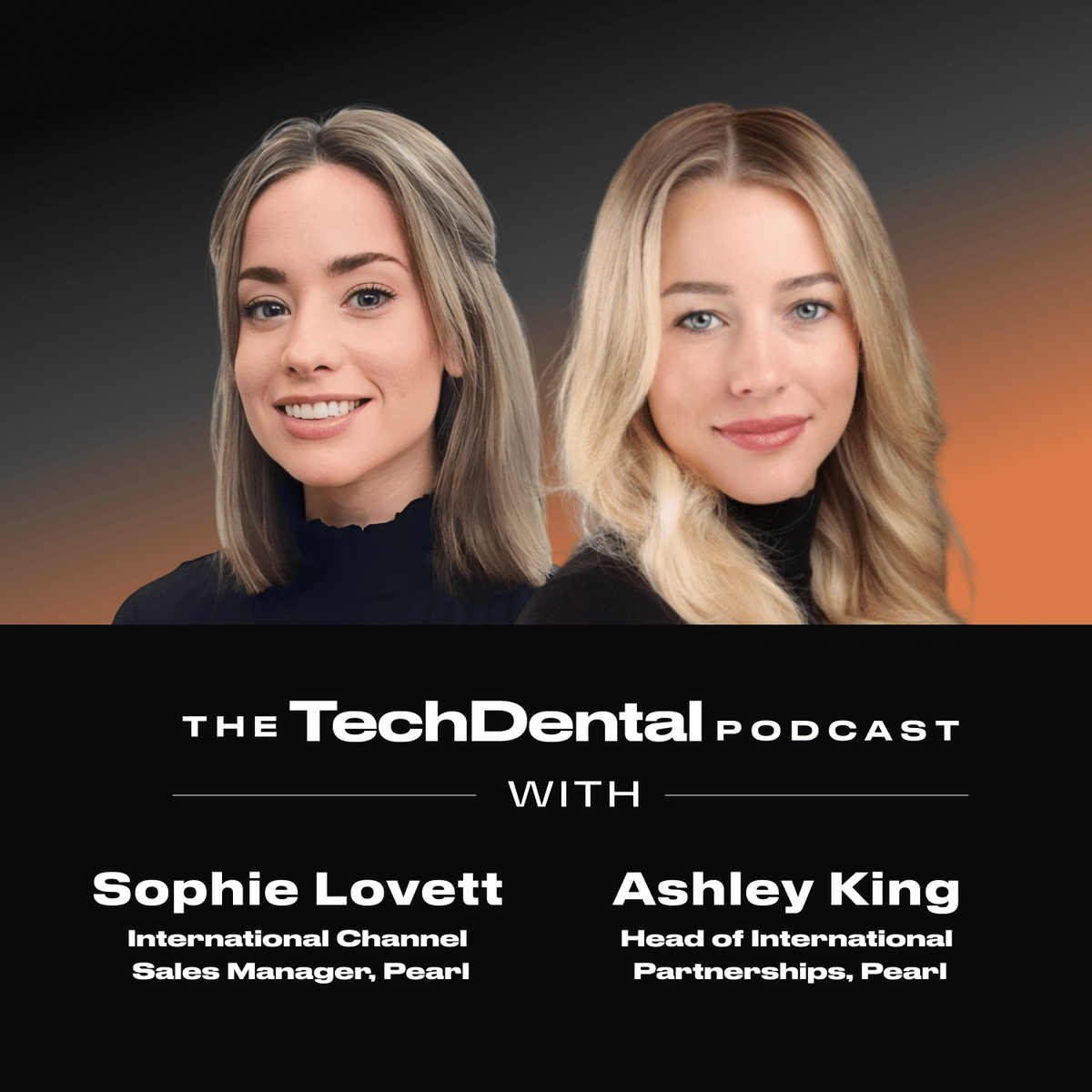
Direct answer: Sophie Lovett and Ashley King, international channel sales manager and head of international partnerships at Pearl AI, argue that dental AI is entering a new phase where diagnostic support, patient education and clinical workflow automation are converging around a single co-pilot model that augments rather than replaces the clinician. Pearl's Second Opinion platform, the first globally to achieve FDA clearance for both 2D and 3D radiographic detections and MDR approval across more than 100 countries, positions regulatory compliance not as a constraint but as a competitive advantage and proof of clinical efficacy. The $58 million Series B funding round Pearl closed in 2024 signals that dentistry is moving from the digital age into what the company calls the cognitive age, where AI-surfaced data becomes as foundational to practice infrastructure as equipment or premises. The core message for UK dental leaders is clear: the practices that educate themselves on AI now, adopt tools built to regulatory standard, and invest in change management alongside technology will be best positioned as this shift accelerates.
There is a moment that Sophie Lovett describes from conversations with clinicians that captures something important about where dental AI stands right now. A clinician goes for an eye test. She sits in the optician's chair, sees her own eyes displayed in front of her and hears the optician explain what is happening in plain language. And in that moment, she understands for the first time what her patients feel when they are sitting in her dental chair, nodding along to an explanation they cannot follow, about images they cannot interpret, for a treatment they are being asked to trust.
"We forget what we don't know. In that moment she was kind of bought into the patient psyche of when they're sitting here and they're just nodding at us and they're pretending to know what we're talking about."
That insight sits at the heart of Pearl AI's clinical proposition. Not that AI can replace the clinician, but that AI can make the clinician's communication so clear, and the patient's understanding so grounded in visible evidence, that trust becomes the natural outcome of every diagnostic conversation.
Sophie Lovett and Ashley King lead Pearl's international expansion from their London base, working across UK and European markets to bring the company's flagship Second Opinion platform to practices and groups navigating the first serious wave of AI adoption in dental diagnostics. Their perspective, shaped by direct clinical engagement across hundreds of practices and by the regulatory and commercial realities of scaling a dental AI product globally, offers one of the most grounded views available on where this technology is headed and what it will take for UK dental leaders to benefit from it.
From Digital to Cognitive: The Shift Pearl Is Helping to Lead
Pearl's positioning in the market is built on a distinction that matters more than it might initially appear. The company describes the current moment in dentistry as a transition from the digital age to what it calls the cognitive age.
The digital age brought digitisation: scanners, cloud records, digital radiography, practice management software. These tools changed how data was captured and stored. The cognitive age changes how data is understood and acted upon. AI does not just record what the scanner sees. It analyses it, surfaces findings, prioritises them, and presents them in a form that both the clinician and the patient can engage with meaningfully.
"Ten, fifteen years ago, scanners became prolific. Now we believe that AI and aligning technology will also be prolific. What this allows us to do is go beyond our current product internationally, which is Second Opinion, allow it to be our cornerstone product. So it's surfacing detections and providing great patient education, and now we can take the data we're finding there and build out things like auto charting or helping with billing."
For UK dental practices, this trajectory has a practical implication. The AI tools entering the market now are not the finished product. They are the foundation. Second Opinion, as Ashley frames it, is the iPhone moment: a cornerstone product that will have things built on top of it that are currently difficult to anticipate. The practices investing in understanding and adopting these foundational tools today are the ones who will be best positioned to build on them as the cognitive infrastructure of dentistry develops.
Pearl's $58 million Series B funding round, the largest in dental AI history globally at the time of closing, is the clearest available signal of where institutional capital believes this trajectory is heading. It is not a bet on a single product. It is a bet on the cognitive age of dentistry as a category.
Regulatory Approval as Proof of Concept, Not Just Compliance
Pearl holds a market position in regulatory credentialing that no competitor has matched. It was the first dental AI company to achieve FDA clearance for 2D radiographic detections, the first to achieve the same for 3D imaging, and the first to pursue MDR approval and GDPR compliance as the foundation for international market entry rather than as an afterthought. That approvals footprint now spans more than 100 countries worldwide.
Ashley is direct about the cost and the risk that came with that decision.
"It costs obviously a lot of money to get FDA approvals and MDR. We're now approved in over 100 countries worldwide. That's cost a significant amount of money. It was us betting on ourselves."
Sophie reframes what those approvals actually mean beyond regulatory compliance.
"It means that we have been approved. We've had to prove that we are effective as a tool. So it's not just about those regulations and approvals. It's about why we've had those, because we're good enough, essentially."
This distinction matters enormously for UK dental leaders evaluating AI diagnostic tools. FDA and MDR approvals are not administrative checkboxes. They are the result of demonstrating clinical efficacy under scrutiny, with a volume of training data and a level of controlled testing that most AI products in the market have not been required to meet. For a practice deploying AI in a clinical setting where patient outcomes and professional indemnity are at stake, the regulatory status of the tool is not a secondary consideration. It is the primary one.
Sophie is equally direct about the difficulty of achieving this standard today.
"As we move forward in a highly regulated world, particularly within Europe and the UK, it's harder and harder to do this. So I have the utmost respect for any companies that are starting today, particularly when so much data is required insofar as what we're doing, the number of radiographs that's gone into teaching any kind of element of our AI."
The EU AI Act is adding a further layer of governance to this landscape. Whilst it does not currently apply directly to the UK post-Brexit, Ashley notes that the UK regulatory environment is tracking closely in the same direction.
"Finding out what is going to be the standard and needed to be compliant with the EU AI Act. And then finding tools that are aligned with that."
For UK practice owners and group operators evaluating their AI strategy, the message is clear: prioritise tools that have already invested in regulatory compliance and clinical validation, because the bar for market entry is rising and the cost of deploying under-validated tools in a clinical setting is significant.
For a broader analysis of how the intelligence gap in UK dentistry relates to tool proliferation without genuine clinical validation, see The Intelligence Gap: Why 550 Dental AI Tools Exist and Most Practices Are Still on Paper and Pen.
Second Opinion in Practice: The GPS Analogy That Reframes Clinical Adoption
The most common source of resistance Pearl encounters from clinicians is a concern about control: that AI-generated findings might replace clinical judgment, create false authority in the treatment conversation, or undermine the dentist's role as the primary decision-maker.
Ashley's GPS analogy addresses this directly and with precision.
"The other day I was back in the US driving to my parents' house and the GPS was trying to take me on this weird route. I knew one of the roads was really hard to take a left turn on. So I didn't listen to it. It was a suggestion. And that's what I'm saying to our clinicians when we speak to them. It's a suggestion. It's pointing out a route that you could take or what it thinks, but in the end you're still driving the car."
Pearl's regulatory approval status reinforces this positioning structurally. Second Opinion is cleared as a detection device, not a diagnostic one. The distinction is not semantic. Detection is the surfacing of a finding for clinical review. Diagnosis is the clinical judgment about what that finding means and how it should be treated. The latter always sits with the clinician. The former is where AI adds its most immediate value: ensuring that nothing is missed, especially under the time pressure and cognitive load of a busy clinical day.
The workflow in practice is designed to preserve this hierarchy. The clinician runs the image through Second Opinion, reviews the AI's findings, agrees or disagrees with each detection, edits what is shown, and then presents the annotated, colour-coded image to the patient. The AI has done the initial analysis. The clinician has reviewed and curated it. The patient sees a clear, visually intelligible representation of what is happening in their own mouth, explained in what Sophie calls "school biology" language.
"If we're paying for something, we want to understand what we're paying for. We don't want to fix it ourselves, but we want to know exactly what's going on so that we can be part of the solution."
The patient education dimension of this workflow is consistently underestimated in conversations about dental AI. The primary commercial conversation tends to focus on diagnostic accuracy and clinical efficiency. But the trust and treatment acceptance benefits of showing patients a clear, AI-annotated image of their own pathologies are significant, and they compound over time in ways that affect both patient retention and case acceptance rates.
For analysis of how AI is reshaping the front of house and back office of dental practice operations more broadly, see The Front Desk Is a Revenue Engine, Not a Cost Centre: How Automation and AI Are Transforming Dental Operations.
Change Management Is the Hard Part. Technology Is the Easy Part.
Both Sophie and Ashley are unambiguous on a point that every dental leader considering AI adoption needs to hear. The technology, once validated and properly implemented, is not the limiting factor. The people are.
Sophie describes the breadth of stakeholder engagement that Pearl's implementation process requires.
"Pearl AI touches everybody from the CFOs, the commercial team, to the receptionist, to the hygienist. So every single conversation we have has to be tailored to ensure that those people who are working with it are comfortable with it and really understand it."
This is not a generic observation about change management. It reflects a specific structural reality of dental organisations: the hierarchy is unusually pronounced, the clinical authority of the principal dentist creates a gravitational pull that can either accelerate or block adoption, and the team members who interact most directly with the technology on a daily basis, hygienists, therapists, dental nurses, are often the last to be consulted in the adoption process.
Pearl's approach is to engage all of these stakeholders with messages calibrated to their specific concerns and interests. Hygienists and therapists, for example, respond to the empowerment dimension of Second Opinion: the fact that AI-assisted detection gives them greater clinical standing in the practice and a more visible contribution to the diagnostic workflow.
The endorsement Pearl finds most compelling is not from practice principals. It is from associates who have worked in a Second Opinion-enabled practice and then moved to a practice without it.
"They say it's like having spell check and having spell check taken away when they go into another practice that doesn't have this. It doesn't mean they're getting lazy. It just means that they're working with the AI."
Ashley's advice to practice owners who are hesitant about AI adoption distils the change management imperative into two steps.
"If you are super concerned about AI and dentistry, educate yourself. I think that's step number one. And you don't want to be the guy who's using the flip phone when everyone's using the iPhone."
For further analysis of how people-centred AI adoption strategies differ from technology-first ones, and why the former consistently outperforms, see People-First AI: Why Most AI Projects Fail in Dentistry (and How Leaders Get It Right).
The Human Element Is Non-Negotiable. The Evidence Is in the Reviews.
The conversation about whether AI will replace clinical roles in dentistry is, for Sophie and Ashley, largely already settled. The answer is no, not because the technology could not theoretically perform certain tasks, but because dentistry is a fundamentally human-centred profession and patients will not accept the removal of that human element.
Sophie's observation is quietly definitive.
"You take a look at reviews online. The reviews aren't about the computers, the reviews aren't about the curtains, the reviews are so often about the people."
Ashley builds on this with a point about what humans bring to clinical interactions that AI structurally cannot replicate.
"There's something that humans have that AI doesn't, and that's context. On top of the level of intelligence that we provide that AI cannot, we also just as humans, we want other humans to be providing our care."
The implication for dental leaders is that the strategic question is not whether to automate but what to automate. Pearl's framework is to identify the parts of the clinical and administrative workflow that consume time without requiring uniquely human judgment, surface those for AI handling, and return the reclaimed time to the activities where human presence, empathy and clinical expertise create the most value for patients.
Sophie's prediction for 2035 is measured and grounded: practices will look back on the current period the way we now look back at the pre-smartphone era, not with nostalgia but with a clear-eyed recognition that the tools available today made everything that followed possible.
"I don't think we'll ever remove people from dentistry. But if we can streamline the practice and make it easier for clinicians, that's what we want to do. Our focus isn't to take away from the people who make the industry."
That is the frame within which Pearl is building. Not replacement. Not disruption for its own sake. But a systematic, evidence-based, regulatory-grade effort to give every dental clinician in the UK and beyond the kind of diagnostic support that makes them more accurate, more communicative and more confident in the treatment conversations that define the patient relationship.
For analysis of how this shift connects to the broader structural changes reshaping UK dentistry, see The Great Dental Reset: Why 2026 Will Reward the Prepared, Not the Big.
Key Takeaways
Pearl AI's Second Opinion platform is approved as a detection device, not a diagnostic one. The clinician always remains the first and primary decision-maker. AI surfaces findings for review; the clinical judgment about what those findings mean sits exclusively with the dentist.
Regulatory approvals, including FDA clearance for 2D and 3D detections and MDR compliance across more than 100 countries, are not administrative checkboxes. They are proof of clinical efficacy under scrutiny and the primary basis on which a dental practice should evaluate the credibility of any AI diagnostic tool.
The patient education benefit of AI-annotated radiography is consistently underestimated. Patients who can see a clear, colour-coded, plain-language representation of their own pathology are more engaged, more trusting and more likely to accept the treatment being recommended.
Change management is the hardest part of AI adoption in a dental practice, not the technology. Every stakeholder, from principal dentist to dental nurse to hygienist, needs a message calibrated to their specific concerns. Practices that invest in this process see adoption rates and clinical engagement that practices relying on top-down mandates do not.
The EU AI Act is shaping the regulatory landscape that UK dental AI is moving towards. UK practices evaluating AI tools should prioritise products that are already building to this standard, because the compliance bar is rising and the cost of deploying under-validated tools in a clinical setting will increase accordingly.
Dentistry will not automate away its human workforce. The strategic question is not whether to automate but what to automate. Time reclaimed from administrative and workflow tasks should be deliberately reallocated to the human-centred clinical interactions where it creates the most patient value.
Pearl's $58 million Series B funding round, the largest in dental AI history globally at the time of closing, signals institutional confidence in the cognitive age of dentistry as a category. The practices investing in foundational AI tools now will be best positioned to build on them as the infrastructure of the cognitive age develops.
About TechDental
TechDental is a strategic intelligence platform for founders, executives, operators and investors shaping the future of dentistry.
Through high-level analysis and systems-focused conversations, we explore how AI, governance frameworks and operating model design influence performance, scalability and enterprise value in dental organisations.
If you are building, scaling or investing in dentistry and want independent, systems-level insight into AI, governance and capital readiness:
For strategic advisory, board briefings or keynote speaking enquiries: www.techdental.com/advisory
The future belongs to those who deploy technology with discipline.
© 2026 RIG Enterprises Limited. All Rights Reserved. This article was authored by Dr. Randeep Singh Gill and is published under the TechDental brand, a trading name of RIG Enterprises Limited (Company No. 11223423), incorporated in England and Wales on 23 February 2018, registered at 1a City Gate, 185 Dyke Road, Hove, England, BN3 1TL. All editorial content, analysis, synthesis and intellectual property contained within this article are the original work of the author and remain the exclusive property of RIG Enterprises Limited. Opinions and statements attributed to named guests reflect the views of those individuals as expressed during recorded interviews and are reproduced here for editorial and informational purposes. No part of this article may be reproduced, distributed, transmitted, republished, or otherwise exploited in any form or by any means, whether electronic, mechanical, or otherwise, without the prior written consent of RIG Enterprises Limited. Unauthorised reproduction or use of this content may constitute an infringement of copyright under the Copyright, Designs and Patents Act 1988.