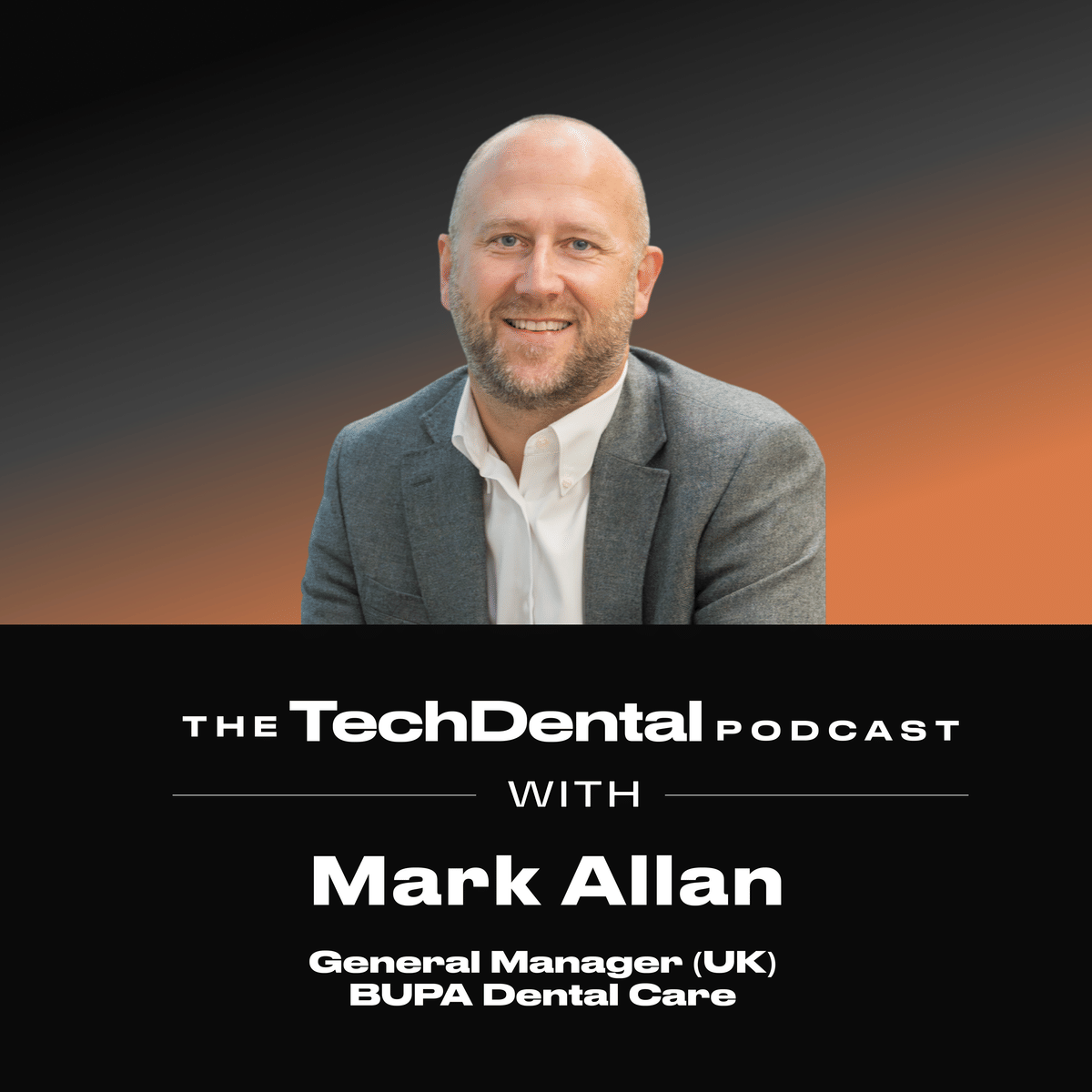
Direct answer: Running a network of nearly 400 dental practices across the UK is not primarily a technology challenge or a commercial challenge. It is a leadership challenge. Mark Allan, Chief Executive of Bupa Dental Care, brings a perspective shaped by senior roles in financial services and insurance before entering healthcare. His assessment of what corporate dentistry must get right in the AI era is grounded in operational reality at significant scale: technology decisions made without a clear problem statement create expensive cul-de-sacs, culture cannot be mandated across 380 dispersed sites, and the real competitive advantage in the decade ahead will not come from the tools a network deploys but from the quality of the data those tools generate and connect. The practices and organisations that understand the difference between technology adoption and intelligence infrastructure will define what the dental industry looks like by 2030.
What Do Most Leaders Get Wrong When Introducing Technology Into a Large Dental Organisation?
The most common failure in technology adoption across large dental organisations is not poor execution. It is poor problem definition.
Mark Allan arrived in dentistry from financial services. His first observation about the sector was not about clinical complexity or regulatory specificity. It was about a pattern of technology decision-making that he recognised immediately from other industries, and that consistently produces the same outcome.
"People often jump straight to seeing a piece of technology and then deciding that they want to implement it, rather than maybe just standing back and asking yourself what problem are you trying to solve and whether technology can help you with that. If you're not careful, you could end up implementing a square peg when really you needed a round peg for the round hole."
The second observation was about scale.
In financial services, rolling out technology to a workforce of call centre employees or home workers, all on the organisation's payroll, is difficult but structurally straightforward. A mandate can be issued, adoption can be monitored, compliance can be enforced.
Deploying technology across 380 dental practices, each functioning as a small independent business, many with self-employed clinicians who cannot simply be instructed to change how they work, is a fundamentally different challenge.
"You've got 380 different places, lots of small businesses, self-employed clinicians that you need to influence to do things your way and you can't necessarily mandate that you want those things to happen. NHS business, private business, specialist referral sites. It certainly made me be a lot more thoughtful about all the things and all the planning you need to consider before you just race ahead and implement a piece of kit."
This distinction is one of the most important in the current conversation about AI and technology adoption in dental groups. The larger the network, the more the technology question becomes a change management and culture question, not an IT question.
How Do You Balance Standardisation with Flexibility Across a Large Dental Network?
In a large inherited dental network, standardisation is essential for data security, clinical governance and operational consistency. But the application of technology and the flexibility afforded to individual practices must be calibrated to the reality of an acquired, not built, business. Mandating uniformity in a network where practices have independent histories, identities and clinical cultures creates more resistance than it resolves.
Allan is candid about the tension that every large dental group leader navigating technology rollout must manage.
"There are some things where standardisation is critical. Data security, the organisation of your data. You do need to make sure that there are minimum standards that everyone adheres to. But how you apply the technology and the flexibility you give, especially in a business like ours, is really key."
The comparison with smaller, faster-growing squat-based groups is instructive.
"I'm always quite envious when I talk to some of the smaller groups that are growing, squat practices growing, where they're able to be very clear about this is our way and if you work for us, you follow this patient flow and we want you to use this piece of kit."
Bupa Dental Care is an inherited business. Practices were acquired with existing cultures, existing ways of working, and existing relationships between clinical teams and their patient communities. Overriding those with a one-size-fits-all approach would be commercially damaging and would undermine the attraction of the network for clinicians.
"If we were to go wading in and say it's one size fits all and our way, we would very quickly have a lot of difficulty commercially. We probably wouldn't be that attractive a place to work. It's all about really understanding those local businesses and trying really hard to get into adult-to-adult, grown-up conversations where we understand each other's perspective and find the smartest way forward."
The model that works at Bupa's scale is not top-down mandate. It is negotiated standard-setting: non-negotiable floors on data security and clinical governance, combined with genuine flexibility in how those standards are implemented and how technology is applied in each practice context.
Where Is AI Having the Fastest and Most Measurable Effect at Bupa Dental Care Right Now?
AI is delivering measurable operational benefit at Bupa Dental Care today in two active pilots: AI-assisted clinical note-taking, which is producing approximately 50 per cent reduction in note-taking time, and AI diagnostic support for X-ray analysis, which is engaging patients more directly in understanding their own clinical situation. Both pilots are being rolled out with deliberate caution and a clear framework for evaluating benefits beyond the immediately obvious.
Allan describes the note-taking pilot with a precision that cuts through the superficial framing that often surrounds this technology.
"There's probably quite a short-sighted view that if you speed up note-taking then you can cram another appointment in the day. If that's the only benefits case you're looking for, I'm not sure that's the richest benefits case."
The richer case is about what the reclaimed time enables, not just what it saves.
"By just taking time out of that admin, that drudgery of writing things up, we are creating space. That space can be used in a multitude of ways. It could be used to put another appointment in the diary, but it could also be used to spend much more time with the patient explaining the care, opening up patient finance, opening up new pathways for that patient, and also at end of the day giving a really much better work-life balance."
The work-life balance dimension is commercially significant in a sector with well-documented burnout and attrition challenges. Clinicians spending evenings catching up on notes is not a neutral baseline. It is a direct contributor to the dissatisfaction that drives clinicians away from the profession or towards competitors.
Bupa has taken the unusual decision to build its own note-taking tool rather than deploying a third-party solution. The rationale reveals a strategic sophistication about data that goes beyond the immediate efficiency gain.
"The reason we've taken at this stage the decision to build something is the potential it creates through the organisation of the data. Rather than just random notes that someone can read if they ever pick up that patient's file, the fact that the data is now structured and we can now start to make connections with that data and add that to all the structured fields. That's huge for an organisation like ours."
This is the distinction between technology as a tool and technology as an intelligence infrastructure investment. The note-taking tool saves time today. The structured data it generates compounds in value over years.
We examined this distinction between operational tools and intelligence infrastructure in AI Didn't Fix Dentistry. Intelligence Will.
What Is the Real Long-Term Bet in Dental AI and Why Is Data Connectivity the End Game?
The immediate commercial benefit of AI in dental operations, time savings, administrative reduction, diagnostic support, is real and measurable. The larger and more transformative opportunity is the connection of structured clinical data across health disciplines to enable truly personalised, predictive healthcare. For Bupa, as a multi-discipline healthcare organisation with dental, medical, insurance and genomics capabilities, the convergence of that data represents a strategic advantage that is not yet fully realised but is being actively built towards.
Allan illustrates the opportunity with a personal example that brings the abstraction of integrated healthcare data into sharp relief.
"In the last six months or so, I've used my private medical insurance, had a dentist appointment, a hygienist appointment, gone up to the Cromwell Hospital to see a consultant, had a health assessment and had a full genome test. And Bupa is now in possession of that information on me. At the moment, we couldn't join all that up and draw many insights from it with any real automation. But our organisation is going strongly in that direction about trying to piece that together and get real actionable insights that can lead us to personalised healthcare and joining the dots between the mouth and the body."
The dental practice's position within this vision is particularly significant.
"What other part of the healthcare system do people voluntarily go to on average four times a year for preventative checks and allow people to put their hands in and around your mouth? It's a very personal and regular touchpoint. So I think we have a huge opportunity to influence that."
The genomics dimension is moving from theoretical to practical faster than most healthcare leaders expected.
"The genomic testing does blow your brain a little bit already with what we can tell from the human genome. I've had my test and it definitely changed my behaviour immediately. Things like knowing what your risk versus average of prostate cancer is. When I found out that mine was higher than average, that motivates me to go and get checked out more regularly. Whereas if I hadn't had that checked, I wouldn't know."
Allan's ten-year prediction is notable for the compression of timeline he expects.
"I think dentistry can play a really important part in that. That's where I'd place my 10-year bets anyway, but I suspect it won't take 10 years. What you think is going to happen in 2035 will be here in 2029 or something like that."
For dental group leaders and investors evaluating where to place infrastructure bets over the next three to five years, this data convergence thesis has direct strategic implications. The organisations building clean, structured, AI-ingested data assets today will be the ones positioned to act on personalised care intelligence when the connectivity tools to deploy it arrive.
We examined the data infrastructure requirements that underpin this future in The Great Dental Reset: Why 2026 Will Reward the Prepared, Not the Big
What Is the Bupa Clinical Training Academy and What Does It Signal About the Future of Corporate Dental Education?
The Bupa Clinical Training Academy is a physical and digital learning infrastructure investment representing a structural commitment to clinical development that goes beyond the continuing education requirements of individual practitioners. With a digital campus delivering ten times more training volume than two years ago and global faculty connections between facilities in the UK, Melbourne and Madrid, it signals that leading dental organisations will compete on clinical capability development, not just commercial scale.
Allan describes the academy's origins with a frankness about the uncertainty that preceded the investment decision.
"We made the decision about 18 months ago that we would create this training centre. I don't think at that stage we really knew exactly what it was going to look like, but it was a joint venture between ourselves, our care services business and our health services business, our hospitals and health centres. Fortunately, we had clinicians designing what was in there."
The outcomes are already measurable.
"About two years ago, we did about four training courses. We're now up to 70. This year, I think we had about 1,000 people on our most recent CPD event."
The digital campus development mirrors a pattern that the most forward-thinking dental education organisations are pursuing globally: foundational theory delivered online, hands-on skill development in simulation environments with increasingly realistic technology, and in-person mentorship for complex procedural progression.
The simulation technology at the academy, which includes immersive training environments with realistic mannequins and virtual reality capability, is the physical expression of the hybrid learning model that educational leaders across dentistry identify as the most effective pathway to accelerated clinical competency.
The faculty network is extending the academy's value beyond its physical location.
"Our most recent CPD event had clinicians from Australia joining and training people in the UK. And there are three of those globally, one in Melbourne, one in Madrid. We are starting to connect the dots between those."
The strategic rationale is not simply clinical quality. It is workforce attraction and retention.
"Clinical development and clinical progression is one of the key things that clinical professionals look for when they're looking for who they should work with. It's been a really good move for us. I think it's going to help us with clinician attraction for sure."
For dental group leaders who continue to treat education as a regulatory compliance exercise rather than a competitive differentiator, this investment signals a significant repositioning of the market.
We examined how structured clinical education pathways change the competitive dynamics of dental workforce strategy in The Competency Crisis: Why Dental Education Is Broken and How AI, Hybrid Learning and Structured Pathways Are Rebuilding It
How Does Patient Trust Connect to Clinical Confidence and What Is the Feeling at Ease Philosophy?
The Feeling at Ease campaign developed by Bupa Dental Care addresses dental anxiety not as a marketing challenge but as an operational design problem. Patient anxiety exists along the entire care pathway from appointment booking through to payment. Solving it requires clinical confidence, practice environment design, communication clarity and administrative simplicity. The blue fluffy chair image has become an internal cultural reference for an approach to human-centred practice design that extends beyond its origins as a campaign.
Allan's starting point for the Feeling at Ease work is personal.
"As a non-dentistry professional, going to the dentist was not somewhere I would ever really choose to go. It's not my favourite outing and not my favourite medical appointment."
That perspective, from a patient rather than a clinician, shaped an unusually complete diagnosis of where dental anxiety actually sits.
"The anxiety could be about trying to get an appointment. The anxiety could be about not really understanding what was going to go on when you got into the practice. The anxiety could be about how do I pay for this afterwards. So we realised there was a thread from a patient perspective, which if we could make everybody feel at ease, then that would be beneficial to welcome people more and make the practice a more welcoming place."
The clinical confidence dimension is equally important.
"There is no doubt there is a different experience between somebody who is at the base level of knowing what they're doing and somebody who's got confidence and wants to engage you in a conversation, take your mind maybe away from the treatment that's going on."
What has surprised Allan is how far the Feeling at Ease framing has travelled within the organisation beyond its origins as an external campaign.
"What's been really kind of exciting for us is it's already starting to go beyond being just a marketing campaign. That feeling, that mindset, is starting to bleed into a lot of other meetings we're having where we're talking about a different topic and someone's saying, well, hang on a minute, how do we bring the Blue Fluffy Chair mindset to this."
The concept of patient experience as a design principle, applied consistently from the first digital touchpoint through to post-treatment communication, is the same logic that drives the most effective service design in hospitality and retail. The dental practices that apply it with the same rigour will build patient loyalty that their competitors cannot replicate through clinical capability or pricing alone.
What Makes Leading in Dentistry Distinctively Challenging and Rewarding?
The defining characteristic of leading a large dental organisation is the combination of a purpose that is visibly meaningful, a workforce that is eclectic and genuinely passionate about their work, and a structural complexity that requires influencing outcomes in hundreds of small businesses without the ability to mandate them. For leaders who have developed their capability across multiple industries and leadership contexts, this combination is unusually demanding and unusually rewarding.
Allan does not describe leading in dentistry as unique. He describes it as the best leadership job he has ever done.
"It is about the people and the eclectic mix of people that you get. There's nothing better than walking into a practice, going in there, they're pleased to see you. They want to show you what they're up to. They want to tell you all the things that are not going so well."
The leadership challenge at Bupa's scale is the simultaneous requirement to maintain a coherent organisation-wide culture while preserving the individual personality of each practice.
"Every practice is like a small business and it needs to have the spirit, it needs to have the flavour of Bupa in it, but it also needs to have its own personality. So leading that kind of environment is tricky because you have to make sure that you're walking in and supporting that and nudging that in the right direction rather than mandating things."
The three principles Allan uses to guide his leadership decisions, stewardship, belonging and activism, are worth unpacking.
Stewardship is about time horizon: building something that whoever follows you will inherit in better condition than you found it.
Belonging is about creating an environment where people feel genuine connection beyond transactional employment.
Activism is about identifying where a large organisation is getting in its own way and having the confidence to go and fix it.
"You build confidence from people seeing you do that. Hiring people who are of a different mindset, you want lots of different perspectives, but you need people wired fundamentally so they're here to do the same sorts of things as you're trying to do."
The single most important skill in this environment, above commercial acumen, technology literacy or strategic thinking, is listening.
"The most important, single most important thing by a country mile in this job is listening to people and listening to the frontline and listening to the people who are serving our patients day in, day out and letting them guide us in how to move the business forward."
Key Takeaways
Technology adoption in large dental organisations fails most often at the problem definition stage, not the implementation stage. The question to answer before evaluating any tool is what specific problem it is solving.
Standardisation and flexibility are not opposites in a large dental network. Data security and clinical governance require non-negotiable minimum standards. How technology is applied within those standards requires genuine flexibility and adult-to-adult negotiation.
AI-assisted note-taking at Bupa is delivering approximately 50 per cent reduction in note-taking time. The richer benefits case is not the time saved but the space created for deeper patient engagement and the structured data generated for future intelligence applications.
Bupa's decision to build its own note-taking tool reflects a strategic understanding of data ownership. Structured clinical notes are not just an efficiency tool. They are a long-term intelligence asset.
The real ten-year bet in dental AI is the connection of structured clinical data across health disciplines to enable truly personalised, genomics-informed preventive healthcare. Dentistry's four-times-a-year patient touchpoint gives it a unique role in that ecosystem.
The Bupa Clinical Training Academy has expanded from four courses to seventy in two years, with 1,000 clinicians on its most recent CPD event. Clinical education is becoming a workforce attraction and retention differentiator, not just a compliance function.
Feeling at Ease began as a patient-facing campaign. It has evolved into an internal cultural framework that is reshaping how the organisation approaches every touchpoint in the patient journey.
Listening to the frontline is the single most important leadership skill in a large, dispersed dental organisation. Culture cannot be mandated across 380 independent practices. It must be earned through visible responsiveness to what clinicians and patients are actually experiencing.
About TechDental
TechDental is a strategic intelligence platform for founders, executives, operators and investors shaping the future of dentistry.
Through high-level analysis and systems-focused conversations, we explore how AI, governance frameworks and operating model design influence performance, scalability and enterprise value in dental organisations.
If you are building, scaling or investing in dentistry and want independent, systems-level insight into AI, governance and capital readiness:
For strategic advisory, board briefings or keynote speaking enquiries: www.techdental.com/advisory
The future belongs to those who deploy technology with discipline.
© 2026 RIG Enterprises Limited. All Rights Reserved. This article was authored by Dr. Randeep Singh Gill and is published under the TechDental brand, a trading name of RIG Enterprises Limited (Company No. 11223423), incorporated in England and Wales on 23 February 2018, registered at 1a City Gate, 185 Dyke Road, Hove, England, BN3 1TL. All editorial content, analysis, synthesis and intellectual property contained within this article are the original work of the author and remain the exclusive property of RIG Enterprises Limited. Opinions and statements attributed to named guests reflect the views of those individuals as expressed during recorded interviews and are reproduced here for editorial and informational purposes. No part of this article may be reproduced, distributed, transmitted, republished, or otherwise exploited in any form or by any means, whether electronic, mechanical, or otherwise, without the prior written consent of RIG Enterprises Limited. Unauthorised reproduction or use of this content may constitute an infringement of copyright under the Copyright, Designs and Patents Act 1988.