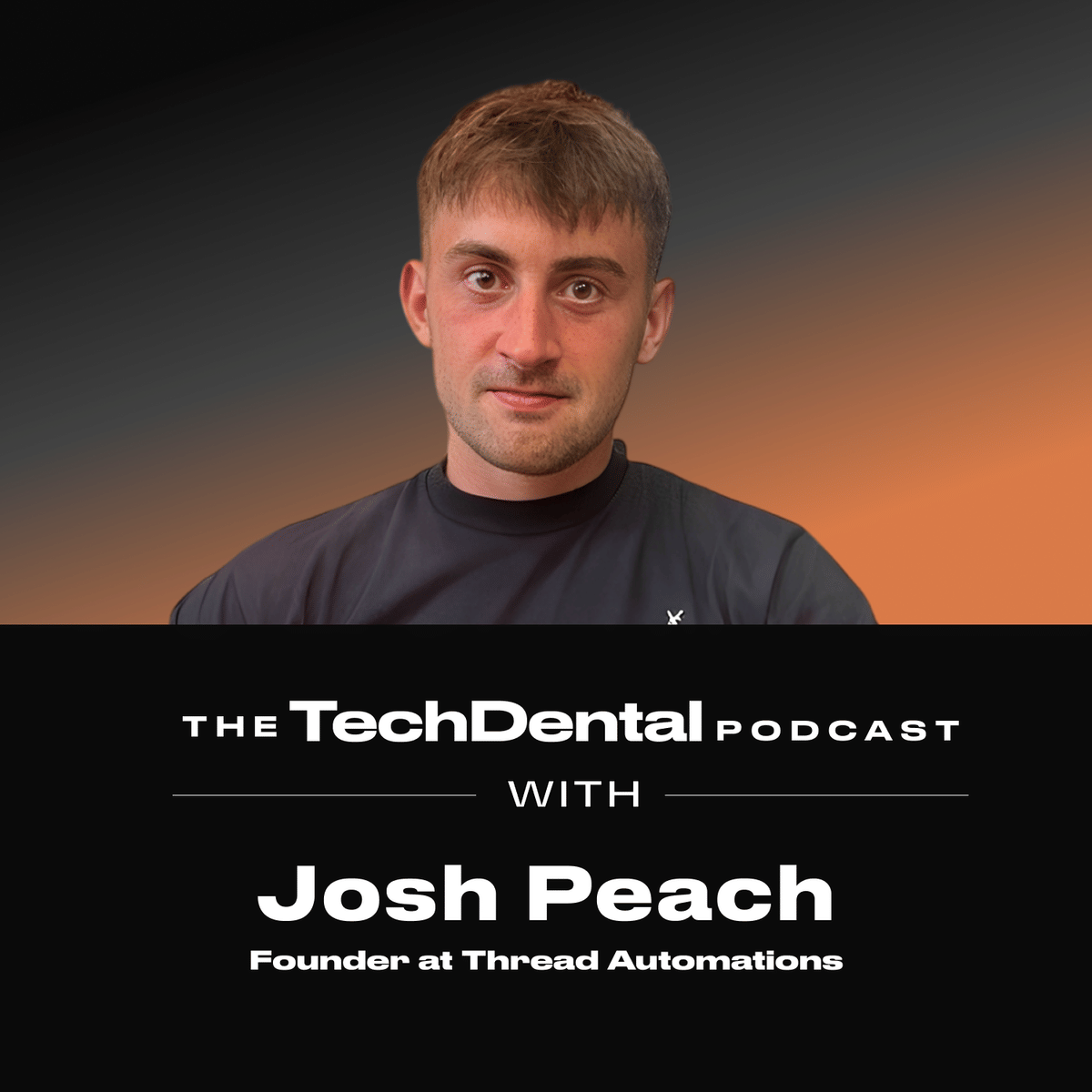
Direct answer: Josh Peach, founder of Thread Automations, argues that most dental practices are haemorrhaging both revenue and receptionist capacity because they have no system to capture patient enquiries outside working hours, and that AI chatbots and voicebots deployed across website, WhatsApp, Instagram and phone channels simultaneously can recover that lost demand at a fraction of the cost of additional headcount. Having founded Thread Automations straight out of his economics degree at the University of Manchester, Peach builds and integrates bespoke AI automation systems for dental surgeries, beginning with a structured AI audit that identifies exactly where each practice is losing time and leads before any technology is deployed. His central argument is that within five years, practices without AI-powered communication and booking infrastructure will look structurally behind, and that the window to get ahead of that curve at lower cost and lower risk is now. The immediate action for UK dental practice owners is to audit their after-hours missed calls and unresponded digital enquiries, because the revenue already being lost there is almost always larger than they expect.
There is a scenario that plays out in dental practices across the UK every single evening. A patient finishes dinner, brushes their teeth, notices something that concerns them, and reaches for their phone. They want to book an appointment. The practice website loads. There is no chat function. Their call goes to voicemail. They try again in the morning, get put on hold, lose patience and call somewhere else.
The practice never knew they called. The lead is gone. It cost nothing to lose and could have generated hundreds of pounds.
Josh Peach built Thread Automations to close exactly that gap. Founding the company in the summer after graduating from the University of Manchester with an economics degree, he identified that the dental sector had a specific and structurally persistent version of a problem he was seeing across multiple industries: the communication infrastructure of most practices was designed entirely around the assumption that patients would engage during working hours, through a phone call, to speak with a human. Everything outside those parameters was either missed or handled inconsistently.
His solution is not to replace the human. It is to ensure the human never has to be the only option.
The Communication Infrastructure Problem: Why Dental Practices Are Losing Leads They Do Not Know Exist
The framing Josh uses to describe the communication gap in dental practices is deliberately economic. Every unanswered call is not an inconvenience. It is a conversion event that failed, with a measurable cost attached to it. Every Facebook message that sat unread for 48 hours while the reception team managed the waiting room is a lead that made its own decision about where to seek treatment.
"You see so many dentists that are particularly in the private industry that have got, they're getting calls in an evening that they can't answer. A customer tries to call once, for example, they don't get an answer, they call somewhere else and next thing you know you've lost a customer that was going to pay you however much amount."
The problem is compounded by the fragmentation of the channels through which patients now attempt to make contact. A dental practice operating in 2026 may receive enquiries through its website, its Facebook Messenger, its Instagram DMs, its WhatsApp business account and its phone line simultaneously. Managing five channels with a single reception team during a busy clinical day is operationally unrealistic. Most practices solve the problem by effectively abandoning the digital channels and defaulting to phone as the only functional route in, losing a significant proportion of potential patients who prefer or exclusively use digital contact.
Josh's architecture addresses this by deploying integrated chatbots and voicebots that sit across all five channels, share data into a single CRM, and operate continuously. When a prospective patient sends an Instagram DM at 9 p.m. asking about Invisalign costs, they get an immediate, accurate, conversational response. When they call at 7:30 a.m. before the receptionist arrives, the voicebot answers, takes their information and books the appointment. By the time the reception team logs on, ten appointments may already be confirmed without a single human interaction.
"Rather than having to think, I've had three missed calls last night, I've got six emails, a receptionist can log on in the morning and there's ten appointments just been booked and they've not had to do a single thing."
Chatbots and Voicebots: The Practical Distinction and Why Both Matter
For UK dental practice owners who have encountered the older generation of website chatbots and found them frustrating, the distinction Josh draws between legacy chatbot technology and the current generation of AI-powered conversational tools is worth understanding carefully.
The chatbot that delivers a rotating set of 20 generic answers regardless of what the patient asked is not what Thread Automations builds. The voicebot that takes four seconds to respond and sounds like an automated telephone menu is not what is being deployed in modern dental AI communication systems.
"Some can be very, very generic, sound really robotic, take four or five seconds to answer every single question. And that's when I totally understand that dentists might be a bit reluctant to use it. But the voice bots that we build, they can process the information that's been asked, push it through the system, convert that back into a language within less than half of a second."
The current generation of voicebots pauses naturally, handles interruptions and learns continuously from interactions. When a response generates positive outcomes, it is reinforced. When it fails to satisfy the patient's need, the system flags it for review. A voicebot deployed on a retainer model, as Thread Automations operates, is actively improved month by month, becoming progressively more accurate, more natural and more capable of handling complex enquiries.
The chatbot side has a similarly important nuance. Rather than operating as a generic FAQ machine, a well-built dental chatbot is trained on practice-specific information, including the clinical judgements the dentist is comfortable having communicated to patients at scale. Josh's example is post-whitening sensitivity: a common reason for patient calls that consumes significant receptionist and dentist time to manage individually, but that can be handled entirely through a chatbot trained with the dentist's preferred guidance.
"The dentist can actually give answers that if they can confirm answers that they're happy giving. For example, someone calls and says they have really sensitive teeth after whitening. A dentist can say: our dentist suggests using Sensodyne, rubbing it here, putting all these different things. If it continues in a week, give us a call back."
That interaction, handled by a voicebot or chatbot at 6 p.m. on a Tuesday, saves the receptionist a five-minute call, saves the dentist a twenty-second interruption in the middle of a treatment room appointment, and gives the patient an immediate, authoritative answer from their own practice. All three parties benefit.
For analysis of how the front-of-house communication function in dental practices is being reframed as a revenue asset rather than a cost centre, see The Front Desk Is a Revenue Engine, Not a Cost Centre: How Automation and AI Are Transforming Dental Operations.
ROI and the AI Audit: Why the Business Case Needs to Be Built Before the Bot
One of the most important structural elements of Thread Automations' delivery model is the AI audit that precedes any implementation. Rather than selling a standard product and leaving practices to measure the results themselves, Josh's team works with each practice to identify precisely where time is being lost and where revenue is failing to convert, before a single line of automation is deployed.
This approach reflects a commercially mature understanding of why automation projects fail in healthcare settings. The technology is not the risk. The risk is deploying the right technology in the wrong place and measuring the wrong outcomes.
"I think a lot of it's highly dependent on why a practice might want some. So a private practice that specialises in Invisalign, for example, might be looking at lead generation, being able to answer calls and book more appointments. Or there might be some that are looking for FAQs to be answered more easily to save receptionist time so they can speak to customers that have come into the dental practice."
The KPIs that matter differ accordingly. For a private clinic with significant treatment revenue per patient, the primary metric is lead conversion: what percentage of new enquiries become booked appointments, and what proportion of those are booked outside working hours. For an NHS and mixed-practice model, the priority is often receptionist capacity recovery: freeing the team from repetitive, low-value calls so they can handle the complex patient interactions that genuinely require human judgment.
Josh's observation about practice awareness of these metrics is characteristically direct.
"Unfortunately not enough practices are tracking them. The methods that the practices have followed for so many years now are so set in stone that it's a normality to employ receptionists that answer the phone all day, answer these FAQs, book appointments. Dentists are spending time on it, and they don't realise that there's a lot of time to be saved, a lot of money to be saved by just implementing AI."
The pilot model he offers to practices reluctant to commit fully is a practical route around this uncertainty. A basic website chatbot with three core interaction paths, book, ask a question or leave a review, can be deployed in days, stress-tested by the practice team before going live, and measured over a single month against straightforward metrics. If within that month the practice has captured 40% more leads, booked a meaningful proportion of appointments out of hours and reduced FAQ call volume noticeably, the business case for expanding the automation becomes self-evident.
Data Security and Clinical Safety: The Non-Negotiable Foundation
For UK dental practice owners and group operators, the question of patient data security and clinical appropriateness is not a secondary concern when evaluating AI communication tools. It is the primary threshold question, and any automation provider that cannot answer it specifically and comprehensively should not be trusted with the communication infrastructure of a regulated healthcare business.
Josh addresses this directly. The platforms Thread Automations builds offer two distinct data handling models: ephemeral conversations where the chat is erased once complete, and stored conversations where the patient is explicitly informed at the outset that their information will be retained, held on an encrypted external platform and accessible for quality review.
"As long as you say at the start of a call that we're recording this call for training and monitoring purposes, you're allowed to store their information. As long as it's stored securely, you're allowed to store their information."
The clinical content of voicebot and chatbot responses is subject to explicit dentist approval before any answer goes live. The model is not one where the AI is making clinical judgements autonomously. It is one where the AI is delivering, at scale, answers that the dentist has already reviewed and confirmed.
"Before we allow the chatbot or the voice bot to give these answers out for certain questions, we go to the dentist and say, do you agree or disagree with these statements that we're giving? Can we tell the customer to brush with Sensodyne for three days and if it still feels sensitive, give us a call back?"
Any question that falls outside the pre-approved response library is routed immediately to the human reception team. The escalation logic is not an afterthought. It is a core design principle.
For analysis of how the compliance and data governance landscape is shaping AI adoption across UK dental groups, see People-First AI: Why Most AI Projects Fail in Dentistry (and How Leaders Get It Right).
Voice Cloning and the Next Frontier: What Is Coming Within 12 Months
One of the more instructive aspects of Josh's perspective is the combination of honesty about current limitations and specificity about what is coming next. On the question of whether a voicebot can be trained on the actual voice of a specific dentist or receptionist, his answer is accurate and appropriately qualified.
The technology to convincingly map a small sample of recorded speech onto a fully expressive conversational voice is not yet widely available in a production-ready form. But Josh is explicit that this is a six-to-twelve-month horizon rather than a multi-year one.
"I reckon within the next six to 12 months, it's almost guaranteed that you'll be able to speak 500 words for example into a bot and then that can develop a voice that it replies from. Because as you can imagine, being a dentist yourself, if you're in Sheffield where I live and you are speaking to a voice bot and it sounds like someone with a South Yorkish accent replies, it's a lot more comforting than if someone with a totally generic non-accent replies."
This development matters for several reasons beyond the obvious comfort factor. Nervous dental patients, a significant segment of the UK patient population, have a qualitatively different experience when a communication feels familiar and locally grounded. A voicebot that sounds recognisably like the practice, using the voice of a known receptionist or principal dentist, will generate a measurably different level of patient confidence than a generic AI voice. When voice cloning reaches production quality at scale, the practices that have already built their automation infrastructure will be best positioned to upgrade it.
The broader product roadmap Josh describes follows the same logic: start with the foundational chatbot and voicebot infrastructure, measure what is working, and build upward in complexity as the practice's confidence and the technology's capability develop in parallel. The practices currently getting this infrastructure right at the basic level will be several iterations ahead of those starting from scratch when the more sophisticated capabilities arrive.
The Competitive Horizon: Why Waiting Is the Most Expensive Decision
Josh's framing of the five-year competitive dynamic is straightforward and based on the pattern he has already observed in other industries that adopted AI communication tools earlier than dentistry.
"I think in five years, people will look stupid if they've not implemented it by then. So why not get ahead of the curve now and start saving yourself costs and generating more revenue earlier on."
This is not a sales argument. It is an observation about compounding advantage. The practice that begins capturing and converting out-of-hours leads this year will have, by 2030, accumulated a patient panel and revenue base that reflects several additional years of lead conversion. The practice that waits until the technology is more established will be starting that compounding process several years behind.
For UK dental practice owners and group operators evaluating their technology investment priorities, the specific and measurable nature of the return from AI communication automation is one of its most useful attributes. Unlike some AI investments that operate at a strategic level with diffuse returns, the economics of chatbot and voicebot deployment are direct and auditable: fewer missed calls, more out-of-hours bookings, less receptionist time spent on FAQ triage, and more human attention available for the complex, relationship-defining interactions that drive patient loyalty.
"We've generated 40% more leads, we're booking appointments, 50% of our appointments are getting booked out of office hours and we're getting 20% less phone calls about random FAQs. From that we can see we've saved this much time, receptionist time, they've done this much more valuable stuff, we've generated X much more revenue."
The pilot model exists precisely to make the decision less risky. No practice needs to commit to a full automation stack without evidence. The starting point is a single, well-built chatbot on the website, measured over one month, with clear metrics agreed in advance. The data from that month will either validate the investment and justify expanding it, or it will not. Either way, the practice will have answered the question with evidence rather than assumption.
For analysis of how the data infrastructure required for AI tools to deliver their full potential connects to the wider digital transformation journey of UK dental practices, see The Great Dental Reset: Why 2026 Will Reward the Prepared, Not the Big.
Key Takeaways
UK dental practices are losing a quantifiable volume of leads every day to unanswered out-of-hours calls and unmonitored digital channels. This is not a speculative risk. It is a measurable revenue gap that an AI audit can size before any technology is deployed.
The difference between a frustrating legacy chatbot and a well-built AI communication system is the training data, the iterative improvement model and the escalation logic. A chatbot that delivers the dentist's own pre-approved clinical guidance, routes complex queries to a human immediately and learns continuously from patient interactions is a fundamentally different product from a FAQ widget.
Voicebots can already handle a minimum of five simultaneous calls, operate 24 hours a day, seven days a week, and respond in under half a second. These are not experimental capabilities. They are production-ready features available to UK dental practices today.
The pilot model is the lowest-risk entry point into AI communication automation. A basic website chatbot, deployed in days, stress-tested by the practice team before going live and measured over one month against agreed KPIs, provides an evidence base for investment decisions that removes most of the implementation risk.
Patient data security in AI communication systems is managed through a combination of ephemeral chat options, encrypted external storage with explicit patient consent, and the structural principle that no clinical content is delivered by the bot without prior dentist approval. The regulatory framework is the same as for any recorded call: inform the patient, store securely, review regularly.
Voice cloning at production quality, allowing a voicebot to speak in the recognisable voice of a specific dentist or receptionist, is a six-to-twelve-month horizon. Practices building their AI communication infrastructure now will be best positioned to add this capability when it arrives.
Persistence is more valuable than pivoting in early-stage technology adoption. The practices that commit to making one automation work well and measure it rigorously will extract more value than those that trial multiple tools superficially and abandon them at the first sign of friction.
About TechDental
TechDental is a strategic intelligence platform for founders, executives, operators and investors shaping the future of dentistry.
Through high-level analysis and systems-focused conversations, we explore how AI, governance frameworks and operating model design influence performance, scalability and enterprise value in dental organisations.
If you are building, scaling or investing in dentistry and want independent, systems-level insight into AI, governance and capital readiness:
For strategic advisory, board briefings or keynote speaking enquiries: www.techdental.com/advisory
The future belongs to those who deploy technology with discipline.
© 2026 RIG Enterprises Limited. All Rights Reserved. This article was authored by Dr. Randeep Singh Gill and is published under the TechDental brand, a trading name of RIG Enterprises Limited (Company No. 11223423), incorporated in England and Wales on 23 February 2018, registered at 1a City Gate, 185 Dyke Road, Hove, England, BN3 1TL. All editorial content, analysis, synthesis and intellectual property contained within this article are the original work of the author and remain the exclusive property of RIG Enterprises Limited. Opinions and statements attributed to named guests reflect the views of those individuals as expressed during recorded interviews and are reproduced here for editorial and informational purposes. No part of this article may be reproduced, distributed, transmitted, republished, or otherwise exploited in any form or by any means, whether electronic, mechanical, or otherwise, without the prior written consent of RIG Enterprises Limited. Unauthorised reproduction or use of this content may constitute an infringement of copyright under the Copyright, Designs and Patents Act 1988.