May 30, 2026 | 13 min read
🎧 Listen to the full episode: Spotify | Apple Podcasts | YouTube
Direct answer: AI is not a technology upgrade. It is a structural change in how dental businesses operate, compete, and create value. Chris Barrow, who has coached over a thousand UK dental practices since 1997, argues that every previous technology wave asked how to build a better mousetrap. AI asks what to replace the mousetrap with. That distinction changes the business model decision underneath every tool selection, and most dental practice owners in the UK are not making it deliberately.
Why AI Is Categorically Different From Every Previous Technology
The argument that AI is different from every previous technology wave is made constantly and usually badly. It relies on scale comparisons, capability benchmarks, and adoption rate charts that sound impressive and explain almost nothing about what a dental practice owner should actually do.
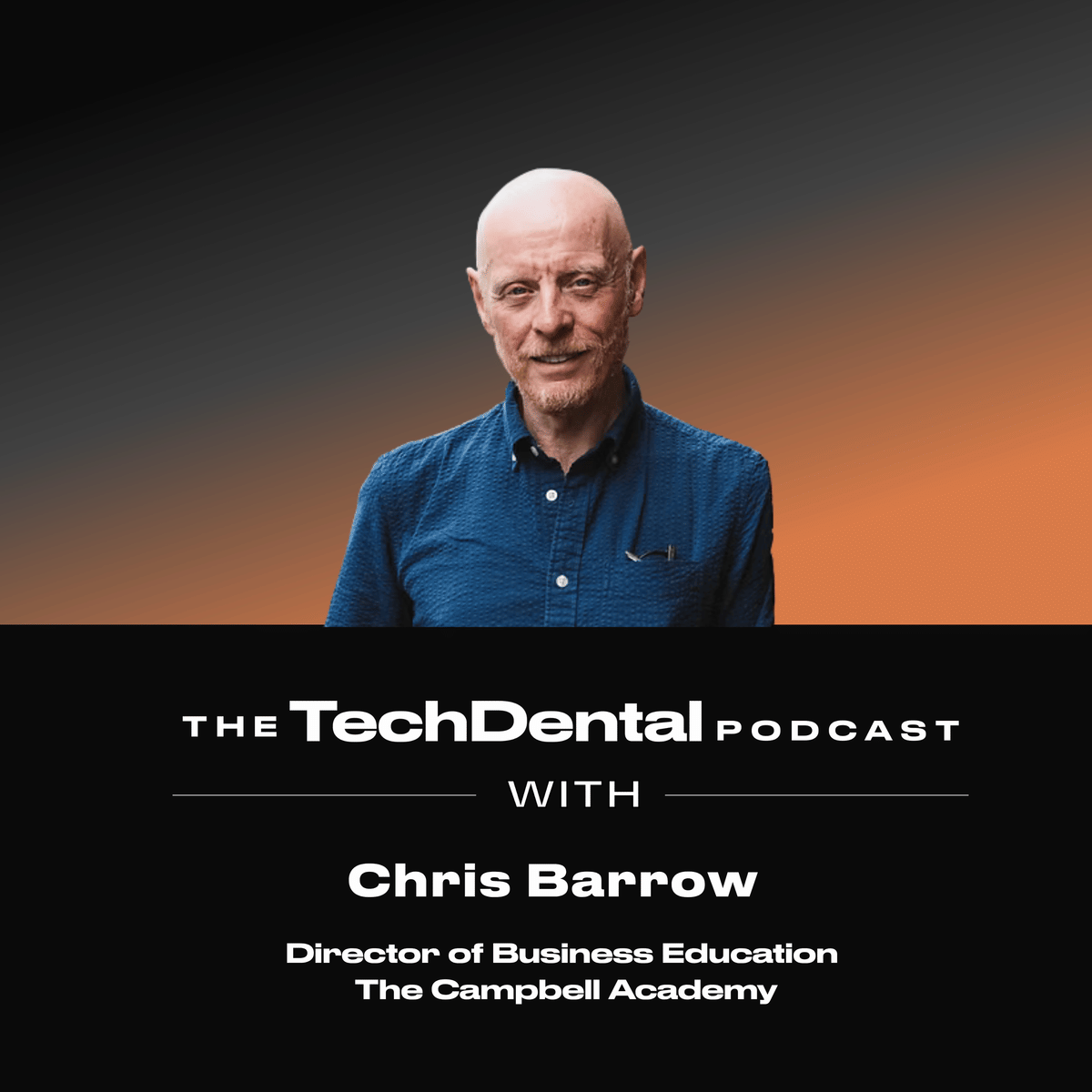
Chris Barrow makes the argument differently. He has been coaching UK dental practices since 1997. He has been inside over a thousand of them. He recently sold his business, which is now part of the Campbell Academy, where he works alongside his good friend and business partner Colin Campbell. When he describes the AI wave as categorically different from every previous technology wave, it is not enthusiasm. It is the conclusion of someone with decades of insider experience who is making a precise structural distinction that most AI commentary fails to make.
In Chris's framing, every technology advance since the industrial revolution has been a variation on the same question: how do we build a better mousetrap? The spinning jenny, the steam engine, digital radiography, cloud PMS, smartphone booking systems. All of them are improvements to existing processes. Faster, cheaper, more accurate versions of things humans were already doing.
AI asks a different question. Not how do we build a better mousetrap, but what could we replace the mousetrap with. That structural difference, the shift from optimisation to substitution and creation, is why he describes AI as a quantum change rather than a technology upgrade.
"Everything that we have done so far has been nothing other than trying to build a better mousetrap since the 1700s. What has happened with AI is that we are now actually able to ask a different question, which is not how do we build an even better mousetrap, but what could we replace the mousetrap with?"
Chris Barrow
The practical evidence he draws on is his own. A personalised GPT trained on 30 years of dental business coaching methodology, on more than 100 UK dental client businesses, and on practices across India and internationally now handles an expanding share of his daily work. The adoption curve for AI in dentistry, he argues, will compress relative to every previous technology wave. Two years ago there were very few AI tools that could support every function in a dental practice. Today there is not a single role in dentistry without an AI support option available. The laggards of this cycle will not have a decade to catch up.
The Time Dividend: A Business Model Decision, Not a Technology Decision
The most commercially significant argument in this episode is not about which AI tools to buy. It is about what you do with the time dividend they create.
Every AI deployment in a dental practice, whether it is an intelligent phone system, a CRM with automated patient communication, an AI-driven financial monitoring platform, or a treatment plan presentation tool, creates time. The question of what to do with that time is the actual strategic decision. And it is one that most practices are not making deliberately.
"There is nothing that escapes the attention of AI driven business systems. Nothing. Every role in dentistry now has an AI support facility available to it."
Chris Barrow
Chris Barrow's framework draws on Will Guidara's hospitality philosophy from Unreasonable Hospitality. Guidara, who ran 11 Madison Park in New York, argues that service is the thing you do and hospitality is the way you make people feel while you do that thing. In a dental context this distinction is commercially precise. The clinical delivery is the service. The experience of every patient interaction, from the first phone call to the post-treatment follow-up, is the hospitality. And hospitality is what drives retention, referral, case acceptance, and lifetime value.
AI deployed as a hospitality amplifier rather than a headcount reduction tool changes what the business produces. A treatment coordinator freed from administrative and communication overhead can invest that time entirely in the human experience of guiding a patient through a treatment decision. A front-of-house team no longer managing manual booking processes can focus on the quality of every patient interaction rather than the quantity of calls processed. A practice manager with AI handling financial monitoring and reporting can direct their cognitive energy toward leadership and team development.
"Can AI driven technology give your front of house team the time to deliver more hospitality, whether telephone or face-to-face? You have treatment coordinators. Same question. You have dental nurses. Same question. Every single role."
Chris Barrow
This is a genuine business model innovation argument, not an efficiency argument in different language. The practices that deploy AI primarily as a cost reduction tool will produce leaner operations. The practices that deploy it as a hospitality amplifier will produce patients who stay longer, refer more actively, accept more treatment, and return more reliably. The commercial difference between those two outcomes, measured over five to ten years in patient lifetime value and practice enterprise value, is material.
The Golden Goose: The Business Model AI Makes Newly Achievable
The structural model that AI makes newly achievable is one that Chris has been developing for several years. He calls it the Golden Goose. The essential argument is that the default dental practice model, built around the owner as primary clinician, primary manager, and primary value driver, is structurally fragile and increasingly difficult to exit at the valuation the owner expects.
A Golden Goose practice is built differently. All clinical delivery is carried out by associates and clinicians who are genuinely invested in the practice's outcomes. Management is led by a managing director with real authority and a clinical director with real governance accountability. Crucially, both carry equity stakes. Colin Campbell describes the meeting point of profitability and ethics in this model as "Prethics": neither is sustainable without the other, and neither attracts the calibre of leadership required without genuine skin in the game.
"A Golden Goose practice is one that allows you, as the owner, should you wish to terminate the delivery of clinical dentistry yourself, and gives you the option to terminate your role as chief executive and managing director. You go and sail around the world for six months, you come back and it is all still there, but you still own it."
Chris Barrow
AI makes the Golden Goose model more practically achievable than at any previous point in the industry's history. The administrative, operational, and communication overhead that historically required either heavy owner involvement or large administrative teams can now be carried significantly by AI-driven business systems. Financial monitoring, patient communication workflows, marketing automation, CRM management, HR administration: every one of these functions now has an AI support layer available. The human roles that remain are the ones that require judgement, relationship, and clinical expertise. Those are exactly the roles a well-structured senior leadership team can own.
The practice that builds this model correctly is not just more efficient. It is structurally more valuable, more defensible, and more resilient to market volatility. If a buyer emerges at the right price, the option exists. If not, the practice generates a sustainable return on investment for its owner without requiring their daily operational presence.
The Market Cycle and Why the Timing Matters
The 30-year corporate acquisition cycle that shaped UK dental M&A is ending. The largest corporate groups are not acquiring. They are consolidating portfolios, closing under-performing locations, and moving toward supercentre models.
In sectors where institutional finance and AI investment intersect, a pattern is emerging. More than a quarter of large private sector companies in the UK anticipate cutting headcount as AI takes hold, according to CIPD research from 2025, with clerical and administrative roles cited as most at risk. Technology, professional services, and financial services are already seeing this play out at scale.
Whether the same logic arrives in dental, particularly in PE-backed groups under margin pressure, remains to be seen. But the structural incentive exists: AI-driven efficiency deployed against a cost base, in an environment where returns need to be demonstrated to institutional investors, produces a predictable pressure.
There is another way. AI deployed not to reduce people but to give people more time, more capacity, and more freedom to do the work that actually builds a practice's long-term value. The hospitality layer. The patient relationships. The clinical quality. The governance infrastructure. That is the model Chris has been building toward for three decades, and AI is the first technology that makes it practically achievable at practice scale without requiring a corporate budget to get there.
Independent buyers drove nearly 70% of UK dental transactions in 2024/25 at an average price of just under £800,000. For practices built with a multimillion-pound exit as the primary objective, the buyer pool is structurally thin.
The multi-layered earnout and "share-in-Topco" model used by many institutionally backed groups has produced what Chris Barrow describes directly as a Southsea Bubble dynamic: successive rounds of acquisition at increasing multiples, funded by institutional capital seeking a liquidity event that requires an even larger buyer downstream. Every bubble resolves the same way.
"I can't guarantee that you can sell your business. But I can guarantee that if you do the homework, you can build a business that will run itself."
Chris Barrow
The cycle will turn. It always does. But the practices that used this window to build genuine operational independence, AI-enabled delivery, and governance infrastructure are the ones with a real option when it does. The 100-year business, as Colin Campbell calls it, is not a consolation prize for a failed exit strategy. In the current environment it is the more rational thesis.
What This Means for Dental Founders, Operators, and Investors
The question this episode forces is not which AI tools to deploy. It is whether the business model underneath the AI deployment is capable of capturing the value the technology creates.
AI deployed into a practice built around owner-dependence and exit-plan thinking will produce incremental efficiency gains. It will not produce the hospitality transformation, the operational independence, or the structural enterprise value that the technology makes possible when deployed into a model designed to receive it.
The distinction between deploying AI inside an old model and building a new model with AI is the most commercially important question in UK dentistry right now. The practices that understand it early will compound their advantage month by month. The ones that discover it late will find the gap considerably more expensive to close.
Key Takeaways
AI in dentistry is a structural change, not a technology upgrade. The question is not which tools to buy but what kind of business to build around them.
Every AI deployment creates a time dividend. Whether that dividend funds headcount reduction or hospitality improvement is the defining strategic decision for every dental practice owner in the UK right now.
The Golden Goose Practice model, built around a managing director, a clinical director, and genuine equity alignment, is more achievable with AI than at any previous point in dental history.
The 30-year corporate acquisition cycle is ending. Independent buyers now drive the majority of UK dental transactions at an average of just under £800,000. The practices building for operational independence are better positioned for this environment than those still building for a multimillion-pound exit.
The laggards of the AI adoption cycle will not have a decade to catch up. The adoption curve for AI is compressing relative to every previous technology wave. The window to position correctly is now.
This article draws on the TechDental conversation with Chris Barrow, dental business coach, coachbarrow.com and the Campbell Academy. Full episode on Apple Podcasts, Spotify, and YouTube.
About TechDental
TechDental is a strategic intelligence platform for founders, executives, operators and investors shaping the future of dentistry. Through high-level analysis and systems-focused conversations, we explore how AI, governance frameworks and operating model design influence performance, scalability and enterprise value in dental organisations.
www.techdental.com | info@techdental.com
The future belongs to those who deploy technology with discipline.
Copyright Dr Randeep Singh Gill and RIG Enterprises Limited (Company No. 11223423) 2026. All Rights Reserved. TechDental is a trading name of RIG Enterprises Limited, incorporated in England and Wales on 23 February 2018, registered at 1a City Gate, 185 Dyke Road, Hove, England, BN3 1TL. Opinions attributed to named guests reflect the views of those individuals as expressed during recorded interviews. No part of this article may be reproduced without the prior written consent of RIG Enterprises Limited.