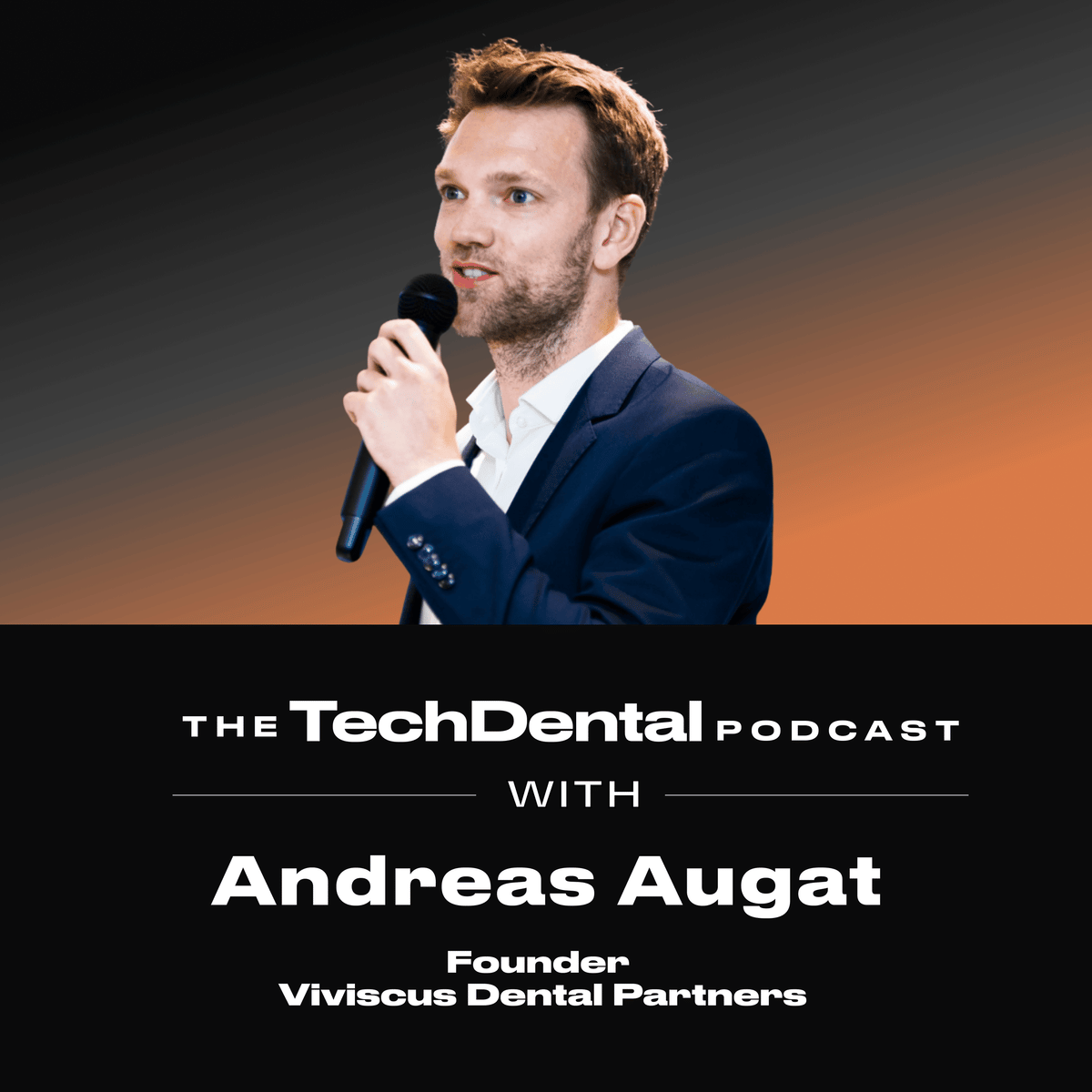
Direct answer: The dental AI and software market now contains more than 550 distinct solutions. Yet a significant proportion of dental clinics globally are still operating on paper and pen. The gap between the volume of technology available and the rate of meaningful adoption is not a technology problem. It is an intelligence problem. Andreas Augat, founder of Viviscus Dental Partners and creator of DentAIware, the dental AI and software market intelligence platform, spent a decade inside Straumann as it grew from 700 million to 2.3 billion Swiss francs in revenue. His conclusion after cataloguing the entire landscape: the differentiator in dentistry's next decade will not be which tools a practice owns. It will be the intelligence to know which tools to choose, how to integrate them and in what order.
What Did a Decade at Straumann Teach About Innovation at Scale?
Most people who enter dentistry do so through clinical training.
Andreas Augat entered through a graduate programme in business administration and marketing. No dental background. No prior exposure to the profession beyond routine patient visits. What followed was ten years inside one of the most consistently innovative organisations in global healthcare.
The lesson he carried out of that decade is precise.
"What gets you here will not get you there. You need to keep growing. You need to grow yourself, grow with the company."
That principle sounds simple. Its implications for dental group leaders and operators are significant. The systems, cultures and behaviours that build a practice to five sites will not automatically scale it to twenty. The management instincts that work at twenty sites will be inadequate at fifty. Growth requires deliberate reinvention at each stage, not incremental refinement of what already exists.
Straumann's trajectory over those ten years, consistent annual growth of ten to fifteen per cent across revenue and people, was not the product of a single innovation. It was the product of an organisation that treated the question of what comes next as a permanent operational discipline rather than a periodic strategic exercise.
"You need to be a very innovative company in order to grow year after year. Just staying where you are today, that won't work."
That discipline is what Augat brought to his analysis of the dental technology landscape when he left. And what he found when he began mapping that landscape was both an extraordinary opportunity and a significant structural problem.
What Is the Real Scale of the Dental AI and Software Market and Why Does It Matter?
The dental AI and software market currently contains more than 550 distinct solutions across imaging, diagnostics, patient engagement, practice management, compliance, business intelligence and workflow automation. The sheer volume of options has itself become a strategic risk for practices and DSOs attempting to evaluate and procure technology.
This is the foundational insight behind DentAIware.
Augat did not build a product catalogue. He built a market intelligence platform because the market had grown beyond the capacity of any individual practice, group or even DSO procurement team to navigate without structured external intelligence.
"On my platform now I have over 550 different software solutions and AI tools for dentists, for the dental industry and for dental professionals. Very specific niche, but the sheer amount of different tools that are in the market is overwhelming for the majority of people. Who would be able to look at 550 different, or even more? Probably there are hundreds more solutions out there that I haven't even mapped out yet."
The proliferation has been accelerated by two intersecting forces. The first is the genuine maturation of AI capability in computer vision, natural language processing and speech recognition, all three of which have direct and valuable applications in dental workflows. The second is the arrival of technology companies from outside dentistry who have identified the sector as commercially attractive without necessarily understanding the clinical workflows, patient journey nuances and regulatory environment that make dental different from other professional services markets.
"You have companies coming into dentistry that have no clue about dentistry, but they think there's good money to make. And they all have great products, great software, but understanding dentistry is important. Understanding how it works, what works differently, especially when we're talking clinical workflows, the patient journey in dentistry."
The result is a market where identifying a tool that addresses a genuine need is genuinely difficult. Where the signals of vendor quality are obscured by marketing noise. And where practices that make poor procurement decisions do not always discover the problem until they have already invested significant time and resource in implementation.
What Are the Three Domains of AI That Are Actually Delivering Value in Dentistry Today?
AI is delivering measurable clinical and operational value in dentistry today within three specific technical domains: computer vision applied to diagnostic imaging, natural language processing applied to documentation and patient communication, and speech recognition applied to telephony and workflow automation. Everything currently marketed as AI in dentistry falls within one of these categories.
Augat's technical framework for understanding AI in dentistry is one of the clearest currently available to non-technical dental leaders.
The starting point is a distinction that most vendor conversations obscure: everything that exists and functions today is artificial narrow intelligence. Not general intelligence. Not superintelligence. Tools that are exceptionally good at one specific, narrow task.
"Everything we have today are basically ANIs, artificial narrow intelligence tools. They are very good at one thing, and one thing only, or maybe two, but a very narrow field. They can enhance human work and human capabilities, but they will never ever replace."
Within computer vision, the diagnostic X-ray tools represent one of the most mature applications. AI that reviews radiographs and surfaces potential pathologies is not replacing the clinical judgement of the dentist. It is providing a second layer of pattern recognition that is particularly valuable at the end of a long clinical day when human fatigue affects detection accuracy.
"How can you expect that even the dentist is working on the same level every single day, all day long? So here's an AI that can support you in finding pathologies on an X-ray, which is a very repetitive task if you think about it."
Within speech recognition, the AI voice telephony use case is further advanced than most practice owners realise. The value proposition is not the automation of calls for its own sake. It is the liberation of reception staff from constant telephone interruption so they can do the work they were actually employed to do: direct, personal interaction with patients in the practice.
"If you're looking at this first use case of AI voice bots and telephone solutions, it's a great thing that finally you free up the receptionist to do the work that they were supposed to do and they love to do, which is the direct personal interaction and not being on the phone all the time."
Within natural language processing, documentation tools that convert clinical conversations into structured notes represent a significant efficiency gain. The common thread across all three domains is identical: AI is not replacing the clinician. It is removing the low-judgement repetitive work that consumes clinical time without contributing to clinical outcomes.
We examined the ambient AI documentation opportunity in detail in Burnout in Dentistry Is Not a Wellbeing Crisis
Is AI Humanising Dentistry Rather Than Replacing Its Human Element?
The counterintuitive thesis emerging from the most rigorous analysis of AI adoption in dentistry is that AI, implemented correctly, increases the quality of human interaction in the clinical environment rather than diminishing it. By absorbing administrative and repetitive cognitive tasks, AI creates the conditions for dentists to spend more genuine time with patients.
This is a reframe that challenges the dominant cultural anxiety about AI in professional services.
Augat makes the case directly.
"Maybe it's a contrarian view, but we might even be in a place where we say AI is humanising dentistry. Because since we are freeing up time, dentists can spend much more quality time with the patients, to explain, to communicate. And I think that is something that is so valuable for the patients as well, to build up this trust, to build up this relationship."
The logic is sound. The administrative load that currently sits on dentists and clinical staff is not contributing to patient outcomes. It is consuming the cognitive and temporal resources that could be directed at the human elements of clinical care that AI cannot replicate: empathy, communication, judgement, relationship.
When AI absorbs the repetitive, the mundane and the mechanical, what remains is precisely the work that clinical professionals trained for and that patients value most.
"Even though there are some people who think AI is a doomsday and will replace all people, I think quite the contrary can be achieved. If we do it right, then we actually will see that AI will humanise dentistry."
The implication for practice leaders is important. Framing AI adoption internally as a technology initiative is likely to generate resistance. Framing it as an initiative to give clinical staff more time for patient care, to reduce the administrative burden that drives burnout, is both more accurate and more likely to generate the team engagement that successful adoption requires.
We examined how AI adoption spreads through clinical teams and what stops it in People-First AI: Why Most AI Projects Fail in Dentistry
What Must Be in Place Before Any AI Tool Is Implemented in a Dental Practice?
The two prerequisites for successful AI implementation in any dental practice or group are people readiness and data quality. AI learns from existing data. If the underlying data is incomplete, inconsistent or poorly structured, AI will not fix it. It will amplify the dysfunction. Similarly, even the most capable AI tool delivers no value in a team that is not ready or motivated to use it.
This is the most important practical guidance for any dental leader currently evaluating AI procurement, and it is consistently underemphasised in vendor conversations.
Augat states it without qualification.
"AI by definition needs a lot of data. AI is learning from your data. So depending on how your dental clinic is set up and how you've managed it in the past, you know, shit in, shit out. If the data that you already have doesn't work and you've never invested in managing your data and having clean data, be it in your patient database or in your clinical work, your X-rays, your CBCTs, whatever it is, if that's all a mess, then no AI will fix it."
The people dimension is equally foundational.
"Even the best tool, if nobody's using it, will be useless. And then the next question you should ask is, am I ready as well from an infrastructure point of view?"
The sequence Augat recommends for any practice or group beginning the AI adoption journey is deliberate and sequential. Start with people. Assess team readiness, motivation and openness to change. Then assess data quality. Identify the gaps, clean what can be cleaned, document what has not been documented. Only then begin evaluating tools.
"Start with your people and start with your data. If you get this right, everything else down the road will be so much easier."
Once those foundations are in place, the tool selection process has a clear starting point: where are the biggest inefficiencies? What are the most time-consuming manual, repetitive tasks that could be automated? What processes are broken and why?
"We must come to a place where we look at the problems or the issues out there, the challenges, and then we find solutions according to how we can overcome those challenges. What are the biggest issues? Where do we spend most time? Manual repetitive tasks that could be automated. Looking at these first."
The risk of inverting this sequence, of beginning with an impressive tool and retrofitting it onto an unprepared organisation, is not simply wasted investment. It is something more damaging. Practices that implement AI into unprepared environments and find it does not work do not conclude that their data was inadequate or their teams were not ready. They conclude that AI does not work. That conclusion spreads through the community and creates resistance to adoption that takes years to overcome.
"I think the harmful thing is not only will they get confused, but they will actually give up on AI because they will see these tools don't work."
How Should DSOs and Multi-Site Groups Think About Technology Procurement Strategically?
Technology procurement in multi-site dental groups and DSOs requires a strategic framework built around three questions: what problem are we solving, how does this tool integrate with what we already have, and are we building a tech stack that avoids dangerous dependency on any single vendor?
The fragmentation of the dental technology market creates a procurement challenge that is fundamentally different for groups and DSOs than for single practices.
A single practice acquiring its first AI tool faces the challenge of selection. A group of fifty sites faces the compounding challenge of interoperability: how do different systems across different sites, often acquired as part of practice acquisitions with pre-existing tech stacks, communicate with each other and provide a coherent operational picture at group level.
"Interoperability today is a huge topic. It's not that we are missing on the number of tools. What we're missing maybe is how they work together. And a DSO maybe with 50 clinics, if they would have different PMS systems in every single clinic, they would be in huge trouble."
The vendor lock-in risk is a related and equally significant concern.
"You don't want to lock in to one vendor where there might be one vendor out there promising they have everything on the shelf and you can get everything from one vendor. What happens if they are down? What happens if their technology is no longer supported? They are raising the prices through the roof. So you're too dependent on just one."
The alternative Augat advocates is a deliberately heterogeneous tech stack: multiple suppliers whose tools integrate through open APIs, creating flexibility and resilience without creating complexity that undermines usability.
"Building up a heterogeneous tech stack that is supported by different suppliers, but still integrates so that you can use all the data across all systems, is super important."
The practical starting point for any group evaluating its current infrastructure is cloud migration. This is the foundational step that precedes meaningful AI adoption.
"Looking for tools that are open and have easy API access so other tools can connect as well is super important. The solutions that are really open and up for collaboration will be the ones that finally will succeed."
The market consolidation implication of this is significant. Vendors who claim openness while protecting their data and integration interfaces will be outcompeted by vendors who genuinely collaborate. The winners in the dental software market over the next five years will not be those with the most features. They will be those whose platforms make it easiest to connect the right tool for each specific clinical and operational need.
We examined the relationship between operational data infrastructure and enterprise value in You Cannot Buy Growth Before You Buy Control
How Are Investors Currently Reading Technology Adoption in Dental Businesses?
Sophisticated investors evaluating dental businesses are increasingly using technology adoption and data infrastructure maturity as a proxy for operational discipline and management capability. A practice or group that can demonstrate clean data, integrated systems and measurable AI-driven efficiency is signalling something more important than technology savvy. It is signalling that the fundamentals of the business are in order.
This is the investment lens through which AI adoption in dentistry is beginning to be evaluated, and it is one that most dental leaders have not fully internalised.
Augat is explicit about what investors are actually looking for and what they can see through.
"With a solid tech stack in place, a dental clinic or a small group is more valuable. If you can prove that you have the culture in place, you have the data in place, and based on these pillars, you have put on top some tools that really drive efficiency, drive quality as well, drive patient experience. All these will prove that this specific clinic or group or DSO has done its homework. And that will mirror as well in their valuation and attract investors."
The inverse is equally readable.
"There might be people out there who don't have the basics in place, and they just get some fancy tools, put it on their slides, and want to impress investors. And I think they can read through that. They can see that these tools, if you don't have the basics in place, will not have a huge impact on top line or bottom line."
The strategic implication for dental leaders planning for capital events over the next three to five years is direct. The investment in data infrastructure, team readiness and integrated systems is not merely an operational improvement exercise. It is a valuation exercise. The businesses that complete that foundational work before they go to market will command materially higher multiples than those that present impressive tool lists on top of fragmented, poorly documented operations.
We examined the relationship between operational infrastructure and investor confidence in The Great Dental Reset: Why 2026 Will Reward the Prepared, Not the Big
What Does the Dental Industry's Collaborative Culture Mean for AI Adoption?
Dentistry's unusually collaborative professional culture, which even seasoned operators from other industries consistently identify as distinctive, creates a network effect that accelerates the adoption of genuinely effective AI tools and filters out those that do not deliver measurable results. Peer credibility, not vendor marketing, is the primary adoption driver in the dental community.
This is an observation that Augat, as someone who entered dentistry from outside, is particularly well-positioned to make.
"In dentistry, there is competition, but it's a different kind of competition. It's still human-centred. People get together at the end of the day and celebrate each other's successes. And that's again going to be a nice environment to introduce something like AI, because when a tool works, people will talk about it and they will tell others how it works."
The implications for both vendors and practice leaders are significant.
For vendors, the route to sustainable market position in dentistry is not the quantity of features or the sophistication of marketing. It is demonstrated, documented, peer-validated impact in real clinical environments.
"Peer credibility is so important. Showing how a tool or software and AI is actually working and what it has achieved in one clinic will help other dentists really understand what they can do, what they can achieve with that specific tool. So having these use cases from real users, from dental professionals using the software, is becoming so important."
For practice and group leaders evaluating tools, this peer network is itself an intelligence resource. The dental community's openness about what is working and what is not creates an information environment that, when accessed systematically, can significantly reduce the procurement risk associated with navigating a market of 550-plus solutions.
"There's almost a network effect where if a tool is truly worthy of success, in the ecosystem that tool will just survive and thrive. And a lot of it will be from word of mouth, people talking to other dentists."
What Is the Growth Mindset That Dental Leaders Need to Thrive in the AI Era?
The mindset shift required for dental leaders to thrive in the AI era is not AI-specific. It is a growth mindset: the willingness to adapt, to learn continuously, to acknowledge the limits of current knowledge and to remain genuinely open to new ways of working. In a market changing at the pace the dental AI landscape is currently moving, the ability to learn faster than the market changes is itself a competitive advantage.
Augat is consistent on this point throughout the conversation, and it is worth taking seriously as a leadership development question rather than a motivational observation.
"I wouldn't say it's AI specific, but I think it's a general thing you need to have. For me, you need to have a growth mindset where you can adapt, you will change as well over time, you will see and listen as well, you will learn, you will open up to new possibilities."
The pace of change in the dental technology landscape makes this more rather than less important. A fixed mindset in a stable market is a manageable limitation. A fixed mindset in a market where the tool landscape, investment dynamics and competitive structure are all shifting simultaneously is a strategic liability.
"You have to have this open mind, to be humble as well, to say okay maybe I don't know everything, but at least I know where I can learn it, I know somebody who can help me."
His closing answer to the question of what the most valuable asset in dentistry's future will be is consistent with everything that precedes it.
"The people. Without the dental professionals who care and take care of the patients, no dental clinic will thrive. You can have the best AI tools, the best software. If you don't have the people who are willing to go the extra mile and care for the patients that are in need, they will not be successful."
Technology is the amplifier. People are the signal.
Key Takeaways
The dental AI and software market now contains more than 550 distinct solutions. The strategic risk is no longer a shortage of tools. It is the intelligence to choose, integrate and sequence the right ones.
Everything that functions as AI in dentistry today is artificial narrow intelligence: tools that are exceptional at one specific task and that enhance human capability without replacing it.
The three AI domains delivering measurable value in dentistry today are computer vision for diagnostic imaging, natural language processing for documentation, and speech recognition for telephony and workflow automation.
AI implemented correctly does not dehumanise dentistry. It humanises it by freeing clinical time for the patient interaction that technology cannot replicate.
The two non-negotiable prerequisites for AI implementation are people readiness and data quality. AI amplifies what already exists. It does not fix broken data or disengaged teams.
Interoperability is the most underestimated challenge in dental group technology procurement. Building a heterogeneous tech stack with open API access protects against vendor lock-in and creates long-term operational resilience.
Sophisticated investors are reading technology adoption as a proxy for operational maturity. Practices and groups that can demonstrate clean data, integrated systems and AI-driven efficiency attract capital on better terms.
Peer credibility, not vendor marketing, is the primary AI adoption driver in dentistry. Documented results from real clinical environments spread through the professional community and determine which tools survive.
The growth mindset is the foundational leadership requirement for the AI era: the capacity to adapt, learn continuously and remain open to ways of working that did not exist five years ago.
About TechDental
TechDental is a strategic intelligence platform for founders, executives, operators and investors shaping the future of dentistry.
Through high-level analysis and systems-focused conversations, we explore how AI, governance frameworks and operating model design influence performance, scalability and enterprise value in dental organisations.
If you are building, scaling or investing in dentistry and want independent, systems-level insight into AI, governance and capital readiness:
For strategic advisory, board briefings or keynote speaking enquiries: www.techdental.com/advisory
The future belongs to those who deploy technology with discipline.
© 2026 RIG Enterprises Limited. All Rights Reserved. This article was authored by Dr. Randeep Singh Gill and is published under the TechDental brand, a trading name of RIG Enterprises Limited (Company No. 11223423), incorporated in England and Wales on 23 February 2018, registered at 1a City Gate, 185 Dyke Road, Hove, England, BN3 1TL. All editorial content, analysis, synthesis and intellectual property contained within this article are the original work of the author and remain the exclusive property of RIG Enterprises Limited. Opinions and statements attributed to named guests reflect the views of those individuals as expressed during recorded interviews and are reproduced here for editorial and informational purposes. No part of this article may be reproduced, distributed, transmitted, republished, or otherwise exploited in any form or by any means, whether electronic, mechanical, or otherwise, without the prior written consent of RIG Enterprises Limited. Unauthorised reproduction or use of this content may constitute an infringement of copyright under the Copyright, Designs and Patents Act 1988.