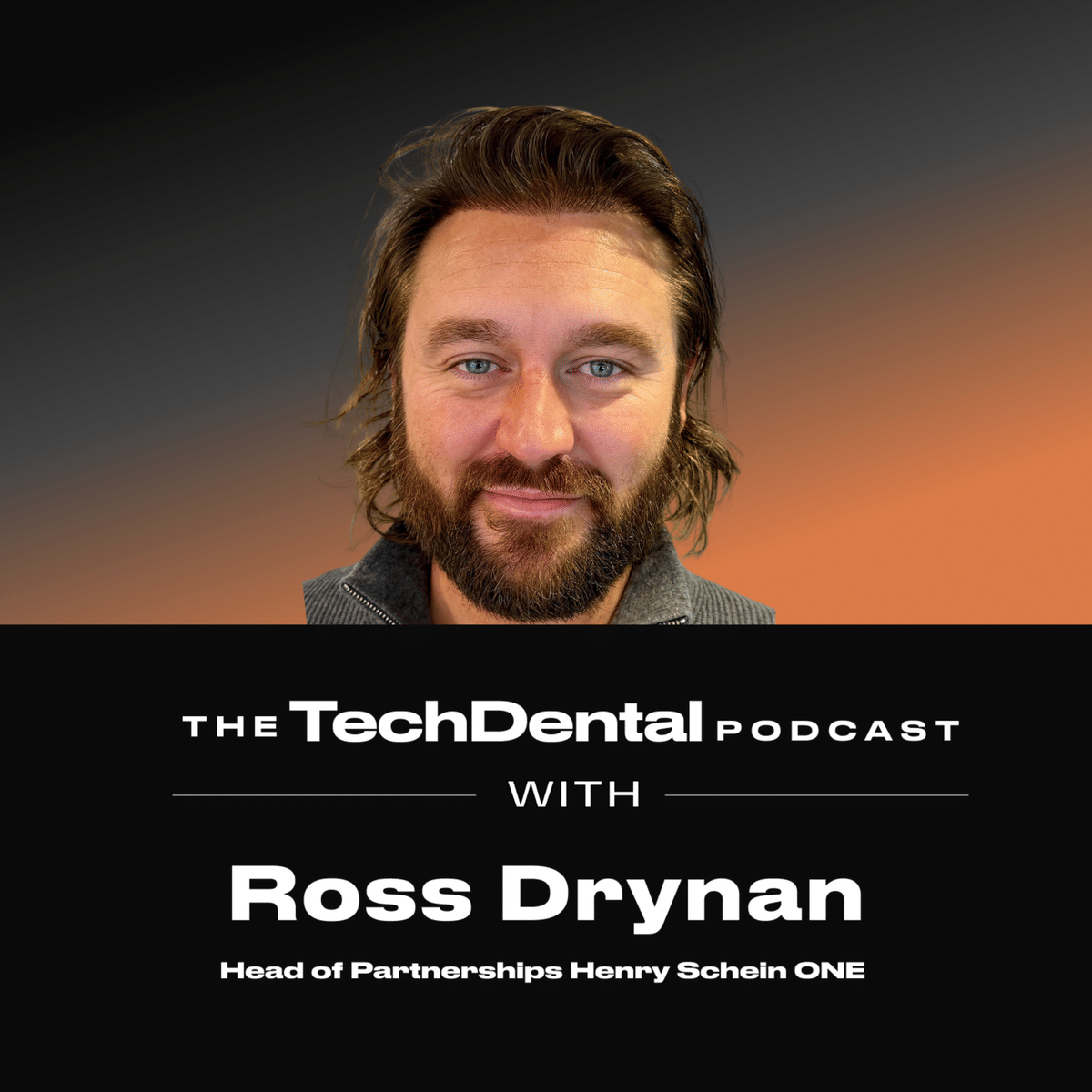
Direct answer: Ross Drynan, Head of Partnerships at Henry Schein One, argues that the single greatest determinant of whether a UK dental practice succeeds with technology and AI is not the software it chooses but the quality of its data and the engagement of its team. Drawing on 11 years of consulting with thousands of practices across dentally and Exact, he identifies chair time utilisation and average hourly rate as the two non-negotiable performance metrics, and argues that dirty data makes both impossible to measure accurately. His framework for no-fluff business transformation is built on a clear sequence: fix the fundamentals, cleanse the data, then layer AI on top of a system that is already working. The core takeaway for dental leaders in the UK is that the migration from client-server to cloud PMS is the most compelling opportunity available right now to create the data foundation that makes every future AI investment viable.
There is a tension at the heart of almost every dental technology conversation happening in the UK right now. Practice owners are being told that AI is the answer, that digital transformation is urgent, and that the competitive landscape will punish those who hesitate. The vendors are louder than ever. The promises are increasingly ambitious.
And yet the practices that are actually moving the needle are not the ones chasing the newest tool. They are the ones doing something far less glamorous: fixing their data, engaging their teams, and executing on a small number of fundamentals with uncommon consistency.
Ross Drynan has spent 11 years inside Henry Schein One, personally overseeing the consulting of approximately 3,000 to 4,000 practices across dentally and Exact. His vantage point is one of the most empirically grounded in UK dental technology, and his conclusions are quietly radical. Technology is a tool. Culture is the strategy. And clean data is the precondition for everything else.
The Two Metrics That Actually Drive Practice Performance
Before any conversation about AI, automation or digital transformation can be meaningful, Ross argues that practice leaders need to anchor themselves to the two performance metrics that have not changed regardless of how much the technology landscape has evolved.
"The most important things in terms of KPIs haven't changed. It's a mixture of chair time utilisation and average hourly rate. Those two things are the core fundamentals and you must focus on them."
Everything else, recalls, reminders, short notice list management, patient communication, scheduling optimisation, sits underneath these two variables. The reason most practices fail to move these numbers is not a lack of technology. It is a lack of accurate data, an absence of diary discipline, and teams that have never been given the time or the framework to focus on what actually matters.
Ross's observation from the field is direct: the average UK dental practice is running at 79% utilisation. That is not a technology problem. It is a data visibility and leadership execution problem. The practices that close that gap with focused consistency, using technology to surface the right information and free the team to act on it, are the ones generating the kind of revenue growth that validates the investment. The 47% average revenue growth figure associated with practices that embrace integrated systems is not the result of deploying sophisticated AI. It is the result of executing on core fundamentals with better data and more engaged teams.
"If you execute on the core fundamentals really well, you'll be able to innovate at a pace that you never have before."
For further analysis on what operational discipline looks like at scale across multi-site dental groups, see Scaling Dentistry Without Breaking It.
Data Hygiene Is Not a Technical Task. It Is a Leadership Decision.
The most consistent finding from Ross's decade-plus of practice consulting is one that most technology vendors prefer not to advertise: AI performs in direct proportion to the quality of the data it is trained on and fed. If the underlying data is inaccurate, incomplete or structurally fragmented, AI does not solve the problem. It amplifies it.
"I think there's a lot of AI out there now that is sold on the proviso that it's easy. It is easy if your data is in a good place. If your data is not in a good place, you have to do an awful lot of transformation to get any sense out of it that you can then execute on."
The root cause of poor data in most UK practices is not negligence. It is accumulated habit. Teams using the same PMS for years develop workarounds. Diary structures that were never properly zoned produce chair time utilisation figures that are meaningless. Patient records that were created inconsistently across different team members generate reporting that cannot be trusted.
Ross's practical entry point is diary zoning. Without an accurately zoned diary, with open time, closed time, and breaks properly recorded, the single most important business metric in a dental practice, chair time utilisation, is unrecoverable from the data.
"If you don't have a zoned diary, the fundamental business metric for your practice is already gone. You can't do it."
The good news, for UK practices currently operating on legacy client-server practice management systems, is that the migration to a cloud PMS creates a forcing function. The data migration process requires the practice to audit and cleanse its records before transfer, creating a natural window for the kind of data governance work that would otherwise never find space in a busy clinical schedule. The migration is the opportunity.
"You can use the client server to cloud journey as an opportunity to get your data in a good place. It's not easy, but it's definitely worthwhile."
The Cloud Migration Imperative: Why Only 5% of Practices Change PMS Each Year, and Why That Will Change
One of the most striking statistics Ross shares is that only approximately 5% of dental practices change their PMS in any given year. In contrast, SaaS churn rates across other industries typically run at 20% to 25%. The implication is significant: dental practices are staying on legacy systems not because those systems are superior, but because the perceived pain of migration has historically outweighed the perceived benefit.
Ross argues that calculation is changing, and changing rapidly.
The core issue is API architecture. A client-server PMS cannot support API integrations at scale. Every integration requires custom engineering work. The result is a severely limited ecosystem of connected tools, and a practice that is structurally unable to adopt the wave of specialised AI applications now entering the market, regardless of how valuable those applications might be.
"If you come to me and said, I use these five providers and I want to integrate them with Dentally, it's a different story altogether. We have APIs, we have OAuth authentication, which is secure, which means that you can integrate with a lot of third party tools now."
The rate of change in the external environment is the critical context here. Ross cites analysis suggesting that the rate of technological change in the 2020s is approximately 100 times that of the 1990s, and that the following decade will accelerate at 100 times that rate again. For UK dental practices that have spent years on the same client-server system, the compounding cost of staying put is not linear. It is exponential.
"The longer you leave it, the worse it gets. So the key thing is to go, when can we actually tolerate the pain of this change? And let's just do it."
Henry Schein One's own experience is instructive here. After five years of optimising its onboarding and data migration processes, the organisation was able to onboard nearly a thousand customers onto Dentally in a single year. The friction that once made PMS migration feel like open heart surgery for a busy practice is systematically being reduced.
For a broader view of how the intelligence gap in UK dentistry is shaped by the tools practices are and are not using, see The Intelligence Gap: Why 550 Dental AI Tools Exist and Most Practices Are Still on Paper and Pen.
AI Is Not Here to Replace the Human. It Is Here to Make the Human More Human.
Ross draws a distinction that cuts through most of the noise in current AI conversations in dentistry. The question is not whether AI will transform the profession. It will. Ross is unequivocal on that point. The question is which parts of the patient journey should be automated, and which should remain irreducibly human.
His framework is derived from personal experience. When he experienced a panic attack during a period of significant personal stress, a paramedic arrived and calmed him down.
"I think only a human could have done that. A LLM or any form of conversational AI could not have done that."
Applied to dentistry, the principle is precise. Transactional interactions, appointment confirmations, scheduling queries, reminders, administrative back-and-forth before a patient reaches a human, are appropriate candidates for AI handling. Clinical consultations, nervous patient management, treatment planning conversations, implant discussions: these require human presence and human trust.
"When it doesn't matter is if I say, what time's my appointment? I don't need a human to connect with me. However, if I've lost a tooth and we're talking about implants, I want to talk to you and trust that drilling a hole in my jaw, I'm in safe hands."
The practical framework Ross proposes for UK practices thinking about where to deploy AI is straightforward: map every patient touchpoint, label each one as human or non-human based on the nature of trust required, and then work systematically to optimise each category. This is not a technology decision. It is a patient experience design decision that happens to have technology implications.
Ross uses the electricity analogy to frame the long arc: when electricity was first introduced, people struggled to articulate what it was for beyond lighting. A century later, electricity is for everything. AI is on the same trajectory. The practices that thrive will be the ones that lean into that reality rather than resist it.
"Jobs won't be replaced. Humans will just be able to be humans more. I think that's where dentistry is headed."
This connects directly with the analysis in The Front Desk Is a Revenue Engine, Not a Cost Centre: How Automation and AI Are Transforming Dental Operations, which argues that the administrative offloading AI enables is not a threat to front desk teams but the mechanism through which they can finally focus on the interactions that generate genuine patient value.
Culture, Vision and the Leadership Discipline Behind No-Fluff Transformation
The phrase Ross uses to describe his approach to dental business transformation is "no fluff." What that means in practice is a refusal to separate the technology conversation from the human and cultural conditions that determine whether technology actually delivers results.
His consistency analogy is instructive. A dental patient who brushes every day and does not visit the dentist for a year will likely be in reasonable oral health. A patient who does not brush for a year but attends two hygienist appointments will not be. Consistency, applied to a small number of the right things, always outperforms intensity applied inconsistently to many things.
"If you decide as a team on a small number of things you're going to do extremely well, and then you optimise those things with AI and technology so that you can do them at scale, you will get success."
The leadership behaviours that underpin this consistency are not complicated. Get the team offsite for a day. Build a shared vision of what the practice will look like in three years. Define three priorities for the coming year that advance that vision. Break those priorities into individual responsibilities. Trust the team to execute. Revisit and refine.
Ross's cathedral story captures the principle precisely. Two builders, identical work, radically different experiences. The difference is not the task. It is the meaning attached to it. Leaders who invest in building that shared meaning, consistently, create the conditions under which change management becomes manageable and technology adoption becomes a collective commitment rather than a top-down imposition.
"When the why is powerful, the how becomes easier."
For dental leaders thinking about how this connects to the wider challenge of building organisations that can sustain AI-driven transformation without losing their cultural core, see People-First AI: Why Most AI Projects Fail in Dentistry (and How Leaders Get It Right).
Partnerships as Strategic Infrastructure
The final dimension of Ross's framework concerns the ecosystem model that Henry Schein One is building around its cloud PMS platform, and what it signals about the direction of competitive strategy in UK dental technology more broadly.
His starting premise is that no single software company can be best in class at everything. The moment a PMS provider attempts to also be a CRM, a marketing engine, a patient communication platform and an AI diagnostics tool, it fragments its focus to the point where it excels at none of them. The strategic response is disciplined partnership: identify the specialised providers that are best in class for specific workflows, integrate them through open APIs, and surface them to customers as a trusted ecosystem.
"You can do anything, but you can't do everything. So you've got to be disciplined."
For UK dental practices and groups evaluating their technology strategy, this ecosystem model has a direct implication. The practices that will extract the most value from the current wave of AI innovation are not the ones with the most tools. They are the ones with the cleanest data, the most open architecture, and the most disciplined approach to selecting partners whose specialised capabilities complement a well-designed PMS core.
Competition in this landscape is also reframed. Rather than viewing competitor innovation as a threat, Ross argues it should be treated as a signal: either the competing capability is something the PMS should build, in which case the challenge is accepted, or it is something better left to a specialist partner, in which case the ecosystem response is appropriate.
"The market ultimately wins there because we significantly improve the experience."
Key Takeaways
Chair time utilisation and average hourly rate remain the two non-negotiable performance metrics in UK dentistry, and neither can be measured accurately without clean, properly structured data in a zoned diary system.
Data hygiene is a leadership discipline before it is a technical task. The migration from client-server to cloud PMS is the most practical forcing function available to UK practices that need to audit and cleanse their data at scale.
AI deployed on top of poor data does not solve the underlying problem. It amplifies it. The sequence must always be: fix the fundamentals, clean the data, then layer AI on a system that is already working.
Every patient touchpoint should be mapped and labelled as either human or non-human based on the nature of trust the interaction requires. Transactional interactions belong to AI. Clinical, emotional and consultative interactions remain irreducibly human.
The 47% average revenue growth associated with practices that embrace integrated systems is driven primarily by consistent execution on core fundamentals, not by advanced AI. Engaged teams with clear priorities and accurate data outperform technically sophisticated practices with disengaged teams every time.
The rate of technological change in the current decade is approximately 100× that of the 1990s, and will accelerate further. UK practices still operating on client-server PMS infrastructure are compounding their competitive disadvantage with every year they delay migration to an open, API-enabled cloud platform.
No single software provider can be best in class at everything. The practices and groups that extract the most long-term value will be those that combine a disciplined, well-governed PMS core with a curated ecosystem of specialised AI partners integrated through open APIs.
About TechDental
TechDental is a strategic intelligence platform for founders, executives, operators and investors shaping the future of dentistry.
Through high-level analysis and systems-focused conversations, we explore how AI, governance frameworks and operating model design influence performance, scalability and enterprise value in dental organisations.
If you are building, scaling or investing in dentistry and want independent, systems-level insight into AI, governance and capital readiness:
For strategic advisory, board briefings or keynote speaking enquiries: www.techdental.com/advisory
The future belongs to those who deploy technology with discipline.
© 2026 RIG Enterprises Limited. All Rights Reserved. This article was authored by Dr. Randeep Singh Gill and is published under the TechDental brand, a trading name of RIG Enterprises Limited (Company No. 11223423), incorporated in England and Wales on 23 February 2018, registered at 1a City Gate, 185 Dyke Road, Hove, England, BN3 1TL. All editorial content, analysis, synthesis and intellectual property contained within this article are the original work of the author and remain the exclusive property of RIG Enterprises Limited. Opinions and statements attributed to named guests reflect the views of those individuals as expressed during recorded interviews and are reproduced here for editorial and informational purposes. No part of this article may be reproduced, distributed, transmitted, republished, or otherwise exploited in any form or by any means, whether electronic, mechanical, or otherwise, without the prior written consent of RIG Enterprises Limited. Unauthorised reproduction or use of this content may constitute an infringement of copyright under the Copyright, Designs and Patents Act 1988.