
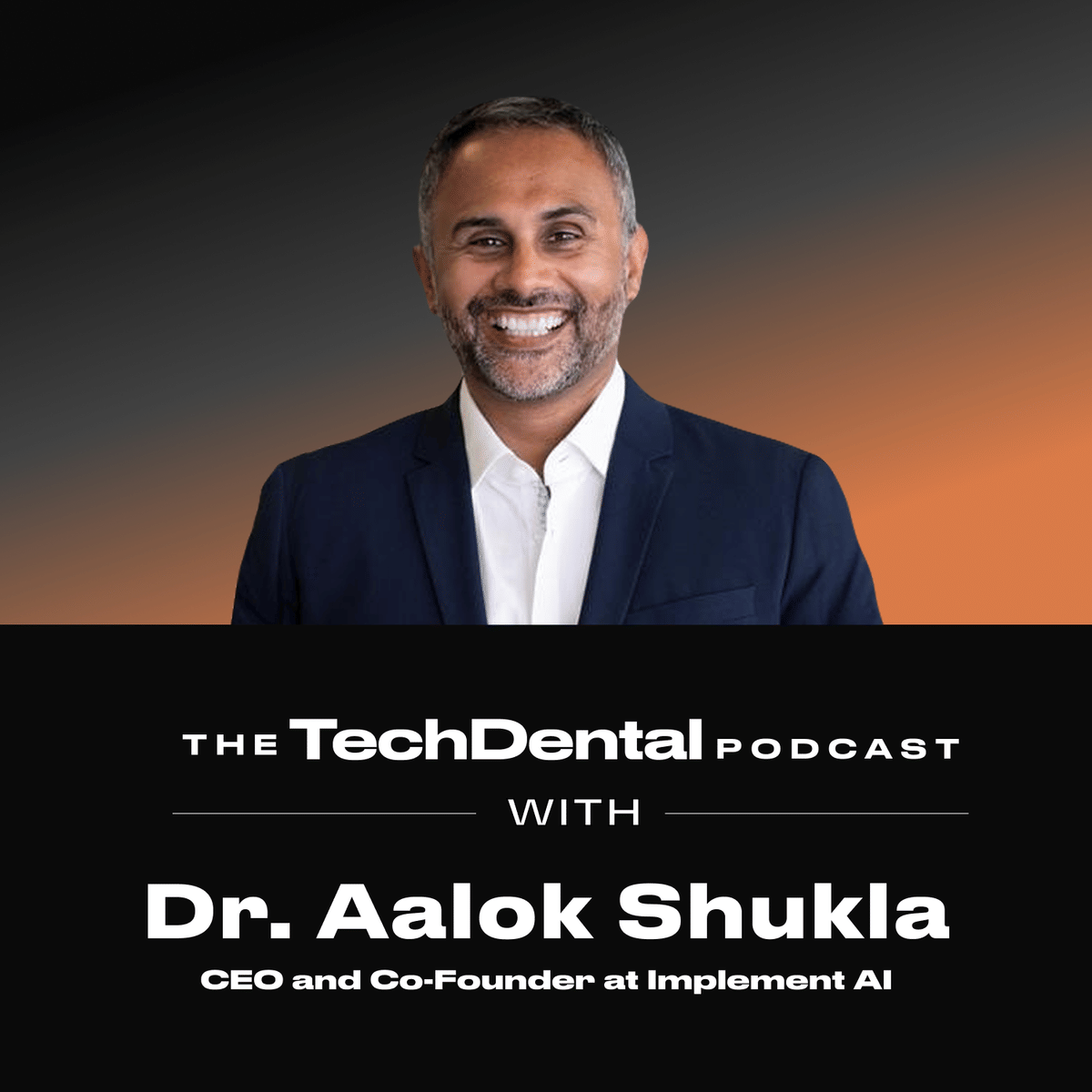
Direct answer: Dr. Aalok Shukla, CEO and co-founder of Implement AI and former dental principal, argues that AI agents are not a technology upgrade for dental practices but a structural reframing of what a practice team can look like: a small group of high-quality human professionals supported by a workforce of digital agents that handles lead recovery, patient reactivation, treatment plan follow-up, out-of-hours communication and personalised patient engagement continuously and without fatigue. Drawing on seven years as a dental practice owner, early work building teledentistry platforms and AI diagnostic tools, and current experience deploying agent systems across dental and healthcare businesses, Shukla demonstrates that within a week of deploying a call analyst agent, practices can identify and quantify revenue opportunities in missed and unconverted calls that most owners did not know existed, with one group uncovering approximately £227,000 in identified implant and high-value treatment inquiries from a single analysis. His central argument for UK dental leaders is that the practices winning the next decade of the profession will not necessarily be the largest or the most clinically advanced. They will be the ones that have designed the most human, most empathetic and most consistently available patient experience, using AI agents as the operational infrastructure that makes that experience possible at every hour of the day.
There is a phrase Dr. Aalok Shukla uses that captures his entire philosophy in a few words: he is building the tools he wishes he had had. In his early years running Alkali Dental Studio in Putney, he would invest in leaflet distribution campaigns at a cost of £1,500 to £2,500 per run, then spend anxious days monitoring how many calls came in. When calls were missed, when team members said a caller was not interested, when inquiries came in over the weekend and nobody was there to respond, the investment would bleed out quietly, with no record and no recovery.
"You'd pay like one and a half, two and a half grand to fly around a particular area, and then you're desperately waiting to see how many phone calls come in. And then you find out that one of your team members didn't answer the phone, or they missed the call, or they say, 'They weren't interested.' I'm like, what do you mean they weren't interested? They called."
That experience, of running a real dental business and watching revenue disappear through gaps that should not have existed, is the foundation on which Implement AI is built. Not as an academic AI project or a technology-first product looking for problems to solve, but as a systematic answer to the operational failures that Dr. Shukla observed firsthand across seven years as a practice principal, then more broadly as a consultant, teledentistry platform founder and AI educator.
He is now CEO and co-founder of Implement AI, deploying teams of AI agents across dental practices, healthcare businesses and national pharmacy groups. His co-founder, Piers Linney, is known for a formulation that sits at the centre of Implement AI's commercial pitch: AI today is the worst it will ever be. The implication for practice owners is that the capability gap between acting now and acting in 18 months is not a reason to wait. It is a reason to move.
The AI Agent Team: A Different Way of Thinking About Workforce
The most significant conceptual shift Dr. Shukla asks dental practice owners to make is not about a specific tool or feature. It is about the fundamental model of what a practice team can be.
The traditional model is human-only, with each role defined by what a person can do in their working hours. The model Dr. Shukla is building towards is a small, high-quality human team supported by a parallel workforce of AI agents that operate continuously, handle scale without fatigue, and are available at every hour of every day.
"The idea that we always look at is how can you give every business owner a superhuman workforce? There's two dimensions: one dimension is doing stuff that humans can't do, and the other is supporting existing humans so they can do their job better."
The calculator analogy he uses is precise and worth dwelling on. A calculator only does something when you tap on it. An AI agent, by contrast, monitors, identifies, initiates and responds without requiring human activation at each step. When a high-value inquiry comes in at 9 p.m. on a Sunday, the agent answers. When a reactivation campaign runs across a list of 2,000 inactive patients, the agent places all the calls, adapts its script based on the conversation, follows up by email and WhatsApp, and feeds the results back to the practice team in a summarised format before the working day begins.
The six structural components of an AI agent, persona, objective, guardrails, tools, knowledge base and memory, ensure that this is not automation running without accountability. It is a designed system with defined parameters, reviewed by the practice before going live and improved iteratively over time.
"There's like six components to an agent, ranging from the persona, the objective that it's trying to do, the guardrails, the tools it has access to, the knowledge base and different stuff. There's a whole system that you have to approach with these things."
The guardrail element in particular addresses the concern that AI will go off-script or make clinical commitments that a practice has not authorised. Dr. Shukla is explicit: nothing is automatic in the sense of being unsupervised. Every response the agent gives is based on content the practice has reviewed and approved. The system is designed, then deployed, then improved. It does not evolve independently of the practice's oversight.
The Call Analyst: Where Most UK Dental Practices Should Start
For practice owners and group operators trying to identify the highest-impact entry point into AI agent deployment, Dr. Shukla's recommendation is consistently the same: start with the call analyst.
The call analyst agent listens to recorded calls, identifies missed opportunities, scores inquiries for interest level, calculates the approximate revenue value of unconverted treatments discussed, and flags them with a summary for the practice team to follow up. It also scores the quality of how the team handled each call, providing a coaching baseline that most practices have never had.
The result, typically within one week of deployment, is a quantified view of the revenue that has been leaking through the phone system.
"With one group, we saw that there was nearly £227,000 worth of treatment identified from implants and calls where the team were excellent, but it's just people who either were busy or got off the phone or asked a tricky question. They were qualified interests that didn't go ahead and book an appointment."
That figure represents money that the practice had already spent to generate through marketing and referral activity, then failed to convert at the final step of the phone call. It was not visible until the call analyst made it visible. The conversations happened. The interest was there. The gap was in the follow-up.
For UK dental groups operating across multiple sites, the call analyst has a compounding value. The ability to benchmark call quality across locations, identify which sites are converting well and which are not, and pinpoint the specific handling patterns that differentiate them, creates a coaching intelligence resource that practice managers can act on immediately.
For analysis of how telephone call data can serve as a primary business intelligence asset for dental practices, see The Front Desk Is a Revenue Engine, Not a Cost Centre: How Automation and AI Are Transforming Dental Operations.
Three Dimensions of AI Agent Value: Revenue, Support and Personalised Experience
Dr. Shukla organises the AI agent systems Implement AI deploys around three dimensions that map directly onto the most common operational challenges in dental practice.
The first dimension is revenue. Beyond the call analyst, this includes reactivation campaigns for inactive patients, follow-up on unconverted treatment plans, and multi-channel inquiry response. AI agents making 750 calls in an hour, with an established memory that can follow up by email or WhatsApp across multiple channels, can systematically work through a practice's entire inactive patient list in the time it would take a reception team member to make a handful of manual calls.
"Our agents can make around 750 calls in an hour. We often find that evenings and weekends work best for reactivations because people answer the phone more. And then you can have the same agent, which has a memory, reach out by email and follow up or by WhatsApp. So you can have that multi-channel approach."
The second dimension is support capacity. This encompasses out-of-hours inquiry response across website chat, WhatsApp, email and phone, treatment-specific qualification conversations, and emergency information provision based on a verified knowledge base. A patient who calls at 7 a.m. with a dental emergency can receive structured guidance from a knowledge base the practice has built and approved, with an escalation path to the clinical team that morning.
The third dimension is the most strategically distinctive: personalised experience at scale. Drawing on work across dental groups, pharmacy networks and financial services businesses, Dr. Shukla demonstrates that AI agents can now personalise patient communications beyond what any human team could replicate manually across a large patient panel.
His pharmacy example is instructive. Across a database of 2.5 million patients, the agent identifies those taking specific medications that make them eligible for funded clinical services, calculates when each patient is due for renewal before they run out, and initiates personalised outreach calibrated to their specific health profile, age and next most relevant health goal.
"You're not going to send the same blue shot thing to everybody. The next health goal for the 50-year-old would be weight management. For the 25-year-old, it might be about whitening or hygiene programmes. That's the idea."
Applied to dental practice, the same logic produces patient newsletters, recall communications, treatment recommendations and anniversary touchpoints that are tailored to the individual's history, expressed concerns and clinical status, rather than generic broadcast messages that generate low engagement.
The Emotional Bank Account: Why AI Should Be Designed to Build Trust, Not Just Efficiency
One of the most important insights in Dr. Shukla's thinking is the reframing of AI agent deployment from an efficiency project into a trust-building project.
His concept of the emotional bank account, where every touchpoint a practice makes with a patient either adds to or draws from a running balance of goodwill, is a useful organising principle for how to evaluate AI agent interactions.
"I always think the psychology is more important than the technology. A smart practice owner will think: how can I analyse the patient experience and how can I almost like sprinkle goodwill throughout it? Certain things you're doing just to help increase trust, help increase understanding. And those are investments in that patient relationship."
His most striking example comes not from dentistry but from a probate law firm, where AI avatar technology was used to send a personalised welcome video from the case handler to each new client at the moment of engagement. The video addressed the client by name, acknowledged the stressful context, and created a sense of personal connection before the first physical meeting.
"You feel connected, and then when I come in and I see you, I know it's you. So that one thing alone changes the whole dynamic."
In a dental context, this maps directly onto the patient journey touchpoints that practices often handle generically: the new patient welcome, the pre-appointment briefing, the post-treatment follow-up, the nervous patient communication. Each of these is an opportunity for an AI-generated, personalised touchpoint that builds relationship equity before the clinical encounter and reinforces it afterwards.
The multi-practice implication is equally important. When a patient moves between associates within a group, the AI system that has maintained a summary of their concerns, preferences and previous discussions ensures the new clinician walks in knowing the patient, rather than starting from zero.
"When a new person takes over, it's not like, oh my God, I have to start from zero again. It's like, I know these things about you. You're not six different individuals in one building. You are a team."
Data, Governance and Where UK Practices Should Start
Dr. Shukla's advice on data readiness for AI agent deployment is notably practical: start with what you already have.
Call recordings, emails, messages and inquiry forms contain a significant amount of actionable intelligence that most practices are not currently analysing. An email inbox agent, for example, can triage a practice inbox, identify inquiries that never converted to appointments, flag complaints for urgent handling, and surface patterns in the types of questions being asked.
"Start where you are, use what you already got. From call recordings, from emails, from messages, all that stuff can be analysed. Start where you are, do that with phone calls too."
The more sophisticated data opportunity that Dr. Shukla identifies is conversational intelligence: the rich contextual information that exists in patient consultations about preferences, concerns, life events and emotional state, but is currently invisible because it lives in spoken conversations rather than structured database fields.
Practices that record consultations with appropriate patient consent and transparency can begin to build a layer of intelligence that is inaccessible to any practice management system operating on structured data alone. The patient who mentioned a wedding six months ago. The patient who expressed anxiety about injections. The patient who asked about implants but said the timing was not right. This information, captured and summarised by an AI agent, becomes the basis for genuinely personalised future communications.
The governance requirements are clear and non-negotiable: transparency with patients about recording practices, appropriate consent, secure storage and defined access controls. Dr. Shukla treats these as foundational steps rather than barriers, equivalent in principle to the signage requirements that already apply to CCTV in clinical environments.
For analysis of how data governance and privacy compliance intersect with AI adoption in dental groups, see Why the Future of Dentistry Depends on Trust, Not Just Technology.
The Fence Is the Most Dangerous Place to Stand
For dental leaders who are uncertain about where they sit on the AI adoption spectrum, Dr. Shukla offers a framework that is more useful than a simple recommendation to adopt.
Some practice owners are natural adopters. They update their websites constantly, invest in the newest scanner, and are already using AI tools in their personal workflow. For them, the question is not whether to engage with AI agents but how to do it systematically rather than reactively.
Some are committed traditionalists. They have chosen a high-touch, human-centric model and are authentic about it. There is nothing structurally wrong with this approach if it is executed with genuine commitment and communicated clearly to patients. A practice that is genuinely excellent at human connection and operates that model consistently can build a deeply loyal patient base.
The dangerous position is the middle ground.
"If you're like, I'm half in, I'm half out, should I do it, should I not do it, I think those people need to then think: I'm either going to be benefited by it or I'm going to be harmed by it. A harm might be that someone else has got better patient experience, better availability. People just go to that practice over time because it's just easy to get hold of or interact with, or you feel more understood. And that might not happen overnight. But it doesn't take long for things to start shifting in the wrong direction, and then trying to reverse it is quite difficult."
The competitive dynamic he describes is not dramatic. It is the slow accumulation of small advantages by practices that are consistently easier to reach, faster to respond, more personalised in their communications and more proactive in their follow-up. These advantages do not announce themselves. They compound quietly. And by the time the effect becomes visible in patient numbers, the gap is harder to close than it would have been to prevent.
Zoom In, Zoom Out: The Leadership Perspective That Changes Everything
Dr. Shukla's description of the mindset shift from clinician to practice leader draws on a metaphor that is among the most useful frameworks in this conversation for dental professionals at any stage of building or scaling a business.
A clinician is trained to zoom in. The discipline of dentistry requires microscopic precision, the ability to focus on a single tooth, a single surface, a single millimetre of anatomy. That capability is non-negotiable. But it becomes a constraint on business leadership when it operates as the only mode of attention.
"You can have a microscope view of what's going on, and you need that as a dental practitioner. But then you need to be able to zoom out and think: what is the experience in the room? Zoom out from that, what is the experience in the building? Zoom out from that, what is the experience of the team? Zoom out from that, what is the experience of people even discovering your business? Zoom out from that, are there macroeconomic trends which are changing what might or might not be?"
The ability to hold multiple levels of vision simultaneously, from the millimetre precision of clinical work to the strategic view of where the profession is heading, is what distinguishes dental business leaders from dental technicians. AI agents, in Dr. Shukla's framing, are part of what makes the zoom-out possible: when the routine operational layer is handled by a well-designed digital workforce, the human leadership team recovers the cognitive capacity to operate at the level the business actually needs.
For a broader analysis of how operational design and leadership philosophy connect to AI readiness in dental organisations, see People-First AI: Why Most AI Projects Fail in Dentistry (and How Leaders Get It Right).
Key Takeaways
The call analyst agent is the highest-impact, fastest-to-deploy entry point for UK dental practices adopting AI agents. Within one week, it provides a quantified view of unconverted high-value inquiries, call handling quality and recoverable revenue that most practices have no current visibility on. The gap is almost always larger than owners expect.
AI agents should be designed as trust-building infrastructure, not just efficiency tools. Every personalised pre-appointment message, post-treatment follow-up and reactivation communication is an investment in the emotional bank account of the patient relationship. Practices that use AI to add warmth and human acknowledgement at every touchpoint will accumulate a loyalty advantage that cannot be replicated by practices operating transactionally.
The conversational intelligence locked inside recorded calls, emails and consultations is a major untapped data asset for most UK dental practices. Agents that can extract, summarise and act on this information, identifying nervous patients, wedding timelines, unconverted treatment discussions and expressed concerns, provide a personalisation capability that no structured patient management system can deliver.
Sitting on the fence between AI adoption and non-adoption is the strategically most costly position. The practices that will be hardest hit by competitor AI adoption are not those that have consciously chosen a high-touch human model and are excellent at executing it, but those that are uncertain and deferring the decision while the competitive gap widens.
Before hiring to handle growth, practice owners and group operators should determine how far AI agents can extend the capacity of the existing team. Deploying an agent to handle a process also defines and documents that process, creating a training asset that makes eventual human hires faster to onboard and clearer in their responsibilities.
Patients are increasingly arriving at consultations having already used AI to understand their options, review their scan results and prepare their questions. Dental practices that engage with this reality by providing their own high-quality AI-guided patient education will shape that journey. Those that do not will find themselves responding to it.
The zoom-in and zoom-out capability is the defining leadership skill for dental practice owners building sustainable businesses. AI agents that handle the operational and administrative layer free the human leadership team to operate at the strategic level the business requires, from patient experience design to team development to market positioning.
About TechDental
TechDental is a strategic intelligence platform for founders, executives, operators and investors shaping the future of dentistry.
Through high-level analysis and systems-focused conversations, we explore how AI, governance frameworks and operating model design influence performance, scalability and enterprise value in dental organisations.
If you are building, scaling or investing in dentistry and want independent, systems-level insight into AI, governance and capital readiness:
For strategic advisory, board briefings or keynote speaking enquiries: www.techdental.com/advisory
The future belongs to those who deploy technology with discipline.
© 2026 RIG Enterprises Limited. All Rights Reserved. This article was authored by Dr. Randeep Singh Gill and is published under the TechDental brand, a trading name of RIG Enterprises Limited (Company No. 11223423), incorporated in England and Wales on 23 February 2018, registered at 1a City Gate, 185 Dyke Road, Hove, England, BN3 1TL. All editorial content, analysis, synthesis and intellectual property contained within this article are the original work of the author and remain the exclusive property of RIG Enterprises Limited. Opinions and statements attributed to named guests reflect the views of those individuals as expressed during recorded interviews and are reproduced here for editorial and informational purposes. No part of this article may be reproduced, distributed, transmitted, republished, or otherwise exploited in any form or by any means, whether electronic, mechanical, or otherwise, without the prior written consent of RIG Enterprises Limited. Unauthorised reproduction or use of this content may constitute an infringement of copyright under the Copyright, Designs and Patents Act 1988.