Governance failure is almost never a dramatic event. It is a gradual disconnect between what leaders believe is happening and what is actually happening on the ground, and by the time it becomes visible, the opportunity to shape the outcome has usually gone.
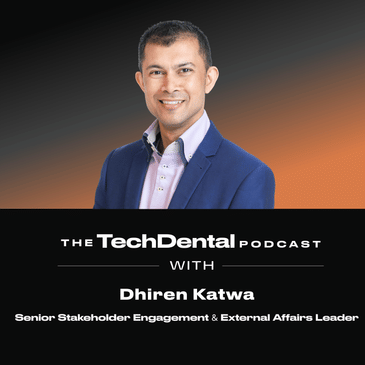
Dhiren Katwa has spent two decades inside some of the most complex regulated environments in the UK, including HS2, the largest infrastructure project in Europe. He is an award-winning PR practitioner, diversity consultant and stakeholder manager who has spoken at the United Nations in Geneva and at the inaugural World Public Relations Festival in Rome.
In this conversation, Dr Randeep Singh Gill and Dhiren move past the usual AI-adoption conversation about tools and into the infrastructure underneath it: the governance, accountability and stakeholder trust that decide whether any deployment survives contact with a real organisation.
They cover the five recurring patterns that precede governance failure in any sector, the single fastest test for telling real governance from performative governance, what deploying a 2,000-tonne tunnel boring machine beneath a 400-year-old woodland teaches you about winning trust before a change programme goes live, why the cost of excluding the people who carry the risk is legitimacy rather than efficiency, what aviation got right about governing automation, and the question most organisations only start asking after deployment: value for whom.
The examples are drawn from infrastructure and dentistry. The patterns apply to any organisation deploying significant change.
Essential listening for anyone leading transformation, deploying AI, or accountable for governance in a regulated organisation.
In this episode:
Why governance failure is a gradual disconnect, not a dramatic event
The five patterns that appear before governance formally breaks
The "bad news test" for telling real governance from performative governance
What HS2 and a tunnel boring machine teach you about stakeholder trust
Why excluding the risk-bearers costs legitimacy, not efficiency
Whether stakeholder alignment is genuine diligence or disguised delay
The "value for whom" question most organisations ask too late
What aviation actually got right about governing automation
The ten-year view: why trust will matter more than technology
About the guest:
Dhiren Katwa, award-winning PR practitioner, diversity consultant and stakeholder manager.
LinkedIn: https://www.linkedin.com/in/dhiren-katwa/
Read the full written analysis: https://www.techdental.com/insights
Connect with TechDental:
Host Dr Randeep Singh Gill: https://www.linkedin.com/in/drrandeep/
Web: https://www.techdental.com
Email: info@techdental.com
🎧 Spotify: https://bit.ly/41UsqRO
🎧 Apple Podcasts: https://bit.ly/41pKL9b
▶️ YouTube: https://bit.ly/3JSfl5c
[00:00:00] What does governance failure actually look like from the inside of an organisation deploying a major change programme? Governance failure is rarely a dramatic event. It is usually a gradual disconnect between what leaders believe is happening and what is actually happening on the ground. When you walk into an organisation, what tells you whether the governance is real or whether it's performative? You can often tell within a few meetings whether people are speaking freely or performing safety.
[00:00:28] This is the TechDental Podcast, the strategic intelligence hub for leaders shaping the dental industry. We break down how AI, data and operating discipline drive performance and scale. I'm Dr. Randeep, let's dive in.
[00:00:51] Welcome back to TechDental. This is the podcast where we examine how artificial intelligence, data and emerging technology are structurally changing the business of dentistry. We cover the systems, the strategy and the real commercial implications for the people running, building and investing in this industry. Today's conversation is about the difference between governance that looks credible on paper and governance that actually holds when something goes wrong.
[00:01:19] My guest today is Dhiren Katwa. Dhiren is an award-winning PR practitioner, a diversity consultant and a stakeholder manager who has spent 20 years inside some of the most complex regulated environments in the country, including HS2, the largest infrastructure project in Europe. He's spoken at the United Nations in Geneva and at the inaugural World Public Relations Festival in Rome.
[00:01:43] And here is the part that makes this conversation critical for everyone listening. He's not a dental insider, which is exactly why his perspective on what the industry is about to get wrong is required listening. Dhiren, welcome to TechDental. Thank you very much, Randeep, for inviting me onto the TechDental Podcast. Delighted to be here. I want to start at the beginning because the story of how big regulated organizations handle change is usually told one way.
[00:02:11] And there is a more interesting argument underneath it. The dental AI conversation in 2026 is almost entirely about products and features. Which diagnostic platform, which practice management system, which vendor is furthest along? Those are legitimate questions, but they're not the most important ones. The most important question is whether the governance and the operational infrastructure underneath those tools is adequate for what is being asked of them. And you've spent two decades watching organizations discover that question too late.
[00:02:41] You've worked inside some of the most complex regulated environments in the UK. What does governance failure actually look like from the inside of an organization deploying a major change program? Well, thanks, Randeep, for that question. Now, in my experience, governance failure is rarely a dramatic event. It is usually a gradual disconnect between what leaders believe is happening and what is actually happening on the ground.
[00:03:07] Now, from inside an organization delivering major change in a regulated sector, governance failure often looks like five recurring patterns. Now, reporting becomes theater. Decisions stop matching accountability. Stakeholder intelligence never reaches the top. Compliance replaces judgment. And bad news travels slowly.
[00:03:27] So, in my view, after two decades in regulated and politically sensitive environments, I would define governance failure as a situation where decision makers no longer have an accurate understanding of operational reality, yet continue making decisions as though they do. Now, everything else, cost overruns, stakeholder conflict, regulatory intervention, program delays, and reputational damage is usually a consequence of that single failure.
[00:03:57] In major change programs, governance is not primarily about committees or reporting structures. It is about ensuring uncomfortable truths can travel from the front line to the boardroom quickly enough for leaders to act on them. When that stops happening, governance has already begun to fail. It's interesting because what I hear underneath that is you mentioned that failure is rarely loud at the start. It's a quiet gap that compounds.
[00:04:23] And you've described the consistent gap between the governance language organizations use and the operational substance underneath it. When you walk into an organization, what tells you whether the governance is real or whether it's performative? What are the telling signs? The quickest test is not found in the governance framework, committee structure or assurance documentation. It is found in how the organization reacts to uncomfortable information. When I enter an organization, I look for a handful of signals.
[00:04:52] What happens when someone delivers bad news? This is usually the fastest indicator. In organizations with genuine governance, bad news moves quickly. People raise concerns early. Leaders ask questions rather than assume blame. And risks become visible because they become crisis. In performative governance, people hesitate. Concerns are softened before reaching senior leaders. Language becomes euphemistic.
[00:05:21] And the messenger becomes the problem. You can often tell within a few meetings whether people are speaking freely or performing safety. I want to stay with that because I think the tell that you've just described is something most people never learn to spot. How does the dental sector compare with the patterns you've seen in other sectors? So that's a very interesting question as well. I would be careful not to overstate my experience here.
[00:05:46] Because my direct experience is primarily in infrastructure, environmental regulation, energy, local government and nationally significant programs. You mentioned HS2 rather than in senior governance role within dental organizations themselves. If I were assessing dental organizations through the same governance lens, however, I would expect many of the underlying patterns to be surprisingly familiar. Because governance failures tend to be sector agnostic. The main difference is scale.
[00:06:12] In infrastructure, governance failures affect multi-billion pound programs, national policy objectives, major communities and thousands of stakeholders. In dentistry, governance issues are closer to patient safety, clinical quality, regulatory compliance, workforce pressures, financial sustainability and reputation within a local community. Dhiren, let me just give you the obvious objection here. Dental AI is not HS2.
[00:06:40] A dental group adopting a diagnostic tool is a contained decision in a small organization. Are there governance parallels that can be drawn from major infrastructure projects that are useful in the context of AI adoption in the dental industry? And what can we learn and implement? In my view, I think it's pretty much simple, actually. It's common sense if common sense exists nowadays. And it's about understanding your stakeholders right at the onset of anything that you are trying to implement.
[00:07:08] And it's just about your variety of stakeholders. And everyone's very different. Everybody needs individual attention. And whether it's an infrastructure project or within the dental industry or whether it's aviation or any sector, I think it's about getting down to the foundations of your stakeholders and understanding what are the issues, what are the concerns and identifying solutions at the start rather than covering up.
[00:07:33] And then finding out later on down the journey that you should have done this or you should have done that. So it's probably harder. How I often describe it is you tread down a path of thorns and then you come to a path of roses. Or you could do it the other way. But that's how I'd describe it. What I'm hearing is that the factor which decides whether a major program succeeds is really technical. It's whether you have aligned the stakeholders whose cooperation you need before launch and not after.
[00:08:03] So what does meaningful stakeholder alignment actually require before a major change program goes live? What has to happen between the key people for it to have a chance of working? You've got to understand your stakeholders right at the very start. What is it that they want? What is it that they need? And often there's a fear factor. It's quite simple. It's just removing that fear factor right at the very start. And it's about bringing them on board. It's about winning their minds and their hearts. And we're all human beings.
[00:08:31] I know AI comes into all this and AI has its own sort of mind, so to speak. But when it comes to human interaction, it's about doing the basics, doing the litmus test right at the forefront. And if you do that and if you're aligned, if your objectives are aligned with the objectives of human beings and your stakeholders, then I think it's pretty much a simple and straightforward ride. I want to talk a little bit about Dorothy. You managed stakeholder relations on HS2 during the deployment of Dorothy.
[00:09:01] And for our listeners, Dorothy is a 2,000-tonne tunnel boring machine driving the first twin bore tunnel between a 400-year-old ancient woodland. So communities were naturally anxious. The engineering was intimidating. Tell me how you turned that fear into trust and what you learned doing it. And that's a great question again, Randeep, because before I joined HS2, I hadn't even heard of TBMs. TBMs are tunnel boring machines.
[00:09:29] And there are 11 tunnel boring machines across the UK. And I was very privileged to be part of the launch of the two first tunnel boring machines in the Midlands, of which one was called Dorothy and the other was called Mary Ann. A wide range of stakeholders were very sceptical of the two tunnel boring machines being launched. And what these tunnel boring machines do is they operate 24-7, they operate underground,
[00:09:55] and they actually dig a hole underground, 10 metres underground, to make space for the actual train to actually the tunnel to go into this space. So obviously there's a lot of pollution, there's noise, there's digging noise, there's all sorts of things happening. So what I was able to do at HS2 was we had a HS2 visitor centre in Long Itchington Wood, which as you mentioned, it's beneath the 400-year-old Wood, the Long Itchington Wood.
[00:10:24] And we had a HS2 visitor centre there. So what I was able to do was to invite stakeholders to the visitor centre, take them up to the viewing platform. And from the viewing platform, you were able to see the scale and nature of the works. And what that enabled was it gave stakeholders a first-hand view of what was involved in the project. So where the noise was coming from, where the pollution was coming from,
[00:10:51] how we were mitigating it, how we were trying to stop any sort of incidents from occurring. So health and safety obviously was involved. And when I brought stakeholders in, and when I say stakeholders, there was sort of MPs, ministers, schools, local businesses. It was a very wide range of stakeholders. They were, oh my God, that was their reaction.
[00:11:13] And I then, obviously not being a technical expert in engineering, what I did was I brought in the right and relevant colleagues who had the expertise and knowledge of the tunnel boring machine. The parts, how they operate, efficiencies, value engineering, whatever you want to call it. And we were able, collectively as a HS2 team, we were able to talk to the stakeholders and tell them what the challenges were, how they can be part of it.
[00:11:43] And we basically want so many hearts and minds. Whilst we were unable to shift 100% of mindsets, there were so many sceptical stakeholders who actually shifted that their mindset was shifted because they could see why this was happening, how it would benefit them in the future. We were very clear. Any technical jargon was simplified. And that was a major project, which I'm really proud of.
[00:12:09] So what, going back to your question, Randeep, what did I learn from this experience? It's simple. Be upfront, be honest, do not have any skeletons in the cupboard. Just say it as it is and try and align key messaging with your different stakeholders. And it works. It works wonders. I love that. I think when you start to talk about tunnel boring machines with dentists, we start having visions of root canals, but the parallels are definitely there, albeit at a slightly different scale.
[00:12:37] What you've just described, demystifying something powerful and opaque so that the people affected by it can actually see how it works, is the exact same problem dental AI has right now. Because AI is arriving in practices primarily through vendor relationships with maybe one or two key technophile champions within a complex and highly regulated business. The people on the ground, the clinicians, the wider team, and even the patients are largely absent from the deployment decision. So from a stakeholder engagement perspective,
[00:13:06] what does that absence cost when something eventually goes wrong? Absolutely, Randip. That's a great question. From a stakeholder engagement perspective, the cost is not primarily technical. The cost is legitimacy. When a major decision is made without the meaningful involvement of the people who will carry out the risk, the organization loses much of its ability to manage the consequences when something goes wrong. In the scenario you've described,
[00:13:32] the deployment pathway is largely vendor, practice owner, organization, and implementation. And while the key risk bearing stakeholders remain largely outside the decision process, the clinician, the patient, the indemnity provider, professional regulator, and everything looks efficient until the first failure. And that's important because decisions happen faster, procurement is simpler, implementation is quicker, and the organization can point to vendor assurances,
[00:13:59] technical documentation, contractual protections, and regularity, ambiguity. So in my view, it's about trust. It's a trust element. And because in every regulated environment I've worked in, the organizations that recover most effectively from failure are really the ones with the best technology. They are the ones that have already built a coalition of stakeholders willing to navigate uncertainty together. And if clinicians, patients, indemnity providers, and regulators
[00:14:27] are absent from the formation of that coalition, the organization may discover that it has implemented a system successfully but failed to build the legitimacy needed to sustain it. Diran, let me give you a counter-argument. Investing heavily in stakeholder alignment is often slow and expensive, and it can be used as a polite form of institutional risk aversion. Meanwhile, patients who could benefit from AI-assisted diagnostics are not benefiting while organizations spend years consulting.
[00:14:57] Is alignment a genuine precondition for responsible deployment, or can it also be delay dressed up in responsible language that can hold back the transformative technology? Not really, because I think what's quite important is stakeholder alignment right at the onset is very important because, as I say, it builds that trust, it wins that sort of mindset. And it's quite simple and it's quite straightforward. For example, this week you've got London Tech Week happening,
[00:15:25] and the names that are actually speaking at this event are incredible. These are absolute geniuses. But again, they are brilliant at AI. They are brilliant at technology. But when it comes down to stakeholder engagement, I would ask the question how many do actually understand and actually align their stakeholders with the great products that are producing. So I think it's very important. Whilst on one hand you've got the product being manufactured, how is that being aligned with the stakeholders?
[00:15:55] And I think that's quite very important. You're one of Britain's most prominent voices on diversity and representation. You've taken the argument to the United Nations and to the world stage. So when you look at the dental AI adoption conversation, I want to know whether you think a basic question is being asked, who benefits from these tools and who might quietly be disadvantaged by them? And if that question is not being asked, what does the silence tell you? So what's interesting about your question, Randeep, is that it moves from the discussion
[00:16:24] from governance to legitimacy, because every major technological change eventually faces the same test. Who benefits? Who bears the risk? Who gets left behind? In my experience, organisations often become very good at discussion functionality, efficiency and innovation long before they become a comfortable discussion distribution of benefit. The question is not whether dental AI will create value. It almost certainly will. The question is value for whom?
[00:16:52] And I'm not yet convinced that this is the central question in many adoption conversations. So again, I think every technology reflects people around the table. What the absence may be telling us is if these questions are not being asked consistently, it may indicate that dental AI is currently being treated primarily as a technology transformation, a commercial transformation rather than a social transformation.
[00:17:17] So the deeper question for me, Ranip, is will AI improve dentistry? Will AI improve dentistry for everyone or primarily for those who already have the greatest access, influence and advantage? When a sector is asking that question openly, it is usually a sign that governance is maturing. When it is absent, it often suggests the industry is still in the adoptions phase of the conversation rather than the accountability phase.
[00:17:43] And history shows that accountability questions rarely disappear. They simply arrive later, usually after deployment, when the opportunity to shape the outcome is much smaller. There's something you mentioned to me in our prequel that I've not been able to stop thinking about. And I want to bring it into this conversation. You mentioned your son wants to be a dentist and his dissertation was on AI. In the future of the profession. So let me ask you as a father, not as a consultant,
[00:18:09] what do you want the governance and the equity infrastructure around dental AI to look like by the time he qualifies? And honestly, how far from that are we today? So I don't think there's a perfect example, Randy. Every regulated sector is still working this out. But if I had to choose one sector that got closer to than most, it would be the aviation approach to automation.
[00:18:33] Not because aviation has got AI right, because aviation got governance around automation right. There is an important difference. And you're right. My son, he did his dissertation on AI in the future of dentistry. And he's learned a lot from it. The critical governance principle, the strongest idea aviation institutionalized was this, that every incident is treated as a system information, not individual embarrassment. When something goes wrong, the first question is often,
[00:19:03] what did the system allow to happen? Rather than who can we blame? That creates learning and learning creates resilience. Many regulated sectors will struggle with that. So the lessons for dentistry is not become like aviation. The lesson is do not wait for your equivalent of an aviation accident before building the governance infrastructure. The strongest feature of aviation is not its technology. It is that industry created institutions capable of questioning, challenging and learning from technology.
[00:19:33] So you asked the question, Randy, what would I like to see? So the dental industry in 10 years, if the governance cap is addressed seriously, the most trusted dental organizations will not be those with the most advanced AI, but those that built governance, accountability, equity and patient trust into the technology before the technology became indispensable. The main thing in my view is overlooking oversight, oversight of stakeholder alignment, stakeholder engagement.
[00:20:00] And when I say stakeholders, it's human being, it's people. While sort of AI can be brought into any process or protocol, it's about understanding people, emotional intelligence, psychological safety. We all talk about these things, but these things are not going to go away. At the end of the day, it's about people and it's about taking people with you along on your journey. You mentioned aviation, but is there a country that you think is getting AI adoption genuinely right? One example and why?
[00:20:32] So again, in my view, I think we, I see we are a global village now. No country, particularly with this sort of the things that are going on in the world at the moment, the wars and the economic instability, the climate change, there's so many different issues and it affects all of us globally. So in my view, I wouldn't say there's one country who has got it right, but it's the way I look at it is what can we learn from other countries? How can we adopt, work together, collaborate?
[00:20:59] If create a win-win situation, learn from a different country, work together, collaborate to create an even better situation for everyone and everybody wins. And how do you see the dental industry in 10 years if the governance gap is not taken seriously from now? If the governance gap is not taken seriously, I think the dental industry will, not just the dental industry, but any industry that sort of overlooks stakeholder engagement, stakeholder management will actually struggle.
[00:21:28] And it'll be too late then to look back in retrospect. So it's laying out the foundations now. The resources are there, the people are there, things are all there. It's about building those foundations so that in 10 years time, you can look back and say, actually, we did this right. And others will learn from you rather than finding out in 10 years that, oh, you wish you did this. So yeah. Deren, it's been a pleasure having you.
[00:21:55] And I think this is a really crucial topic that isn't given enough airtime. I think you've given us a mirror that we didn't know we needed. Trust as the real specification, governance that has to be visible to be real. And the reminder that the technology is rarely the hard part. Where can people connect with you and follow your work? I'm on LinkedIn. LinkedIn, Dhiren Katwa is my name. And through the Tech Dental Podcast, get in touch with me. Anything I can do to support help.
[00:22:23] I've worked in that stakeholder engagement for the last over 20 years, as you said, Randip. And I'm genuinely grateful for your very generous words and for inviting me on this podcast. It's been an absolute pleasure. And to our listeners, if you are building, operating or investing in dental AI and something in this episode resonated with you, subscribe, share, like, and comment. You can find everything on www.techdental.com. Join us on LinkedIn. All links are in the show notes.
[00:22:51] You've been listening to the Tech Dental Podcast, strategic intelligence for dental leaders navigating structural change. If you're responsible for growth, performance, or long-term value in this industry, make sure you're subscribed. I'm your host, Dr. Andeep. We'll see you next week.