🎧 Listen to the full episode: Spotify | Apple Podcasts | YouTube
Direct answer: Almost the entire conversation about AI in dentistry is happening at the level of individual products. Andrea Albertini, CEO of Global Distribution and Technology at Henry Schein, argues that the decisive questions sit one layer underneath, in the infrastructure through which any tool actually reaches a practice. Distribution and technology are not two businesses but a single operating environment, and AI cannot be layered onto a fragmented one. The industry's real constraint is not algorithm quality, it is interoperability, governance and workflow integration. On that reading, the winners of the next decade will not be the organisations with the best individual tools, but the ones whose operating environment is coherent enough for AI to compound across it.
The Layer Nobody Argues About
The dental AI debate has organised itself around a question of product quality. Which diagnostic platform is most accurate, which imaging tool is furthest ahead, which vendor has the better model. These are legitimate questions and they are not the most important ones, because none of those tools reaches a single patient on its own. They reach practices through a layer of software, distribution and trust that the profession depends on daily without examining.
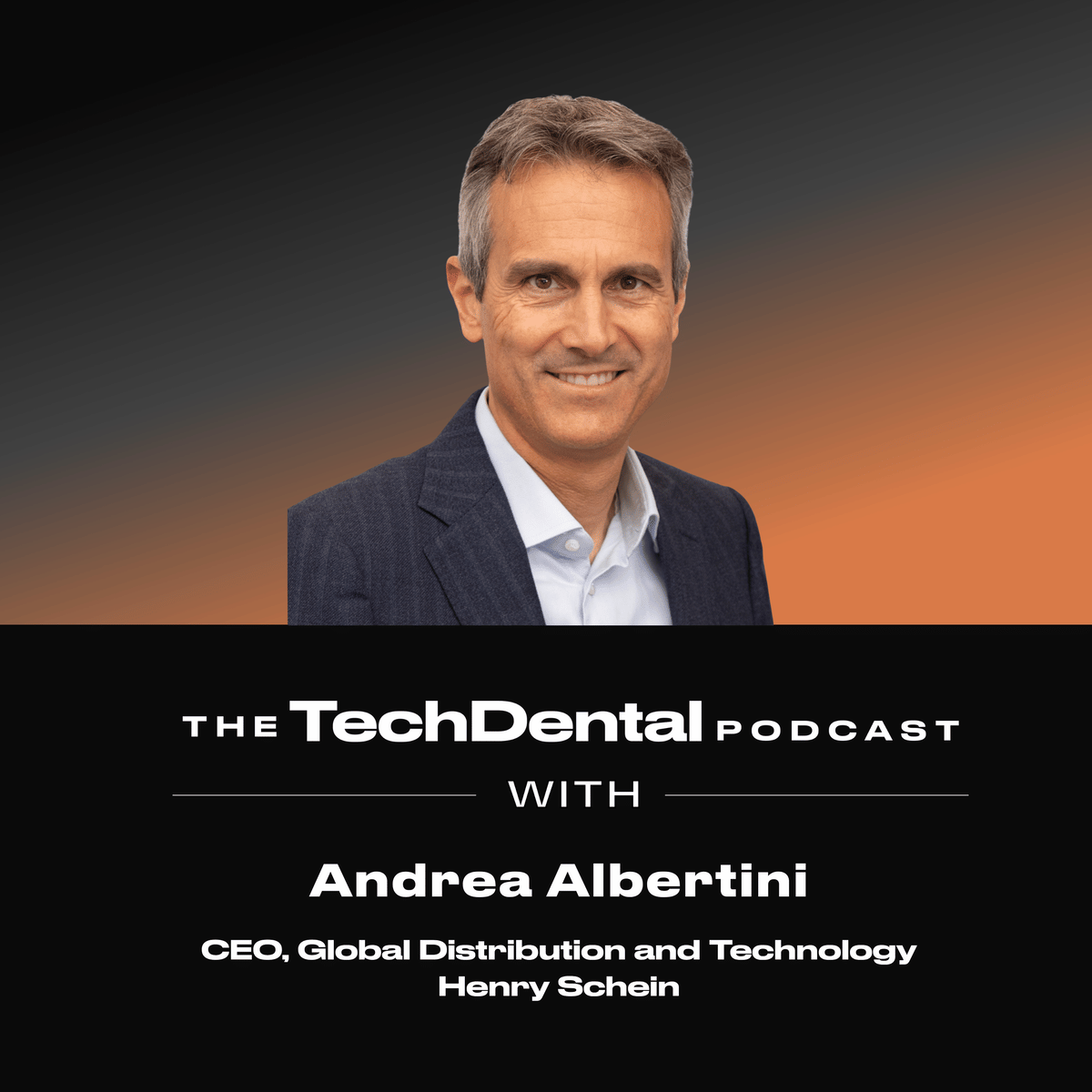
Andrea Albertini sits at the centre of that layer. He is CEO of Global Distribution and Technology at Henry Schein, with executive responsibility for both the distribution business and the technology business, including the Henry Schein One joint venture, whose software runs in more than 100,000 customers' dental locations worldwide. Before Henry Schein he was at Cefla and Castellini on the manufacturing side, which means he has seen the industry from the factory, from the region and now from the top of the global platform.
That arc produces an unusual vantage point, and he summarises it precisely.
Manufacturing taught me how value is created. Distribution taught me how value is delivered. Andrea Albertini
Most people in this industry only ever see one half of that equation. Product companies optimise creation. Distributors optimise delivery. The consequence is a market full of well-designed things that never make it into a working practice, which leads directly to his central point about innovation.
Innovation doesn't succeed on design alone. It succeeds when it is part of a workflow, supported by the infrastructure, and aligned to how the practice operates. Andrea Albertini
Fragmentation Is the Same Problem at Every Scale
Andrea spent the better part of a decade in EMEA before taking a global remit, and that experience produced the most portable insight in the conversation. EMEA is fragmented by regulatory framework, reimbursement model and digital maturity, with every market slightly different from its neighbour.
His observation is that this external complexity is structurally identical to what a large group or DSO experiences internally: variability across locations, uneven staff adoption and digital literacy, legacy systems that do not align with one another. The multi-country problem and the multi-site problem are the same problem wearing different clothes.
That reframe has real operational consequence. It means the discipline that makes technology adoptable across fragmented markets is the same discipline that makes it adoptable across a fragmented estate, and Andrea is specific about what that discipline consists of: ease of use, integration into existing practice management, minimal disruption to the clinical workflow, consistency across locations, and training that lets teams extract value from the system.
Note what is absent from that list. Model accuracy. Feature depth. Technical sophistication. The variables that determine adoption are almost entirely operational, which is exactly why so many technically excellent tools fail in the field.
One Infrastructure Layer, Not Two Businesses
The strategic core of the conversation is Andrea's argument that distribution and technology are not separate functions at all. Traditionally they are treated as distinct businesses, distribution concerned with logistics, procurement and relationships, technology concerned with software, data and analytics. His position is that for any practice operating at scale, they constitute a single operating environment.
The reason is that the customer does not experience them separately. A group operator does not think in terms of distribution versus technology. They think about running an efficient practice, delivering better care, and achieving better clinical and financial outcomes. Underneath that, supply chain decisions shape workflow rather than just cost. Software drives efficiency but also clinical excellence and case acceptance, which in turn drives growth. Data enables oversight across locations and signals how the whole system is performing.
These are not parallel systems. They are part of a single operating environment. And that matters especially when you adopt technology like AI, because AI needs data consistency and integration. You cannot layer this technology on top of a fragmented ecosystem. Andrea Albertini
That final sentence is the one worth sitting with. It reframes the AI question from procurement to architecture. If the operating environment is incoherent, the tool inherits the incoherence.
Pressed on whether holding both remits creates genuine leverage or simply organisational complexity, Andrea did not reach for the easy answer. He acknowledged that integration does not automatically create value and can slow decision-making if done poorly, and that the two businesses have genuinely different cultures, models and investment horizons. Distribution optimises for execution, reliability and operational discipline. Technology optimises for innovation, product development and long-term value creation. Forcing them into a single model would be a mistake.
What emerges instead is a division of labour. Technology, in his phrase, has stopped being a product category and become the connective tissue linking clinical workflow, practice management, equipment, imaging, laboratory relationships and supply chain. Distribution provides what technology companies consistently struggle to build: trusted local relationships, daily engagement, and an established route to market. The value sits at the intersection, not in the merger.
Why Scale Removes the Pilot Phase
Henry Schein One's partnership with AWS, announced in November 2025, aims to embed generative AI across the patient journey, from booking and imaging through payments and treatment presentation. The obvious question is why deploy across an entire platform rather than pilot narrowly and iterate.
Andrea's answer inverts conventional deployment logic. With more than 100,000 customers, the installed base is itself the proof-of-concept environment. They already know what breaks, what workflows look like under load, and what practices need, because they observe it continuously at a scale no pilot could replicate.
There is no experimental phase. There is continuous improvement. The care journey doesn't have an interruption, and neither can the AI development. Andrea Albertini
There is a serious operational principle buried in that. A pilot has a start and an end, and it produces a verdict. But AI systems are probabilistic and their behaviour drifts, which means a verdict has a short shelf life. Continuous observation in live conditions is not a nice-to-have on top of a pilot, it is the replacement for one. The AWS partnership, on his account, is less about capability and more about architecture: enterprise-grade security, compliance and reliability across a highly regulated and highly distributed network.
From System of Record to Active Participant
The clearest articulation of what is actually changing came when I tested the phrase "AI-augmented practice management ecosystem," because language like that often runs ahead of reality.
Andrea's framing is that practice software has historically functioned as a system of record, a static repository where data is deposited. AI and agents shift it into an active participant in how the practice runs. Agents handle repetitive administrative tasks, freeing the team to spend time with patients. His emphasis throughout was on support rather than autonomy: the technology automates the predictable and repetitive so that humans concentrate where trust and quality of care are actually built.
He was concrete about where this is real today rather than aspirational. Revenue cycle management, with cleaner claims, denial prediction and chairside eligibility verification. Scheduling and reactivation, with predictive models reducing no-shows and recovering lapsed patients. Clinical documentation, where imaging analysis supports claims documentation and voice charting compresses documentation time without touching clinical judgement.
Credible AI exists today and is being deployed. I believe it is reality, not noise anymore. Andrea Albertini
The strategic read for operators is that the highest-return, lowest-risk deployments sit in the administrative and revenue layer, not the clinical one. That is where the friction is measurable, the failure modes are recoverable, and the return arrives fastest.
Governance as an Adoption Strategy
At the scale Henry Schein operates, governance cannot follow deployment. Andrea's framing of the sequence is instructive: the first question when deploying an AI solution across tens of thousands of practices is not what the technology can do, but what role it should play in the clinical workflow.
On the liability question, which the wider healthcare AI market continues to circle, his position was unambiguous. AI is a decision-support tool. Clinical responsibility remains entirely with the clinician. The obligation on the provider is to ensure the system is accurate and explainable, and never to position it as a substitute for clinical judgement.
What makes this commercially significant rather than merely ethical is what he connects it to.
If we want to build trust in the tool, and trust is needed to generate adoption, we do it not with the most powerful algorithm, but with the right governance, the right transparency, and clear accountability for every stakeholder. Andrea Albertini
Governance, on this account, is not the compliance tax paid after the value is captured. It is the mechanism by which the value gets captured at all, because adoption runs on trust and trust runs on accountability that people can actually inspect.
Where the Demand Is, and Where the Noise Is
Henry Schein's direct relationship with over a million customers worldwide produces a category of market intelligence almost nobody else in dentistry holds. Andrea's read is that the market has moved past the early-adopter phase. Two years ago the conversation was about what AI might one day do. Now customers ask what it can do for them tomorrow.
The strongest demand clusters around workflow improvement, driven by staffing pressure, administrative complexity, reimbursement challenges and rising patient expectations. Practices want tools that save time, reduce friction and improve productivity: documentation, scheduling, patient communication, treatment planning support. The single most adopted category is AI-assisted diagnostics, and notably not as a replacement for judgement but as an aid to consistency, clinician confidence and patient communication, which in turn lifts case acceptance.
The noise is more interesting than the demand.
Where I see more noise than demand is the shiny, standalone AI tools. There are many that claim a great algorithm. But when these tools are standalone, adoption is not happening, because it's difficult to integrate them into the practice workflow. Andrea Albertini
That is a market signal founders should read carefully. Algorithm quality is not the binding constraint. Integration is.
The adoption curve also splits by segment. DSOs are further ahead, in Andrea's view not because they are more sophisticated but because they have the scale to invest, and their focus is enterprise-grade consistency and centralised data. Independent practices are earlier, but they are adopting against sharp outcome questions, how much time will this save me, what does it do for patient care, and he expects them to close the gap quickly.
The Question Almost Nobody Is Asking
Asked what the industry is missing about the infrastructure layer, Andrea gave the answer that organises the entire conversation.
How do all these AI solutions work together inside the practice? Most discussions focus on how good one tool is. The bigger challenge is interoperability, because that is where real value is created. Andrea Albertini
The care journey does not respect product boundaries. It runs from image capture through treatment planning, to the laboratory, to the patient, and back again. A tool that performs brilliantly inside its own boundary and poorly at the seams degrades the workflow it was bought to improve. Andrea's stated ambition is integration so intuitive and natively embedded that practitioners do not notice it happening, where the experience is not of using an AI tool but of a practice that simply runs better.
The stated risk if the industry fails to solve this is not commercial disappointment. It is that a lack of integration produces a lack of adoption, and the opportunity to improve the quality and delivery of care is lost.
What This Means For Operators, Founders and Investors
For operators, the sequencing is the strategy. Map your operating environment before you buy anything, because the seams between practice management, imaging, laboratory, patient communication and finance are where AI either compounds or collapses. Start where the friction is measurable and the clinical risk is contained, which for most groups means the administrative and revenue-cycle layer. And write your governance framework before deployment, not after, because it is what converts a capable tool into an adopted one.
For founders, the message is uncomfortable and useful. A superior model is not a defensible position if the tool cannot integrate. Interoperability, implementation and workflow fit are the product, as much as the algorithm is. The standalone tool with the impressive benchmark is precisely the category Andrea identifies as noise, and the market is already voting with its adoption rates.
For investors, the diligence question moves. Weight a company's integration architecture and route to market alongside its technical capability, and treat evidence of real workflow adoption as a stronger signal than model performance. In an industry where distribution and infrastructure determine whether anything reaches a patient, the connective layer is where durable value accrues.
The organisations that lead the next decade of dentistry will not be the ones with the best individual tools. They will be the ones whose operating environment is coherent enough that AI has something worth multiplying.
Key Takeaways
Distribution and technology are one operating environment, not two businesses. AI cannot be layered onto a fragmented ecosystem, because it requires data consistency and integration to function.
Fragmentation is the same problem at every scale. The variability across a multi-country market mirrors the variability inside a multi-site group, and both respond to the same discipline.
Adoption is decided by operational variables, not technical ones. Ease of use, integration, minimal workflow disruption, consistency and training determine uptake far more than model quality.
Practice software is shifting from system of record to active participant. The most credible near-term value sits in revenue cycle management, scheduling and reactivation, and clinical documentation.
Governance is an adoption strategy. Clinical responsibility stays with the clinician, and trust built through transparency and accountability is what converts capability into use.
Interoperability is the real constraint. Standalone tools with impressive algorithms are failing on integration, and the question buyers should ask is not how good the model is but what it connects to and how.
This article draws on the TechDental conversation with Andrea Albertini, CEO of Global Distribution and Technology at Henry Schein. Full episode on Apple Podcasts, Spotify, and YouTube.
About the Guest
Andrea Albertini is CEO of Global Distribution and Technology at Henry Schein, with executive responsibility for the company's global distribution business and its technology business, including the Henry Schein One joint venture with Internet Brands. Before joining Henry Schein he held leadership roles at Cefla and Castellini on the dental equipment manufacturing side, spanning operations, supply chain, product development and general management.
Connect with Andrea: linkedin.com/in/andrea-albertini-0735262 | henryschein.com
About TechDental
TechDental is a strategic intelligence platform for founders, executives, operators and investors shaping the future of dentistry. Through high-level analysis and systems-focused conversations, we explore how AI, governance frameworks and operating model design influence performance, scalability and enterprise value in dental organisations.
www.techdental.com | info@techdental.com